























From SEO to AEO & GEO: The evolution of search
The Future of Search: Why SEO Alone Is No Longer Enough
Published 03/ 27/ 2026
Search has come a long way. Go a few years back, and you could rank on Google, basing your rankings mainly on search engine keywords, backlinks, and web page optimization. It was the essence of SEO, and long it served the purpose. However, nowadays, search is not merely about displaying links. It is about providing solutions.

Ready to Automate Your Success?
From AI-powered applications to scalable software development, we help businesses automate workflows and accelerate growth.
Book a Free ConsultationWith the change in user behavior and the increasing sophistication of technologies, such as AI, the search process has transformed entirely, as well as the method of content discovery.
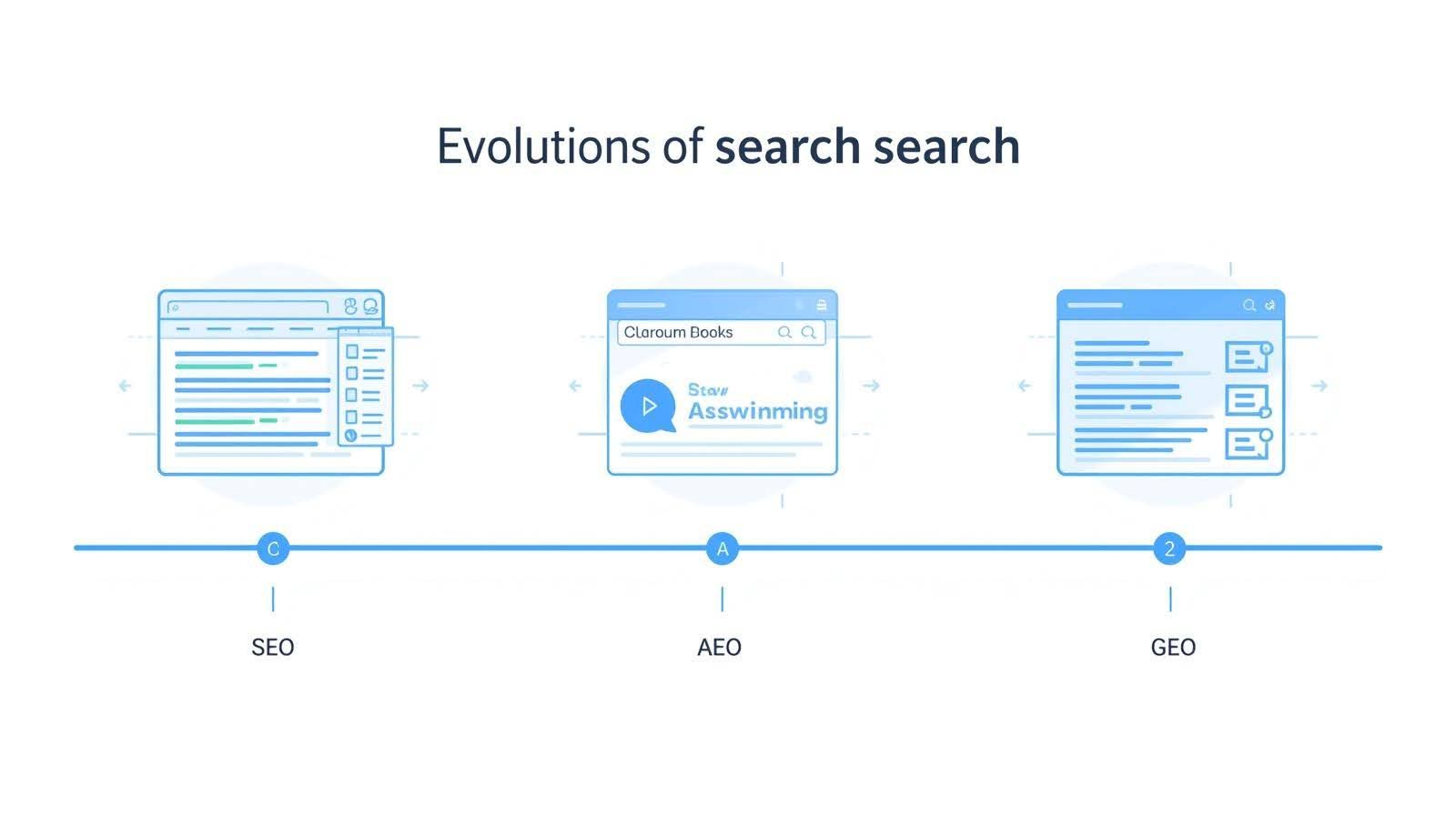
This has brought us out of the conventional SEO to the more recent techniques such as AEO (Answer Engine Optimization) and GEO (Generative Engine Optimization). When you are coming up with content today, this evolution is no longer a luxury to get to know. It is essential.
The foundation: SEO still matters
SEO or Search Engine Optimization has been the stronghold of online presence over the years. The objective was basic: make your website appear at a greater height in search engine result pages.
To accomplish it, companies specialize in keyword research, on-page optimization, technical search, and link construction. If what the users were searching for was what you had and your site was well-optimized, then you stood a good chance of ranking.
But here is the point--SEO was created based on search engines providing a list of links. People would enter a query, browse through the results, and click on a page to locate their answer.
That behavior is changing.
The Shift: From searching to asking
Nowadays, search is not the only thing that people do. They ask.
They do not have to enter brief keywords such as the best CRM tools; rather, they pose a more targeted question, such as, What is the best CRM in small businesses with a low budget? The AI voice search, mobile, and AI-enhanced tools are contributing to this change.
This has been accommodated by search engines. They do not just display links anymore, but attempt to give direct answers. This transformation includes featured snippets, knowledge panels, and AI-generated summaries.
This is where AEO is used.
What is AEO (Answer Engine Optimization)?
Answer Engine Optimization, or AEO, is interested in making content so that it has a direct answer to the query. The idea here is not to simply attempt to be ranked on a page, but to be the answer.
Consider the fact that Google regularly gives a fast answer at the top of the search results. That is not a coincidence. It draws structured, relevant, and understandable content.
To achieve success in AEO, the content must be:
- Clear and concise.
- Organized in headings and short paragraphs.
- Oriented to the resolution of certain questions.
- Optimized for sniping.
Simply, it can be said that AEO is the ease of making your content understandable by search engines and eliciting answers.
The rise of AI: Enter GEO
Whereas the AEO is aimed at finding the answers, the GEO (Generative Engine Optimization) goes one step further.
GEO is regarding the optimization of content towards AI-based search experiences. These are tools such as ChatGPT, Google using AI generator features of search, and other generative engines that not only list results, this generates the answer.
Whenever people pose a query in these systems, they receive a summarized response that has been derived from various sources. It implies that you may not simply get a click on your content, but it may be used to create an answer.
That changes everything.
Though you are no longer just competing to be visible, now you are competing to be included in AI-generated answers.
How GEO changes content strategy
In the case of GEO, the content should not only be optimized but should also be reliable, informative, and properly organized.
AI systems give more preference to content that proves to be significant, clearly displayed, and pertinent. This means:
- Using a conversational tone of writing.
- Giving precise and clearly elaborated information.
- Covering topics in depth
- Clearly headed and logically organized.
Generative engines are less likely to utilize content that is vague, too promotional, or poorly formatted.
The second important consideration is context. Artificial intelligence applications attempt to discern the meaning of a query, rather than the keywords simply. You should not only write about what, but also about why and how.
SEO, AEO, and GEO: Not replacements, but evolution
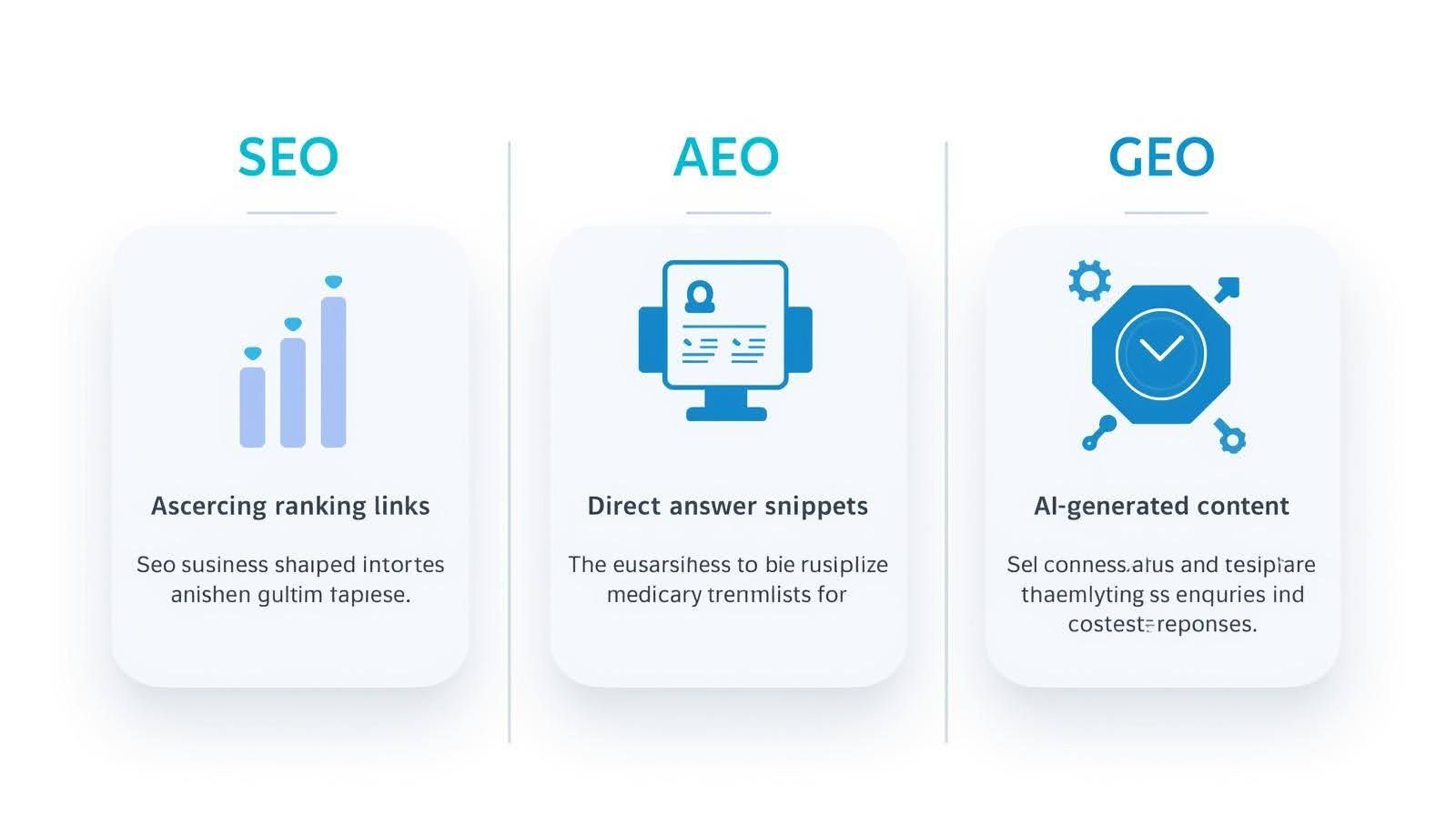
One should keep in mind that AEO and GEO are not substituting SEO. They are building on it.
SEO is still the foundation. Your content might not even be found without optimizing it appropriately. However, after being so, AEO and GEO decide the manner of its presentation and use.
Think of it this way:
- SEO helps you get found
- AEO helps you get featured
- GEO assists in referencing AI-based responses.
The combination of both forms a more comprehensive approach to contemporary search.
What this means for content creators
You must adjust to this new scene if you are generating content nowadays. Ranking is not the birch anymore, but value delivery.
Begin with the questions of your audience. So, what is it they are seeking? Then make content that answers those questions in a simple and comprehensive manner.
Use simple language. Break down complex ideas. Organize your writing in a way that makes it easy to read and easy to retrieve information.
However, simultaneously, disregard technical SEO. They are page speed, mobile optimization, and correct formatting.
Final thoughts
Search is developing, and faster than ever. Since the times of traditional SEO, through AEO and now GEO, the emphasis is no longer on the keywords but on the answers; the emphasis is not on links anymore, but on intelligent responses.
This is an opportunity for businesses and the makers of the content. Early adopters are in a position to lead the curve and can reach their audience in fresh and strong ways.
Ultimately, it is all about one thing, which is to produce content that actually benefits people. That will always be the core of search, since no matter how much technology evolves, that will keep it.
Frequently Asked Questions (FAQs)
Everything you need to know about our products and services
SEO focuses on improving rankings in traditional search engines. AEO (Answer Engine Optimization) optimizes content for direct answers in AI-powered search, while GEO (Generative Engine Optimization) helps content appear in AI-generated responses from platforms like ChatGPT and Google AI Overviews.
As more users rely on AI-powered search and conversational assistants, businesses are optimizing content for both search engines and generative AI. Combining SEO, AEO, and GEO improves visibility across traditional search results and AI-generated answers.
Create accurate, well-structured content that directly answers user questions, demonstrates expertise, uses clear headings, includes FAQs, and follows schema markup and E-E-A-T best practices. This helps AI systems understand and reference your content.
Yes. SEO remains the foundation of online visibility. AEO and GEO build on SEO by helping content perform in AI-driven search experiences, making all three strategies important for long-term organic growth.
CodeAutomation helps businesses develop AI-ready content strategies by combining SEO best practices with AEO and GEO techniques. Its approach focuses on improving visibility in search engines, AI-powered search experiences, and generative AI platforms while supporting long-term organic growth.





Adnan Ghaffar is the visionary CEO of CodeAutomation.ai, a platform dedicated to transforming how businesses build software through cutting-edge automation. With over a decade of experience in software development, QA automation, and team leadership, Adnan has built a reputation for delivering scalable, intelligent, and high-performance solutions.
Under his leadership, CodeAutomation.ai has grown into a trusted name in AI-driven development, empowering startups and enterprises alike to streamline workflows, accelerate time-to-market, and maintain top-tier product quality. Adnan is passionate about innovation, process improvement, and building products that truly solve real-world problems.
More Articles

30/ 04/ 2026
Autonomous task-oriented AI agents: Redefining workflow execution in 2026

03/ 27/ 2026
How a robotic process automation company can transform your business
03/ 09/ 2025
How to Hire QA and Automation Engineers: A Complete Guide
04/09/2026
How AI Agents Work: Architecture, Components, and Examples

15/ 04/ 2026
AI virtual assistants for business: Use cases and benefits
01/10/2026