






















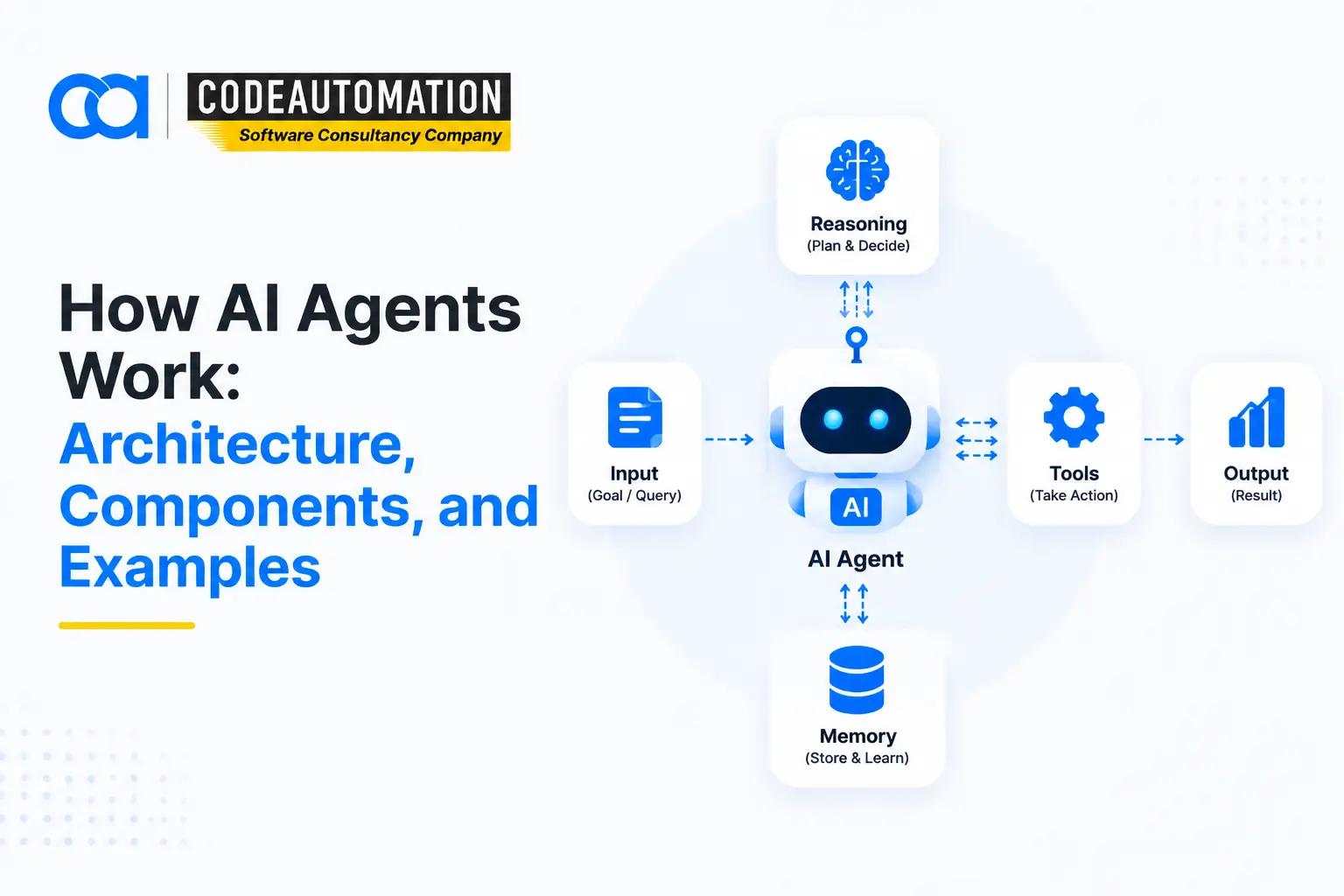
How AI Agents Work: Architecture, Components, and Examples
Published 04/09/2026
AI agents are becoming an important part of modern automation because they can do more than generate responses. Unlike traditional software workflows that follow fixed rules, AI agents can understand goals, reason through problems, use external tools, and complete multi-step tasks.

Ready to Automate Your Success?
From AI-powered applications to scalable software development, we help businesses automate workflows and accelerate growth.
Book a Free ConsultationAI agents are becoming an important part of modern automation because they can do more than generate responses. Unlike traditional software workflows that follow fixed rules, AI agents can understand goals, reason through problems, use external tools, and complete multi-step tasks.
However, the ability of an AI agent to perform reliably depends heavily on its architecture.
The architecture defines how an agent receives information, processes context, makes decisions, interacts with systems, and improves through feedback. A well-designed architecture allows businesses to build AI agents that are secure, scalable, and capable of handling real operational workflows.
Understanding how AI agent architecture works helps businesses evaluate where these systems can create value and what components are required to build reliable AI solutions.
What Is AI Agent Architecture?
AI agent architecture is the underlying structure that enables an AI agent to understand information, make decisions, and perform actions toward a specific goal.
Think of it as the blueprint behind an intelligent system. The AI model provides reasoning capability, but other components such as memory, tools, knowledge sources, and orchestration layers allow the agent to operate effectively in real environments.
A complete AI agent architecture typically includes:
- An AI model for reasoning and understanding
- Memory for storing relevant context
- Knowledge sources for retrieving information
- Tools and APIs for taking actions
- Planning mechanisms for managing tasks
- Monitoring systems for evaluating performance
The architecture determines how independently and reliably an AI agent can operate.
Why Does AI Agent Architecture Matter?
The architecture of an AI agent directly impacts its accuracy, security, and scalability.
A simple demonstration agent may only need a language model and basic instructions. However, business AI agents often need access to company data, applications, workflows, and customer information.
Without proper architecture, AI agents may produce inaccurate responses, access incorrect information, or fail when handling complex tasks.
For businesses, strong architecture ensures that AI agents can operate within defined boundaries while delivering consistent results.
How Do AI Agents Work?
AI agents generally operate through a continuous cycle:
Understand → Reason → Plan → Act → Evaluate
When a user provides a request, the agent first understands the objective and available context. It then determines the required steps, selects appropriate tools, performs actions, and evaluates the outcome.
For example, a customer support AI agent does not simply answer a question. It may identify the customer's issue, search internal knowledge, retrieve account information, update a ticket, and provide a response.
This ability to move from understanding to action is what separates AI agents from basic conversational systems.
Step 1: Understanding User Goals and Context
The first stage of an AI agent workflow is interpreting the user's objective.
The agent analyzes:
- User instructions
- Available information
- Previous interactions
- Business rules
For example:
"Find customers who are likely to renew their subscription and prepare follow-up messages."
The agent understands the intended outcome rather than only processing individual words.
Step 2: Reasoning and Planning Actions
After understanding the goal, the AI agent determines how to complete the task.
The reasoning layer helps the agent:
- Break complex requests into smaller steps
- Decide which actions are required
- Select appropriate tools
- Adjust decisions based on results
For example, a sales AI agent may decide to review CRM data, analyze customer activity, identify opportunities, and prepare personalized outreach.
Planning allows AI agents to handle workflows that involve multiple decisions instead of simple rule-based actions.
Step 3: Using Tools and External Systems
AI agents become more useful when connected with external systems.
Through APIs and integrations, agents can interact with:
- CRM platforms
- Databases
- ERP systems
- Business applications
- Internal knowledge bases
For example, an AI operations agent can retrieve inventory data, check order status, and update records without requiring an employee to manually complete each step.
Tool usage is one of the main capabilities that allows AI agents to move from answering questions to completing business tasks.
Step 4: Executing Tasks and Improving Results
After selecting an action, the AI agent executes the required task and evaluates the outcome.
Feedback helps the system determine whether:
- The goal was achieved
- Additional steps are required
- Human approval is needed
This feedback loop improves reliability and allows businesses to monitor agent performance.
Core Components of AI Agent Architecture
A reliable AI agent depends on multiple connected components working together. The AI model alone is not enough; the surrounding architecture determines how effectively the agent operates.
AI Model and Reasoning Engine
The AI model acts as the intelligence layer of an AI agent.
It enables the agent to:
- Understand natural language
- Analyze information
- Generate responses
- Support decision-making
Large language models (LLMs) are commonly used because they can process complex instructions and handle different types of business scenarios.
However, the model is only one part of the system. Without memory, tools, and business context, it cannot effectively complete operational tasks.
Memory and Context Management
Memory allows AI agents to retain relevant information during and across interactions.
There are two common types:
Short-term memory
Stores current conversation details and immediate context.
Long-term memory
Stores important information from previous interactions, preferences, or business knowledge.
For example, an AI customer support agent can remember previous customer interactions to provide more personalized assistance.
Knowledge Base and Retrieval Systems
AI agents often need access to reliable business information.
Knowledge retrieval systems allow agents to access:
- Company documents
- Product information
- Internal policies
- Customer records
Retrieval-augmented generation (RAG) is commonly used to connect AI models with external knowledge sources, helping agents provide more accurate responses based on business data.
Tools and API Integrations
Tools allow AI agents to perform actions outside the AI model.
Examples include:
- Sending emails
- Updating CRM records
- Searching databases
- Creating reports
- Processing transactions
Without tools, an AI agent can only provide information. With tools, it can complete workflows.
Planning and Orchestration Layer
The orchestration layer manages how different components work together.
It helps coordinate:
- Task planning
- Tool selection
- Multiple workflow steps
- Agent communication
For complex business processes, orchestration ensures that the right actions happen in the correct sequence.
Monitoring and Feedback Layer
Enterprise AI agents require monitoring to maintain reliability.
This layer tracks:
- Agent performance
- Errors
- Response quality
- Completed actions
Monitoring helps businesses identify issues and continuously improve AI agent performance.
AI Agent Architecture Workflow Example
Example: Customer Support AI Agent
A customer support AI agent may work through the following process:
Customer submits a request
↓
The agent identifies the customer's intent
↓
The knowledge system retrieves relevant information
↓
The reasoning engine determines the best response
↓
The agent accesses CRM or ticketing systems
↓
The action is completed or escalated
↓
Feedback improves future interactions
This architecture allows businesses to automate support workflows while maintaining accuracy and human control.
Single-Agent vs Multi-Agent Architecture
AI agent systems can be designed using either a single-agent or multi-agent approach.
Single-Agent Architecture
A single AI agent handles the complete workflow.
Example:
A customer service agent that manages inquiries, retrieves information, and responds to customers.
Single-agent systems work well when the workflow is focused and does not require specialized capabilities.
Multi-Agent Architecture
Multi-agent systems use multiple specialized agents that collaborate.
Example:
A sales process may include:
- Lead research agent
- Qualification agent
- Communication agent
- CRM management agent
Each agent handles a specific responsibility while working toward a shared goal.
Multi-agent architectures are useful for complex business processes requiring different areas of expertise.
What Makes an AI Agent Architecture Enterprise Ready?
Businesses need more than a working prototype. Production AI agents require additional layers to ensure reliability and security.
Security and Access Control
AI agents should only access information and systems required for their tasks.
Proper permissions help protect sensitive business data.
Human Oversight and Governance
Some decisions require human approval.
Businesses should define where AI agents can act independently and where employee review is required.
Monitoring and Evaluation
Organizations should continuously evaluate:
- Accuracy
- Performance
- Errors
- Business outcomes
This ensures AI agents continue delivering reliable results.
How Businesses Build AI Agent Solutions
Building an AI agent starts with identifying the right business problem.
A typical approach includes:
Identify repetitive or complex workflows.
Define the agent's goals and responsibilities.
Connect required data sources and applications.
Test the agent in controlled environments.
Monitor performance and improve over time.
The best AI agent solutions focus on specific business outcomes rather than automating processes without a clear purpose.
Why Custom AI Agent Development Matters
Every business has unique workflows, systems, and operational requirements.
Generic AI tools may solve common tasks, but custom AI agents can be designed around specific business processes.
Custom AI agent development helps businesses:
- Connect existing software systems
- Automate unique workflows
- Improve operational efficiency
- Build industry-specific solutions
- Scale AI capabilities as requirements grow
For organizations looking to implement AI agents into real business operations, custom development provides greater control over functionality, integrations, and security.
Build AI Agents Designed for Your Business Workflows
AI agent architecture determines whether an AI system can simply answer questions or actually complete valuable business tasks.
From reasoning and memory to tools, integrations, and governance, every component plays an important role in creating reliable AI solutions.
CodeAutomation helps businesses design and develop AI agent solutions that integrate with existing systems, automate workflows, and support scalable operations.
Ready to Build an AI Agent Solution?
Explore how custom AI agents can help your business automate complex workflows and improve operational efficiency.
Frequently Asked Questions (FAQs)
Everything you need to know about our products and services
The main components include the AI model, memory, knowledge sources, reasoning engine, tools, orchestration layer, and monitoring systems.
An AI agent analyzes goals, processes available information, creates a plan, selects actions, and evaluates results through feedback.
Traditional automation follows predefined rules, while AI agents can interpret goals, make decisions, and adapt actions based on context.
Memory allows AI agents to store and use relevant information from previous interactions, improving personalization and consistency.
Architecture determines how securely, accurately, and efficiently an AI agent can operate within business workflows.





Adnan Ghaffar is the visionary CEO of CodeAutomation.ai, a platform dedicated to transforming how businesses build software through cutting-edge automation. With over a decade of experience in software development, QA automation, and team leadership, Adnan has built a reputation for delivering scalable, intelligent, and high-performance solutions.
Under his leadership, CodeAutomation.ai has grown into a trusted name in AI-driven development, empowering startups and enterprises alike to streamline workflows, accelerate time-to-market, and maintain top-tier product quality. Adnan is passionate about innovation, process improvement, and building products that truly solve real-world problems.
More Articles

03/ 23/ 2026
CMS development services: How to manage content efficiently

03/ 09/ 2026
How AI Development Services Help Businesses Scale

26 November 2024
Competitors and Insights for Your QA Strategy
15/09/2026
AI Supply Chain Optimization How Businesses Use AI to Reduce Costs and Improve Efficiency

10/09/2026
Top AI Automation Platforms for Enterprise Workflows: Companies, Features, and Use Cases

18 April 2025