



















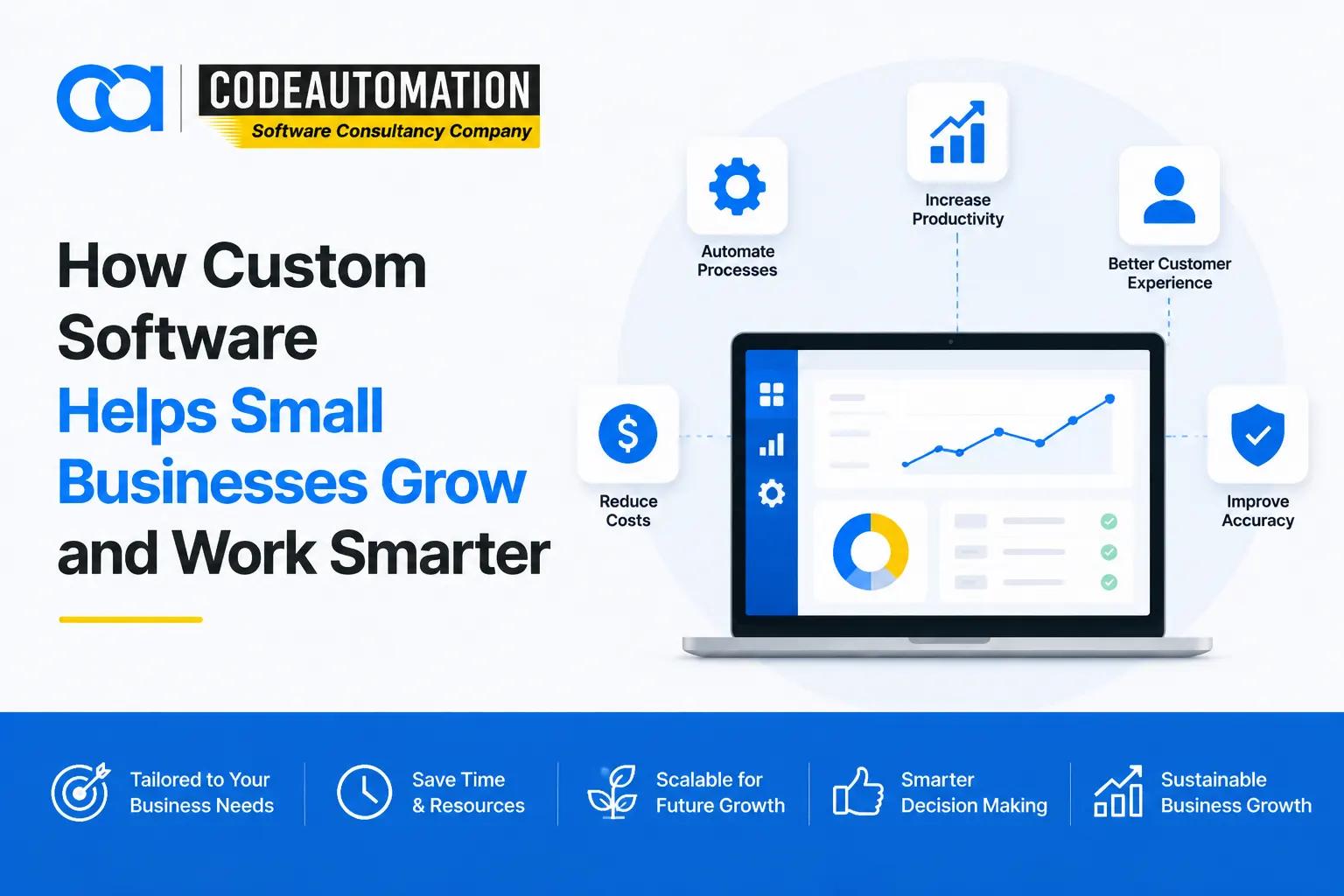
How Custom Software Helps Small Businesses Grow and Improve Efficiency
Published 01/09/2026
Small businesses often rely on multiple tools to manage daily operations. Accounting software, CRM platforms, spreadsheets, communication tools, and industry applications can help companies get started.

Ready to Automate Your Success?
From AI-powered applications to scalable software development, we help businesses automate workflows and accelerate growth.
Book a Free ConsultationIntroduction
Running a small business often means managing multiple responsibilities at the same time. Owners and teams rely on different software tools to handle customers, accounting, operations, communication, and reporting.
At the beginning, these tools usually work well. They are affordable, easy to set up, and provide the basic functionality a growing company needs.
However, as the business expands, problems often start appearing. Employees may spend hours moving information between systems, creating manual reports, updating spreadsheets, or finding workarounds because existing software does not match their processes.
This is where custom software becomes valuable.
Instead of changing business operations to fit a generic tool, custom software allows companies to create solutions around the way they actually work. It can automate repetitive tasks, connect disconnected systems, improve decision-making, and provide a better experience for both employees and customers.
For small businesses, the biggest advantage is not simply having new technology. It is creating a system that removes operational friction and supports sustainable growth.
What Problems Does Custom Software Solve for Small Businesses?
Many small businesses do not struggle because they lack software. They struggle because their existing tools do not work together efficiently.
A company may have a CRM for customer information, accounting software for payments, spreadsheets for tracking operations, and separate communication tools for employees. Individually, each system may work well, but together they can create unnecessary complexity.
Custom software addresses these gaps by creating solutions around specific business challenges.
For example, a service-based company may need a system that connects customer requests, scheduling, employee assignments, invoices, and follow-up communication. Instead of managing each step manually, a customized platform can create one connected workflow.
The result is fewer repetitive tasks, better visibility, and smoother daily operations.
How Custom Software Helps Small Businesses
1. Reduces Manual Work Through Automation
One of the biggest challenges for small businesses is spending valuable employee time on repetitive activities.
Tasks such as entering customer information, sending notifications, preparing reports, processing approvals, or updating records may not seem significant individually, but together they can consume many working hours every month.
Custom software can automate these processes by creating workflows that handle repetitive activities automatically.
For example:
- A sales team can receive automatic follow-up reminders after customer interactions.
- A service company can automate appointment confirmations and scheduling updates.
- Managers can receive real-time reports without manually collecting data.
This allows employees to spend more time on customer relationships, problem-solving, and business growth.
2. Creates Software Around Your Actual Business Processes
Most off-the-shelf applications are designed for the average business. They provide useful features, but they cannot always accommodate unique workflows.
Every business has its own way of operating.
A healthcare provider may need different workflows compared with a construction company. A logistics business may require different tracking capabilities compared with a professional service firm.
Custom software allows businesses to create features based on their actual requirements rather than forcing teams to adjust their processes around software limitations.
This creates a more natural working environment where technology supports the business instead of becoming another obstacle.
3. Connects Existing Business Systems
As businesses grow, they often add more software platforms to manage different areas of operations.
The problem begins when these systems operate separately.
For example, customer information stored in a CRM may not automatically update accounting records. Inventory data may not be visible to sales teams. Important reports may require manual preparation from multiple sources.
Custom software can connect existing platforms through integrations and APIs, creating a more unified business ecosystem.
This improves data accuracy and reduces the need for employees to repeat the same work across different systems.
4. Improves Customer Experience
Customer expectations have changed. People expect faster responses, easier communication, and convenient digital experiences.
Custom software allows small businesses to create solutions that match their customers' needs.
For example, businesses can develop:
- Customer portals for accessing information
- Online booking systems
- Self-service platforms
- Personalized dashboards
A smoother customer experience can improve satisfaction, increase retention, and help businesses compete with larger organizations.
5. Provides Better Business Insights
Many small businesses collect valuable data but struggle to turn it into useful information.
When data is spread across multiple platforms, understanding business performance becomes difficult.
Custom software can organize important information into centralized dashboards and reporting systems.
Business owners can gain clearer visibility into areas such as sales trends, customer activity, operational performance, and resource usage.
Better information allows leaders to make decisions based on actual business conditions rather than assumptions.
Examples of Custom Software Solutions for Small Businesses
Custom software can be designed for almost any industry because it focuses on business requirements rather than a fixed product model.
Customer Relationship Management Systems
A customized CRM can support businesses with unique sales processes by managing customer information, communication history, opportunities, and follow-up activities in a way that matches internal workflows.
Inventory and Order Management Systems
Retailers, distributors, and manufacturers often require more flexibility than standard inventory tools provide.
Custom inventory systems can help businesses monitor stock, manage suppliers, track orders, and improve operational visibility.
Scheduling and Booking Platforms
Businesses that depend on appointments or field services can create scheduling solutions that manage availability, customer requests, reminders, and employee assignments.
Internal Business Applications
Many companies build internal tools to simplify approval processes, employee workflows, reporting, and daily operations.
These applications reduce dependency on spreadsheets and manual processes.
Can Custom Software Reduce Small Business Costs?
Custom software requires an initial investment, but the long-term value often comes from improving efficiency.
Businesses may reduce operational costs by eliminating repetitive manual work, reducing errors, and replacing multiple disconnected tools with a more effective system.
However, custom software should not be viewed as a guaranteed cost-cutting solution. The value depends on the business problem being solved and how effectively the software improves operations.
The right question is not:
"How cheap can we build software?"
The better question is:
"How much time, efficiency, and growth opportunity can this solution create for our business?"
When Should a Small Business Consider Custom Software?
Custom software is not necessary for every company. Standard tools remain the right choice for many common business needs.
However, a business should consider a custom solution when technology limitations start affecting operations.
Common indicators include:
- Employees spending excessive time on manual tasks
- Multiple systems creating disconnected workflows
- Important business processes that existing software cannot support
- Difficulty accessing accurate business information
- Customer experiences being limited by current tools
The decision should always begin with identifying the business challenge, not choosing technology first.
How Custom Software Supports Future Growth
Small businesses need technology that can adapt as they grow.
A solution that works for a small team today may become inefficient as customers, employees, and operations increase.
Custom software provides flexibility because businesses can continue improving the system as requirements change.
New features, integrations, automation capabilities, and reporting tools can be added over time, allowing technology to evolve alongside the business.
Final Thoughts
Custom software helps small businesses overcome the limitations of generic tools by creating solutions designed around their unique workflows.
Whether the goal is reducing manual work, improving customer experiences, connecting business systems, or gaining better operational visibility, the right software can become a valuable business asset.
The most successful custom software projects start with a clear understanding of business challenges. When technology is built around real operational needs, it can help small businesses work more efficiently and create a stronger foundation for future growth.
Build Software That Fits Your Business Needs
Every small business has different processes, challenges, and growth goals. The right technology should support the way your team works instead of forcing your business to adjust around software limitations.
Whether you need to automate repetitive tasks, connect disconnected systems, improve customer experiences, or create a solution designed around your workflow, a custom software approach can help create a stronger digital foundation.
Explore how custom software development services can help your business build scalable applications, integrations, and automation solutions designed around your specific requirements.
Contact CodeAutomation.ai today to discuss your software needs and discover the right approach for your business.
Frequently Asked Questions (FAQs)
Everything you need to know about our products and services
Custom software helps small businesses by creating solutions that match their specific workflows, reducing manual work, improving efficiency, connecting existing systems, and helping teams manage operations more effectively. Unlike generic software, custom solutions are designed around the business processes that make each company unique.
Custom software can be worth the investment when existing tools create operational challenges, require too much manual work, or cannot support business growth. The value comes from improving productivity, reducing inefficiencies, and creating a system that can adapt as the business evolves.
Yes. Custom software can automate many repetitive business activities, including data entry, notifications, approvals, reporting, scheduling, and customer communication. Automation helps teams reduce time-consuming tasks and focus on more strategic activities.
Common examples include custom CRM systems, inventory management platforms, scheduling applications, customer portals, workflow automation solutions, and business reporting dashboards. The right solution depends on the company's industry, processes, and operational requirements.
Off-the-shelf software is built for a broad audience and provides standard features that work for many businesses. Custom software is developed around a specific company's workflows, allowing greater flexibility, customization, and integration with existing systems.





Adnan Ghaffar is the visionary CEO of CodeAutomation.ai, a platform dedicated to transforming how businesses build software through cutting-edge automation. With over a decade of experience in software development, QA automation, and team leadership, Adnan has built a reputation for delivering scalable, intelligent, and high-performance solutions.
Under his leadership, CodeAutomation.ai has grown into a trusted name in AI-driven development, empowering startups and enterprises alike to streamline workflows, accelerate time-to-market, and maintain top-tier product quality. Adnan is passionate about innovation, process improvement, and building products that truly solve real-world problems.
More Articles

05/ 11/ 2025
How Software and QA Testing Services help reduce post release chaos for scaling SaaS teams
15/09/2026
AI Supply Chain Optimization How Businesses Use AI to Reduce Costs and Improve Efficiency
29/08/2026
How to Choose the Right AI Automation Agency for Your Business

02/10/2026
What Is an Intelligence Explosion and How Could It Happen?
08/09/2026
Applications of Artificial Intelligence: Uses, Examples, and Business Impact
02/10/2026