





















Multi-Agent AI Systems: Architecture, Orchestration, and Enterprise Use Cases
Published 01/10/2026
Single LLM agents hit a ceiling fast. Give one model a 40-step workflow, a dozen tools, and a context window stuffed with retrieved documents, and you get drift, hallucinated tool arguments, and brittle error recovery. That ceiling is why engineering teams are moving toward multi-agent AI systems, where multiple AI agents with narrow roles plan, delegate, and verify each other's work.

Ready to Automate Your Success?
From AI-powered applications to scalable software development, we help businesses automate workflows and accelerate growth.
Book a Free ConsultationSingle LLM agents hit a ceiling fast. Give one model a 40-step workflow, a dozen tools, and a context window stuffed with retrieved documents, and you get drift, hallucinated tool arguments, and brittle error recovery. That ceiling is why engineering teams are moving toward multi-agent AI systems, where multiple AI agents with narrow roles plan, delegate, and verify each other's work.
The shift is already on enterprise roadmaps. Gartner predicts that 40% of enterprise applications will integrate task-specific AI agents by the end of 2026, up from under 5% in 2025, with collaborative agents inside applications following by 2027. This guide breaks down the multi-agent architecture, orchestration patterns, and production trade-offs that matter when you move from demo to deployment.
What Are Multi-Agent AI Systems?
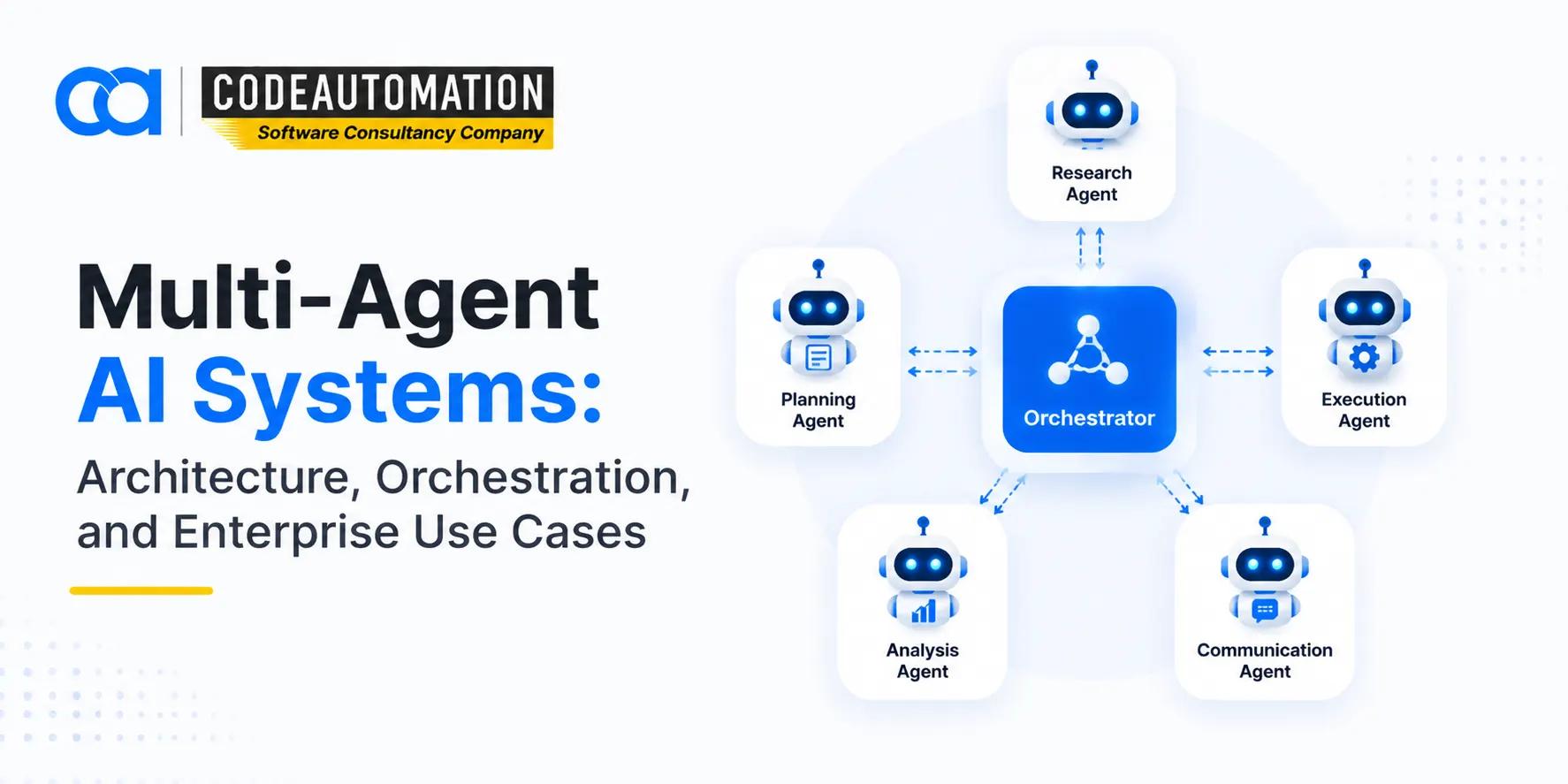
A multi-agent AI system is a group of autonomous AI agents, each typically an LLM running tools in a loop, that share a goal and coordinate through structured messages, shared state, or a central orchestrator. Each agent owns a scoped role. A planner decomposes the task, a retriever pulls context, an executor calls APIs or writes code, and a critic validates the output before anything ships.
The concept predates LLMs. Multi-agent systems grew out of distributed artificial intelligence and agent-based computing research, where intelligent agents bid for tasks and reached consensus without a single controller. What changed is the reasoning layer. Large language models give every agent natural language processing, agent planning, and tool calling out of the box, so AI multi-agent systems now handle unstructured enterprise work instead of only simulated environments.
Single AI Agent vs. Multi-Agent System
Choosing between a single AI agent and a multi-agent system is an engineering trade-off, not a maturity ladder.
Dimension
Single AI agent
Multi-agent system
Context handling
One window holds plan, tools, and results
Each agent gets an isolated window; summaries flow up
Tool surface
Every tool exposed to one model
Tools scoped per role, least privilege
Execution
Sequential reasoning loop
Parallel subtasks via AI task delegation
Token cost
Lower
Significantly higher
Debugging
One trace to inspect
Distributed traces across agents
Best fit
Tightly coupled, sequential tasks
Breadth-first, parallelizable, multi-tool work
Anthropic's engineering team quantified this trade-off. Its research system, a lead Claude Opus 4 agent directing Claude Sonnet 4 subagents, outperformed a single Opus 4 agent by 90.2% on an internal research eval. It also burned roughly 15× the tokens of a standard chat. In practice, multi-agent AI systems earn their cost on wide, parallel workloads, while one well-tooled agent often wins on narrow sequential tasks.
Multi-Agent Architecture: How AI Agents Work Together
Every production multi-agent architecture answers four questions: who decides, how agents talk, what they remember, and what they can touch.
Orchestration Patterns
- Orchestrator-worker: a lead agent plans, spawns subagents in parallel, and merges their results. It is the easiest pattern to trace and the default for most enterprise AI agents.
- Sequential pipeline: agents hand off in a fixed order, such as extract, enrich, validate, write. Predictable, but one weak stage stalls the chain.
- Decentralized (peer-to-peer): agents negotiate through a shared message bus or blackboard. Decentralized intelligence scales well but makes AI decision-making harder to audit.
- Debate and critic loops: agents propose and challenge answers before committing, which strengthens AI reasoning systems on high-stakes outputs.
Agent Communication and Coordination
Agent communication works best with typed, schema-validated messages, not free-form chat between models. The Model Context Protocol (MCP) standardizes how agents reach tools and data, while agent-to-agent protocols such as A2A target cross-vendor multi-agent coordination. For LLM orchestration, frameworks like LangGraph, CrewAI, AutoGen, and the OpenAI Agents SDK supply the graphs, routing, and handoff primitives that AI agent orchestration depends on.
Agent Memory and Tool Calling
Agent memory splits into short-term working context and long-term stores, usually a vector database plus structured state. In multi-agent workflows, memory isolation is the real advantage. Each subagent explores with a clean context window and returns a compressed summary, which is how multi-agent AI systems process more information than any single window holds. Tool calling should stay least-privilege: a retrieval agent has no reason to hold write access to your CRM.
Enterprise Use Cases for Multi-Agent AI
Multi-agent AI delivers the clearest ROI where workflow execution spans several systems, data types, or approval steps.
- Software engineering: planner, coder, test-writer, and reviewer agents iterate on a ticket, and QA agents run regression suites before a pull request opens.
- Finance operations: dedicated agents handle invoice extraction, ledger reconciliation, anomaly detection, and audit-trail generation.
- Customer support: a triage agent classifies intent and routes to billing, technical, or retention agents, escalating to a human on low-confidence turns.
- Supply chain and logistics: forecasting, inventory, and carrier agents coordinate replenishment decisions in near real time.
- Research and analytics: parallel retrieval agents scan internal docs, BI dashboards, and web sources, then a synthesis agent produces a cited brief.
In each case, AI agent collaboration replaces brittle rules-based RPA with generative AI agents that reason over unstructured inputs. Teams already running AI business automation solutions across CRM, ERP, and support stacks tend to move fastest, because the APIs, data contracts, and event triggers that multi-agent AI systems plug into are already in place.
Engineering Challenges in Production
Most failures in multi-agent AI systems are coordination failures, not model failures. Anthropic's own team notes that coordination complexity grows rapidly once agents start delegating to each other.
- Error compounding: an agent that is 95% reliable, chained across five handoffs, lands near 77% end-to-end (0.95^5 ≈ 0.774). Put validators, schema checks, and retries at every handoff.
- Over-delegation: orchestrators without explicit effort budgets spawn too many subagents for simple queries. Encode scaling rules in the lead agent's prompt.
- Non-determinism: identical inputs take different paths, so you need trace-level observability and LLM-as-judge evals, not only unit tests.
- Cost and latency: set per-agent token budgets, route worker tasks to smaller models, and cache shared context.
- Security and governance: a prompt injection in one agent can propagate across the AI ecosystem. Scope credentials per agent, log every tool call, and add human-in-the-loop checkpoints for irreversible actions.
Architecture decisions made in week one decide whether the system survives month six. A team experienced in building production-grade autonomous AI agents with orchestration, guardrails, and observability shorten the path from a promising notebook to intelligent agent systems your SRE team can actually operate. When agents need to live inside an existing product, end-to-end AI software development for LLM-powered applications covers the surrounding APIs, data pipelines, and deployment infrastructure.
The Bottom Line for Engineering Teams
Multi-agent AI systems are not a replacement for good single-agent design. They are what you reach for when one context window, one toolset, or one sequential loop stops being enough. Start with a single agent, instrument it, find the bottleneck, then split roles where parallelism or specialization pays for the extra tokens. Keep human-agent collaboration at the decision points where accountability lives, and let collaborative AI handle the throughput everywhere else.
Frequently Asked Questions (FAQs)
Everything you need to know about our products and services
Multi-agent AI systems are setups where several specialized AI agents, each with its own role, tools, and context, coordinate toward a shared goal. Think of it as microservices for reasoning: instead of one monolithic LLM call, a planner, workers, and a reviewer divide the job and pass structured results between them.
A single agent runs one reasoning loop over one context window. A multi-agent system decomposes the task, runs subtasks in parallel with isolated contexts, and merges the outputs. You gain breadth, specialization, and fault isolation, but you pay in token cost, latency from coordination, and debugging complexity.
Common choices include LangGraph for stateful agent graphs, CrewAI for role-based crews, Microsoft AutoGen for conversational agent patterns, and the OpenAI Agents SDK for handoffs. MCP is widely used to standardize tool and data access, so agents can share integrations instead of each team rebuilding connectors.
Usually, yes. Anthropic reported its multi-agent research setup used about 15× the tokens of a standard chat interaction. Teams control spend by routing worker tasks to smaller models, capping per-agent token budgets, caching shared context, and reserving multi-agent execution for tasks where the quality gain justifies the cost.
Adopt it when a workflow needs parallel research, spans many tools or systems, or exceeds what fits in one context window. If a single agent with good tools and retrieval meets your accuracy and latency targets, keep it. Move to multiple AI agents once evals show a clear, measurable ceiling.





Adnan Ghaffar is the visionary CEO of CodeAutomation.ai, a platform dedicated to transforming how businesses build software through cutting-edge automation. With over a decade of experience in software development, QA automation, and team leadership, Adnan has built a reputation for delivering scalable, intelligent, and high-performance solutions.
Under his leadership, CodeAutomation.ai has grown into a trusted name in AI-driven development, empowering startups and enterprises alike to streamline workflows, accelerate time-to-market, and maintain top-tier product quality. Adnan is passionate about innovation, process improvement, and building products that truly solve real-world problems.
More Articles
27/08/2026
What Is CRM Integration? A Complete Guide for Businesses

18 February 2026
Top IDEs for Android Developers in 2026

26 November 2024
Competitors and Insights for Your QA Strategy
15/09/2026
AI Supply Chain Optimization How Businesses Use AI to Reduce Costs and Improve Efficiency

30 December 2025
Unlocking the Mystery: What Does a Software Developer Really Do and How Much Can You Earn?