


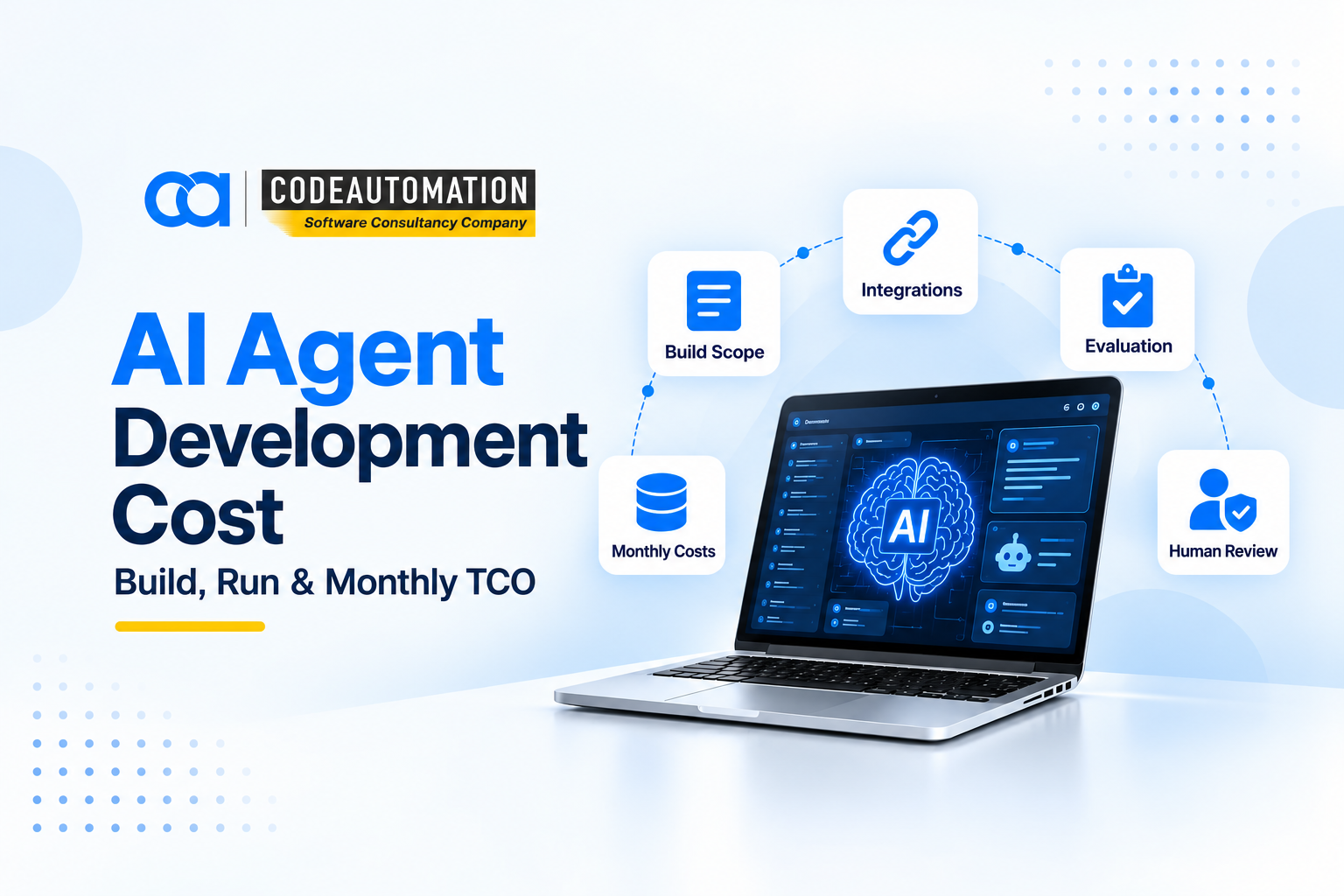
AI Agent Development Cost: Build, Run and Monthly TCO
Published 30/10/2026
Plan an AI agent budget around build scope, integrations, evaluation and ongoing operation. Use a transparent worked example to estimate first-year total cost.
How much does AI agent development cost?
AI agent development cost has three parts: the initial build, monthly operation, and the work required to keep the agent reliable as systems and policies change. A useful budget names the task, connected applications, expected volume, approval rules and success criteria before attaching a price.
In the hypothetical planning example below, a narrow support-triage agent costs $24,000 to build and $2,736 per month to operate, giving a first-year total of $56,832. These are transparent modeling assumptions, not a market average, a client result or a CodeAutomation quote. Replace the hours, rates and volumes with your own evidence.
This guide focuses on agents that interpret a task and use tools to act. For simpler trigger-and-action workflows and platform subscriptions, see our broader AI automation cost guide. If you need help defining the task and integration scope, explore custom AI agent development services.
Start with scope: prototype, production agent or multi-agent system
These are different deliverables, so their quotes should not be compared as if they include the same work.
- Prototype: Tests one bounded task with a small, approved dataset and limited tools. Its purpose is to establish feasibility. A successful demonstration does not establish production reliability.
- Production agent: Adds authenticated integrations, permissions, evaluation cases, human escalation, monitoring, deployment controls and an owner for maintenance.
- Multi-agent system: Coordinates multiple roles or execution paths. That can add orchestration, shared-state handling, evaluation and debugging work. More agents do not automatically mean a better solution.
For architectural context, read how AI agents work. Anthropic's engineering guidance on effective agents recommends starting with simple solutions and adding complexity when the task warrants it. This is a design principle, not a pricing benchmark.
What drives the initial AI agent development budget?
1. Task boundaries and acceptance criteria
“Handle support” is not a scope. “Classify an incoming ticket, retrieve approved policy, draft a reply and send uncertain cases to a person” is a starting point. Specify inputs, permitted actions, excluded actions, supported languages and what counts as success. Ambiguous requirements make estimates less reliable.
2. Integrations and permissions
A read-only search tool has a different risk profile from a tool that changes customer records. Budget for authentication, field mappings, API limits, test environments, duplicate prevention, retries and an audit trail. An undocumented legacy integration may require investigation before a fixed estimate is credible.
3. Knowledge and data preparation
Retrieval-augmented generation, or RAG, lets an application retrieve information to supply context to a model. The work can include document cleanup, access rules, indexing, retrieval tests and update handling. It does not eliminate the need to evaluate whether the retrieved information supports the answer.
4. Evaluation, approval and recovery
Test representative cases, ambiguous requests, tool failures and actions outside the agent's permissions. Check the resulting system state, not just whether a reply sounds plausible. Budget for sample creation, grading, repeat runs, investigation and regression tests after changes. Anthropic's agent evaluation guide explains why multi-step agents need evaluation of tasks and outcomes across their execution.

Ready to Automate Your Success?
From AI-powered applications to scalable software development, we help businesses automate workflows and accelerate growth.
Book a Free Consultation5. Deployment and operating requirements
Hosting, environments, logs, secrets handling, access controls and rollback procedures are part of the delivery scope. Voice, low-latency interaction, sensitive data or several customer environments can introduce additional work. Ask for these requirements explicitly rather than assuming they are included in a prototype price.
A worked build-cost example you can adapt
Illustrative scope: A text-based support-triage agent retrieves approved help content, drafts a response and writes a category to one help-desk system. It routes uncertain cases to an operator and cannot issue refunds. Assume existing API access and usable source content.
Hypothetical effort at an assumed blended rate of $100 per hour:
- Discovery and acceptance criteria: 16 hours × $100 = $1,600.
- Knowledge preparation and retrieval: 48 hours × $100 = $4,800.
- Agent logic and help-desk integration: 64 hours × $100 = $6,400.
- Evaluation and failure handling: 48 hours × $100 = $4,800.
- Deployment and monitoring setup: 32 hours × $100 = $3,200.
- Documentation, handoff and release preparation: 32 hours × $100 = $3,200.
Total: 240 hours × $100 = $24,000. This arithmetic explains one possible scope; it is not a recommended rate or a standard amount of work. Hours are team effort, not an elapsed delivery commitment. Taxes, major data remediation, custom model training, complex security reviews and additional integrations are outside this example.
Request a work breakdown from each provider and compare matching deliverables. A lower price may represent a smaller scope rather than a cheaper way to deliver the same outcome.
How to calculate monthly AI agent running costs
Model usage is one component of operating cost. Include hosting, tool charges, monitoring, human review and maintenance as applicable. AWS's AgentCore pricing documentation illustrates that agent infrastructure capabilities can have separate consumption charges. Check the current provider, region and feature prices for your actual architecture.
Monthly operating cost = model usage + infrastructure and tools + evaluation and monitoring + human review and rework + maintenance.
Calculate model usage from complete task attempts
An agent may make several model calls while completing a task. Include all calls in an attempt, including retrieval context, tool results and retries where billed. Keep uncached input, cached input and output separate if the provider prices them differently.
For a simplified text-only model without caching: cost per attempt = (input tokens ÷ 1,000,000 × input price) + (output tokens ÷ 1,000,000 × output price). Add separately billed tools and other modalities rather than folding them into a token assumption.
Use observed token totals from a representative pilot. A token estimate based only on the user's initial message can miss much of the actual processing.
Monthly example: 8,000 cases
The following assumptions extend the hypothetical support-triage project. They are not current model-provider prices or measured production results.
- Volume: 8,000 cases per month.
- Attempts: 1.2 full attempts per case, including retries, giving 9,600 attempts.
- Average tokens per attempt across all its calls: 20,000 input and 2,000 output.
- Assumed model rates: $2 per million input tokens and $10 per million output tokens.
- Model usage: (0.02 × $2 + 0.002 × $10) × 9,600 = $576.
- Infrastructure and tools allowance: $250.
- Evaluation and monitoring allowance: $150, separate from the task-call budget.
- Human review: 20% of cases × 1 minute × $36 per hour = $960.
- Maintenance: 8 hours × $100 = $800.
Monthly total: $2,736. In this example, the model bill is only $576 of that total. The budget is $0.342 per processed case, including cases that receive human review. It is not the cost of a successfully completed autonomous task. Track autonomous completion, escalation and rework separately.
First-year total cost and payback
First-year TCO = initial build + 12 × monthly operating cost + separately identified one-time charges. With no additional one-time charges in this example, $24,000 + 12 × $2,736 = $56,832.
Suppose the existing process takes one minute per case at a loaded labor cost of $36 per hour. The baseline capacity value is 8,000 ÷ 60 × $36 = $4,800 per month. Subtracting the full operating budget gives $2,064 in modeled monthly net capacity value. Simple payback is $24,000 ÷ $2,064, or approximately 11.6 months.
This is a scenario, not a savings claim. Released time becomes cash savings only if the business can actually reduce spending or use that capacity productively. Do not count review labor twice: it is already included in the operating total.
Stress-test the assumptions. If half the cases need the same one-minute review, review cost rises to $2,400 and monthly operating cost becomes $4,176. Net modeled capacity value falls to $624 and simple payback stretches to approximately 38.5 months. Other assumptions are unchanged. This shows why the exception rate deserves as much attention as the token price.
Build custom or use an agent platform?
Consider a platform when its supported integrations, permissions, data terms and deployment options fit the task. Consider a custom build when the workflow needs behavior or system access that a platform cannot adequately support. Compare the same workload and control requirements before deciding.
- Which actions and approval steps can each option support?
- Are model usage, tool calls and seats included or billed separately?
- Who maintains integrations when source APIs change?
- Can you export the relevant data, configuration and evaluation cases?
- What does the solution cost at expected volume and at a plausible peak?
If a deterministic integration solves the task reliably, an agent may add cost without enough benefit. For multiple agents, require a measured improvement that justifies extra coordination and operating expense. Our multi-agent systems guide explains the architectural tradeoffs.
What should an AI agent development quote include?
Give prospective providers the same brief: task, current process, monthly volume, sample inputs, knowledge sources, integrations, allowed actions, escalation rules and desired outcomes. Ask the quote to identify:
- Included deliverables, assumptions, dependencies and exclusions.
- Prototype versus production responsibilities and release criteria.
- Data preparation, integration and evaluation work.
- Third-party charges, usage assumptions and billing ownership.
- Source-code, configuration, data and documentation handoff.
- Monitoring, incident response, change handling and ongoing support scope.
For team selection rather than project economics, use our AI agent developer hiring guide. Keep a quote's commercial terms separate from estimates of business value.
Frequently asked questions about AI agent costs
Is an AI agent subscription the same as development cost?
No. A subscription may provide a platform or hosted capability. Configuration, data preparation, custom integrations, evaluation and ongoing support may still require separate work. Check exactly what the plan includes.
Why is a production agent more expensive than a prototype?
Production adds responsibilities such as authenticated integrations, permissions, failure recovery, evaluation, monitoring and maintenance. A prototype can demonstrate one task without satisfying all those requirements.
Are multi-agent systems always more expensive?
They can add coordination, testing and model usage. Total cost depends on architecture and workload. Compare a simpler baseline on the same tasks before adding agents.
Can we reduce costs by choosing a cheaper model?
Possibly, but compare cost per acceptable outcome. A cheaper model can lose its advantage if it requires more attempts, longer prompts, additional tool calls or more human correction. Evaluate quality and operating costs together.
What is the most useful first step for a reliable estimate?
Define one task and gather representative cases, integration requirements and current-process measurements. Use a bounded pilot to replace assumptions about usage, completion and review with observations before scaling.
Scope your AI agent project
CodeAutomation's AI agent service covers scoping tasks, connected systems, evaluation criteria and human approval steps alongside implementation. Share your workflow, systems, representative cases and expected volume to discuss the development scope. Discuss your AI agent development requirements.





Adnan Ghaffar is the visionary CEO of CodeAutomation.ai, a platform dedicated to transforming how businesses build software through cutting-edge automation. With over a decade of experience in software development, QA automation, and team leadership, Adnan has built a reputation for delivering scalable, intelligent, and high-performance solutions.
Under his leadership, CodeAutomation.ai has grown into a trusted name in AI-driven development, empowering startups and enterprises alike to streamline workflows, accelerate time-to-market, and maintain top-tier product quality. Adnan is passionate about innovation, process improvement, and building products that truly solve real-world problems.
More Articles

03/ 10/ 2026
Web Application Development Services for Growing Businesses
08/09/2026
Applications of Artificial Intelligence: Uses, Examples, and Business Impact

15/ 09/ 2025
How CodeAutomation’s AI Software Development Solutions Can Transform Your Business

25 March 2025
Outsourcing Software Development: Is It Good or Bad?
04/11/2026
How to Improve AI Agent Performance in Sovereign Multi-Agent Systems
16/09/2026


