



















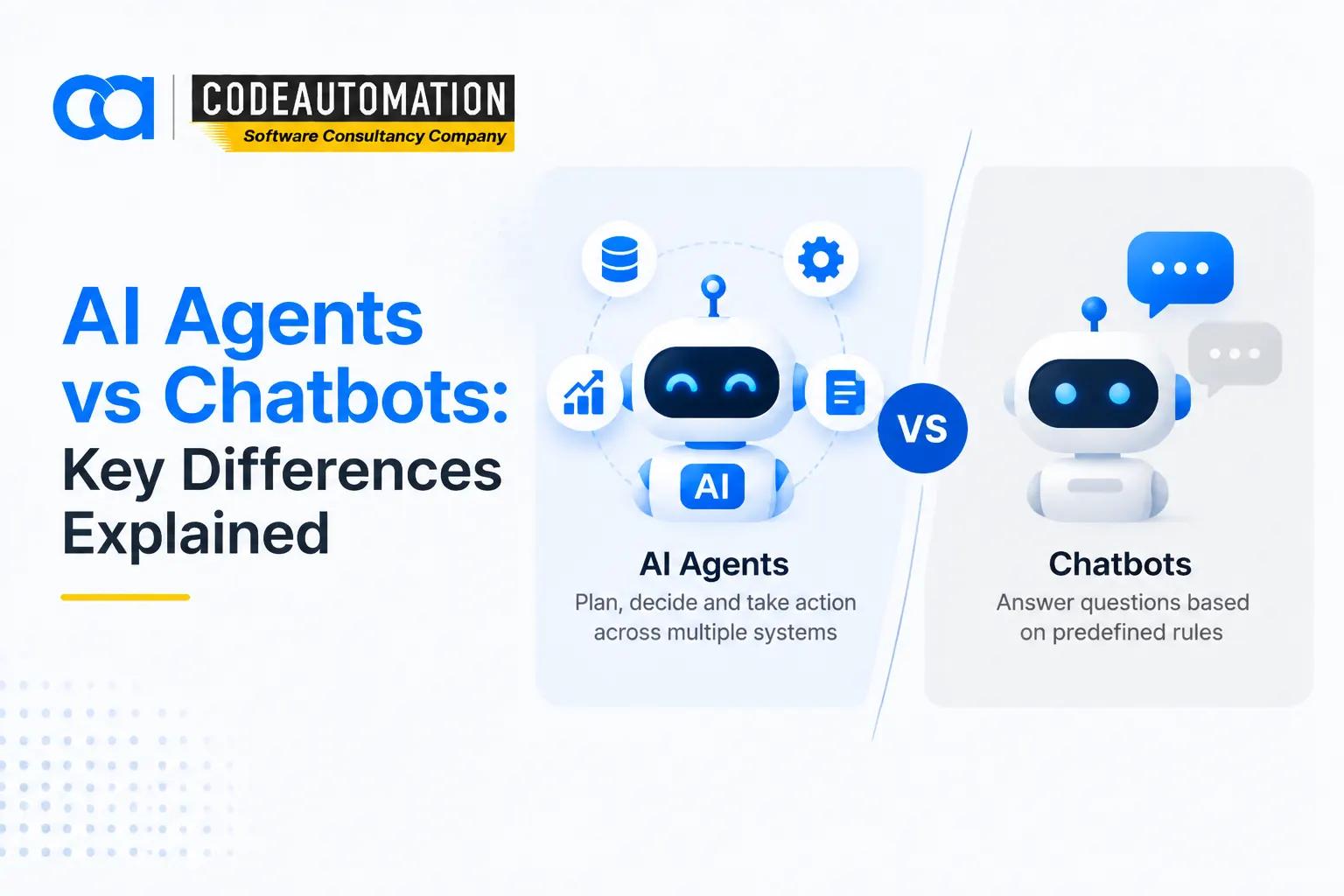
AI Agents vs Chatbots: Key Differences Explained
Published 29/09/2026
Nearly every vendor now calls its bot "agentic," which muddies the AI agents vs. chatbots debate. The distinction is architectural: a chatbot generates responses, while an agent plans, calls tools, and changes state in your systems. Gartner expects 33% of enterprise software applications to include agentic AI by 2028, up from under 1% in 2024, so getting this right now shapes your automation roadmap.

Ready to Automate Your Success?
From AI-powered applications to scalable software development, we help businesses automate workflows and accelerate growth.
Book a Free ConsultationNearly every vendor now calls its bot "agentic," which muddies the AI agents vs. chatbots debate. The distinction is architectural: a chatbot generates responses, while an agent plans, calls tools, and changes state in your systems. Gartner expects 33% of enterprise software applications to include agentic AI by 2028, up from under 1% in 2024, so getting this right now shapes your automation roadmap.
AI Agents vs Chatbots
A chatbot is a conversational interface that maps user input to a response. An AI agent is a goal-driven system that uses an LLM as its reasoning engine, calls tools and APIs, maintains state, and executes multi-step tasks with bounded autonomy. That's the core of AI agents vs chatbots: chatbots talk, agents do.
What Is a Chatbot?
A chatbot is software that simulates dialogue over text or voice, usually on a single channel such as a web widget, WhatsApp, or Slack.
How Chatbots Work
NLU handles intent classification and entity extraction, then a dialogue manager selects a response from a decision tree, knowledge base, or LLM completion. Session state is short-lived.
Types of Chatbots
Rule-based bots follow scripted flows. Intent-based bots use NLU engines like Dialogflow or Rasa. Generative bots wrap an LLM, often with RAG over a document corpus.
Common Chatbot Use Cases
FAQ deflection, order-status lookups, lead capture, appointment booking, and knowledge-base search.
What Is an AI Agent?
An AI agent is an autonomous system that perceives its environment, reasons toward a goal, and acts through tools until the goal is met or it escalates to a human.
How AI Agents Work
The stack combines an LLM planner, a tool layer (function calling, MCP servers, REST APIs), a memory store (vector database plus structured state), and an orchestrator such as LangGraph or CrewAI running the observe-think-act loop.
How AI Agents Make Decisions
Agents decompose goals into subtasks using patterns like ReAct or plan-and-execute, evaluate tool outputs, and re-plan when results diverge. Guardrails constrain the action space.
How AI Agents Take Action Across Systems
In a single run, an agent can query a CRM, update an ERP record, open a Jira ticket, and post a Slack alert. This is where custom AI agent development for enterprise workflows delivers value, since integrations, auth scopes, and error handling determine what an agent can reliably execute.
AI Agents vs Chatbots: Key Differences
Conversation vs Goal Completion
A chatbot succeeds with a relevant reply; an agent succeeds with a completed outcome, like a processed refund.
Reactive vs Proactive Behavior
Chatbots wait for a prompt. Agents can be triggered by webhooks, schedules, or anomaly signals.
Rules and Scripts vs. Reasoning
Chatbot logic lives in predefined flows. Agents reason at runtime, choosing which tools to call and when.
Limited Context vs Persistent Memory
Chatbots forget after the session ends. Agents persist episodic and semantic memory across tasks.
Answering Questions vs Taking Actions
A chatbot explains how to reset a password. An agent verifies identity, resets it, and logs the change.
Single-System vs Cross-System Workflows
Chatbots sit on one channel with read-only access. Agents orchestrate across SaaS apps, databases, and internal APIs.
Static Configuration vs Adaptability
Chatbot changes require redeploying flows. Agents adapt to edge cases within policy bounds.
AI Agents vs Chatbots: Side-by-Side Comparison
The table below summarizes AI agents vs chatbots across the dimensions engineering teams care about most.
Dimension
Chatbot
AI Agent
Primary goal
Respond
Complete a task
Trigger
User message
Message, event, or schedule
Memory
Session-scoped
Persistent
Tool use
Minimal, read-only
Read and write function calling
Exception handling
Human fallback
Retries, re-plans, escalates
Are AI Agents Just Smarter Chatbots?
No. A frontier model behind a chat widget is still a chatbot.
What Makes an AI Agent Different?
Agency: the capacity to pursue a goal by selecting and executing actions. Chat is an interface, not the architecture.
The Role of Reasoning, Memory, Tools, and Autonomy
Reasoning plans the path, memory carries context forward, tools change real systems, and autonomy defines how far the agent goes without approval. Remove any one and you have a sophisticated responder.
AI Agents vs Chatbots vs AI Assistants
Chatbots
Narrow, scripted or retrieval-backed conversation within a defined domain.
AI Assistants
Copilots that draft, summarize, and search on direct instruction, with the human driving every step.
AI Agents
Delegated operators that own outcomes end to end while humans supervise.
AI Agents vs Chatbots: Business Use Cases
Customer Service
Chatbots deflect tier-0 FAQs; agents check order data, issue refunds within policy, and close tickets. Gartner predicts agentic AI will autonomously resolve 80% of common customer service issues by 2029.
Sales and Marketing
Chatbots qualify leads. Agents enrich and score them, draft outreach sequences, and sync activity to the CRM.
IT and Employee Support
Chatbots answer policy questions. Agents provision access, rotate credentials, and triage incidents.
Data Analysis and Business Operations
Agents generate SQL, reconcile invoices, and flag anomalies—workloads that belong to AI-driven business process automation rather than conversation.
AI Agents vs Chatbots: Security and Governance
Data Access and Permissions
Use least-privilege, per-tool scoped credentials. A misconfigured agent with write access can corrupt data, not just leak it.
Human Oversight and Escalation
Add approval checkpoints for payments, deletions, and external communications, plus confidence thresholds that trigger handoff.
Monitoring and Auditability
Log every prompt, tool call, and output. OpenTelemetry-based tracing makes agent runs reproducible for audits.
Risks of Autonomous Actions
Prompt injection, hallucinated tool arguments, runaway loops, and token cost blowouts. Gartner expects over 40% of agentic AI projects to be canceled by end of 2027 due to cost, unclear value, and weak risk controls.
When Should You Use a Chatbot?
When queries are high-volume, predictable, and informational, with no backend state changes required.
When Should You Use an AI Agent?
When tasks span multiple steps and systems, require judgment over unstructured input, or demand resolution rather than deflection.
Can Chatbots and AI Agents Work Together?
Yes, and it's the dominant production pattern: the chatbot captures intent at the front end, and a router hands complex requests to specialized backend agents.
AI Agents vs Chatbots: What Should Businesses Consider?
Task Complexity
Single-turn lookups suit chatbots; branching, multi-step workflows need agents.
Required Level of Autonomy
Assign each action a tier: suggest, act with approval, or act independently.
System Integrations
Audit API availability, auth models, and rate limits first. Teams investing in AI software development with secure API and data-layer integrations scope agents faster.
Data and Security Requirements
Account for PII handling, data residency, SOC 2 or HIPAA obligations, and model hosting.
Cost and Maintenance
Agents consume more tokens per task and need eval pipelines, prompt versioning, and ongoing tuning.
Scalability
Design for concurrency, idempotent tool calls, and graceful degradation when a model or API fails.
AI Agents vs RPA: What's the Difference?
RPA executes deterministic scripts that are fast and auditable but break when a UI or input format changes. Agents handle unstructured data and ambiguity. Many teams pair them: agents decide, while robotic process automation services for rule-based tasks handle high-volume execution.
How to Tell Whether an AI Agent Is Truly Agentic
Can It Reason?
It should decompose goals and re-plan when a step fails.
Can It Take Actions?
Look for real write operations through function calling, not just generated text.
Can It Work Across Systems?
A single run should span multiple tools or data sources.
Can It Handle Exceptions?
Test against missing data, API errors, and conflicting instructions.
Is Human Oversight Available?
Approval gates, kill switches, and audit logs should be built in.
The Future of AI Agents and Chatbots
Conversational platforms are adding tool calling, and protocols like MCP make integration cheaper. Gartner projects 15% of day-to-day work decisions will be made autonomously by 2028. As chat becomes the interface and agents the execution layer, the AI agents vs chatbots question will shift from which one to choose to how to layer them.
Frequently Asked Questions (FAQs)
Everything you need to know about our products and services
A chatbot responds within a conversation. An AI agent pursues a goal by reasoning, calling tools, and executing multi-step actions across systems.
Not universally. Agents suit complex, cross-system tasks; chatbots are cheaper and easier to govern for predictable queries.
Yes, by adding a planning loop, tool integrations, persistent memory, and guardrails. Upgrading the LLM alone isn't enough.
Chatbots converse narrowly, assistants help on direct instruction, and agents autonomously own outcomes under human supervision.
Yes. A chatbot often serves as the conversational front end, routing complex requests to backend agents that execute the work.





Adnan Ghaffar is the visionary CEO of CodeAutomation.ai, a platform dedicated to transforming how businesses build software through cutting-edge automation. With over a decade of experience in software development, QA automation, and team leadership, Adnan has built a reputation for delivering scalable, intelligent, and high-performance solutions.
Under his leadership, CodeAutomation.ai has grown into a trusted name in AI-driven development, empowering startups and enterprises alike to streamline workflows, accelerate time-to-market, and maintain top-tier product quality. Adnan is passionate about innovation, process improvement, and building products that truly solve real-world problems.
More Articles

18 April 2025
Can You Develop Mobile Apps with Python? Everything You Need to Know
11/09/2026
Remote Sensing AI How Artificial Intelligence Is Transforming Earth Observation
25/ 11/ 2025
A Complete Guide to How Vibe Coding Works in Modern AI Workflows
27/08/2026
Software Development Outsourcing: Complete Guide for Businesses
02/10/2026
What Is an Intelligence Explosion and How Could It Happen?
01/10/2026