























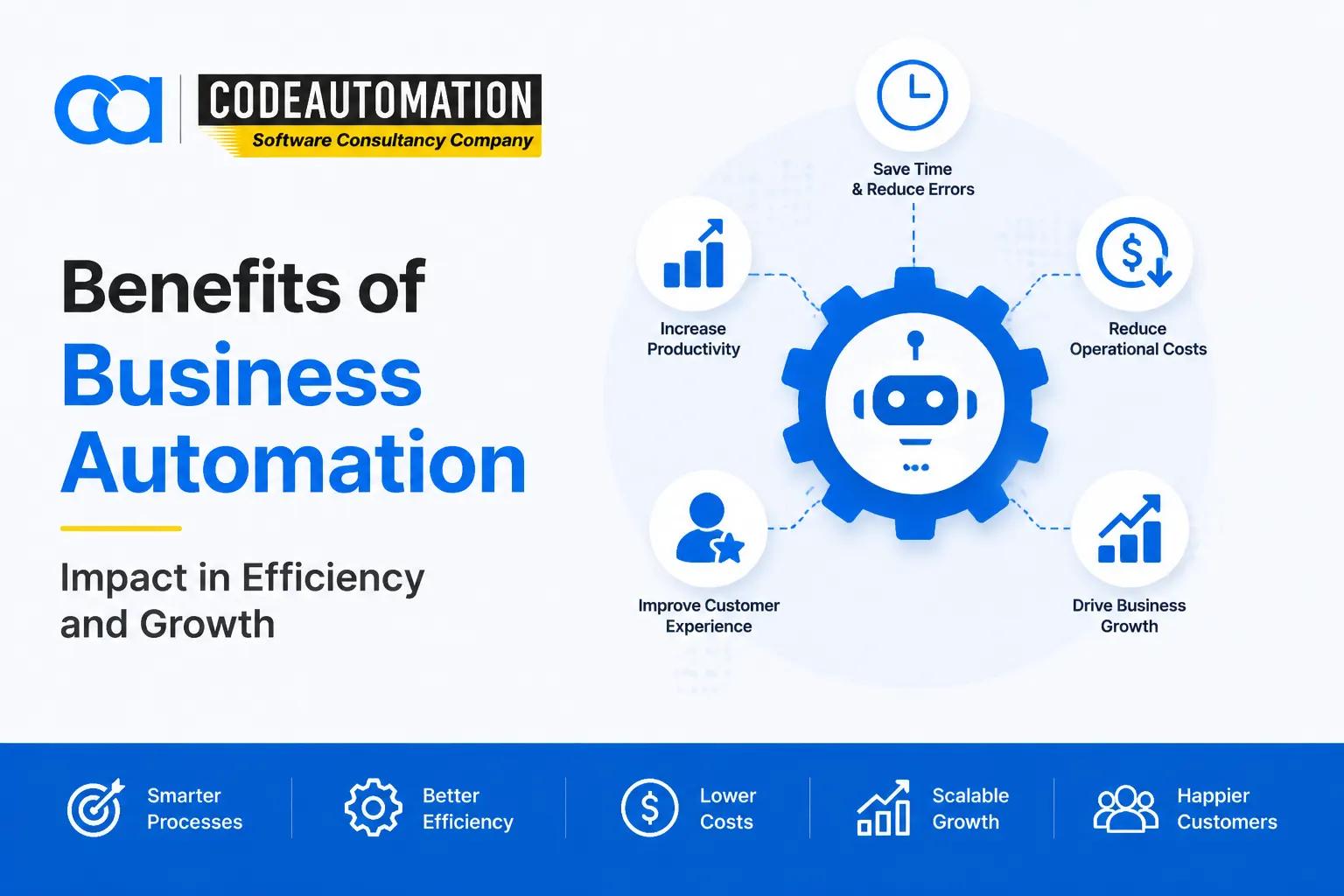
Benefits of Business Automation: How Businesses Improve Efficiency, Reduce Costs, and Scale Faster
Published 02/09/2026
Business operations often become more complicated as companies grow. Teams manage increasing volumes of customer requests, documents, approvals, reporting, and repetitive administrative tasks. While traditional processes may work initially, they can eventually create delays, increase operational costs, and limit growth.

Ready to Automate Your Success?
From AI-powered applications to scalable software development, we help businesses automate workflows and accelerate growth.
Book a Free ConsultationIntroduction
Business operations often become more complicated as companies grow. Teams manage increasing volumes of customer requests, documents, approvals, reporting, and repetitive administrative tasks. While traditional processes may work initially, they can eventually create delays, increase operational costs, and limit growth.
Business automation helps organizations improve these processes by using technology to handle repetitive tasks, connect disconnected systems, and create more efficient workflows.
From automating customer communication and sales processes to streamlining finance, HR, and internal operations, automation allows businesses to spend less time managing routine work and more time focusing on strategic activities.
Modern automation solutions also combine workflow automation, integrations, artificial intelligence, and data-driven capabilities to help businesses create smarter and more scalable operations.
What Is Business Automation?
Business automation is the use of technology to automate repetitive business activities, workflows, and processes that normally require manual effort.
Instead of employees performing the same tasks repeatedly, automated systems can execute predefined actions, move information between applications, trigger notifications, process data, and support decision-making.
For example, a company can automate:
- Customer follow-up emails after a sales inquiry
- Invoice approvals and payment workflows
- Employee onboarding processes
- Data synchronization between business systems
- Customer support requests
Business automation does not mean replacing employees. The goal is to remove unnecessary manual work so teams can focus on tasks that require creativity, judgment, and human interaction.
Why Are Businesses Investing in Automation?
As companies grow, operational challenges usually increase:
- More customer interactions
- More data to manage
- More applications and systems
- More repetitive processes
Manual workflows often create bottlenecks because information moves slowly between departments and employees spend valuable time completing routine activities.
Business automation helps companies create structured processes that improve speed, accuracy, and visibility across operations.
The biggest value comes when automation solves a real business problem instead of simply adding new technology.
Key Benefits of Business Automation
1. Improves Productivity by Reducing Manual Work
One of the biggest benefits of automation is allowing employees to spend less time on repetitive tasks.
Activities such as data entry, reporting, document processing, scheduling, and notifications can consume hours every week when handled manually.
By automating these workflows, businesses can reduce unnecessary administrative work and allow employees to focus on higher-value activities.
For example, a sales team can automatically update customer records after interactions instead of manually entering information into multiple systems.
2. Reduces Operational Costs
Automation helps businesses reduce costs by improving how resources are used.
Instead of increasing workforce requirements as operational demand grows, companies can automate repetitive processes and handle higher volumes without increasing manual effort.
Cost improvements often come from:
- Reducing time spent on repetitive activities
- Minimizing process delays
- Lowering error correction costs
- Improving resource allocation
However, automation should be viewed as an efficiency investment rather than simply a cost-cutting measure.
3. Improves Accuracy and Reduces Human Errors
Manual processes are more vulnerable to mistakes, especially when employees handle large amounts of repetitive data.
Automation creates consistent workflows that follow predefined rules, reducing errors in areas such as:
- Data processing
- Document management
- Customer records
- Financial workflows
This improves reliability and helps businesses maintain consistent operations.
4. Creates Faster and Better Customer Experiences
Customer expectations continue to increase. Businesses need faster responses, smoother interactions, and easier access to information.
Automation helps companies improve customer experiences through:
- Faster communication
- Automated notifications
- Self-service options
- Personalized interactions
- Faster issue resolution
For example, automated customer support workflows can route requests to the right team while providing immediate responses for common questions.
5. Provides Better Business Visibility and Decision Making
When information is scattered across different tools, businesses struggle to understand what is happening across operations.
Automation can connect systems and centralize important information, helping managers monitor workflows, identify problems, and make better decisions.
Connected automation workflows can provide clearer insights into:
- Sales performance
- Customer activity
- Operational efficiency
- Financial processes
Examples of Business Automation Across Different Departments
Business automation can be applied across almost every area of an organization.
Sales and Marketing Automation
Businesses use automation to manage:
- Lead capture
- Customer follow-ups
- Email campaigns
- CRM updates
- Sales pipeline activities
This helps sales teams respond faster and maintain consistent customer engagement.
Customer Support Automation
Automation can improve support operations through:
- AI-powered assistants
- Automated ticket routing
- Customer notifications
- Knowledge base systems
This allows support teams to handle more requests while maintaining service quality.
Finance and Accounting Automation
Finance teams can automate:
- Invoice processing
- Approval workflows
- Expense management
- Reporting tasks
This reduces manual administration and improves financial accuracy.
Internal Operations Automation
Companies can automate internal workflows such as:
- Employee onboarding
- Document approvals
- Task assignments
- Internal requests
This creates smoother collaboration between departments.
Benefits of Workflow Automation for Growing Businesses
Workflow automation focuses on improving how tasks move between people, systems, and departments.
For growing companies, workflow automation can:
- Reduce process delays
- Standardize operations
- Improve team collaboration
- Create repeatable business processes
Instead of relying on emails, spreadsheets, and manual follow-ups, businesses can create structured workflows that operate consistently.
How AI Is Expanding the Benefits of Business Automation
Traditional automation follows predefined rules, while AI-powered automation can analyze information, recognize patterns, and support more complex business decisions.
AI automation can help businesses with:
- Intelligent customer interactions
- Document analysis
- Predictive insights
- Automated recommendations
- Advanced workflow decisions
This combination of automation and AI allows companies to move beyond simple task automation toward smarter business operations.
How to Identify Processes That Should Be Automated
Not every business process needs automation.
The best candidates usually have:
- High repetition
- Manual data handling
- Frequent delays
- Multiple handoffs
- High error potential
Before automating, businesses should evaluate:
The current workflow
The business problem
Expected improvement
Available technology options
A successful automation project starts with understanding the process, not selecting a tool.
How Business Automation Supports Long-Term Growth
Automation provides businesses with a foundation for scalability.
As companies grow, automated systems can help manage increased workloads without creating additional operational complexity.
Businesses can expand processes, integrate new tools, and improve workflows without rebuilding operations from scratch.
This makes automation valuable not only for solving current challenges but also for preparing organizations for future growth.
Choosing the Right Business Automation Approach
The right automation strategy depends on business goals, existing systems, and operational requirements.
Companies should consider:
- Which processes create the biggest inefficiencies
- Which systems need integration
- Whether AI capabilities are required
- How the solution will scale over time
Working with an experienced automation partner helps businesses identify practical opportunities and build solutions aligned with their objectives.
Turn Repetitive Work Into Smarter Business Operations
If your business is spending too much time on manual processes, disconnected systems, or repetitive workflows, the right automation strategy can help you improve efficiency and scale with confidence.
Explore our AI business automation solutions to discover how automation can transform your daily operations.
Frequently Asked Questions (FAQs)
Everything you need to know about our products and services
The main benefits include improved productivity, reduced operational costs, fewer errors, faster workflows, better customer experiences, and improved business visibility.
Automation improves efficiency by reducing repetitive manual tasks, creating consistent workflows, and allowing employees to focus on higher-value activities.
Examples include automated customer support, invoice processing, CRM updates, employee onboarding, marketing workflows, reporting systems, and data synchronization.
Yes. Small businesses can use automation to reduce administrative workload, improve customer service, and scale operations without adding unnecessary complexity.
AI is increasingly becoming part of business automation by helping systems analyze information, make recommendations, and handle more complex workflows.





Adnan Ghaffar is the visionary CEO of CodeAutomation.ai, a platform dedicated to transforming how businesses build software through cutting-edge automation. With over a decade of experience in software development, QA automation, and team leadership, Adnan has built a reputation for delivering scalable, intelligent, and high-performance solutions.
Under his leadership, CodeAutomation.ai has grown into a trusted name in AI-driven development, empowering startups and enterprises alike to streamline workflows, accelerate time-to-market, and maintain top-tier product quality. Adnan is passionate about innovation, process improvement, and building products that truly solve real-world problems.
More Articles
10/09/2026
Location Intelligence Solutions: How Businesses Use Geospatial Data for Better Decisions
16/09/2026
Mapbox Development Services: Building Custom Mapping and Location Solutions
16/09/2026
AI CRM Automation: AI Solutions That Integrate With Popular CRM Systems
02/09/2026
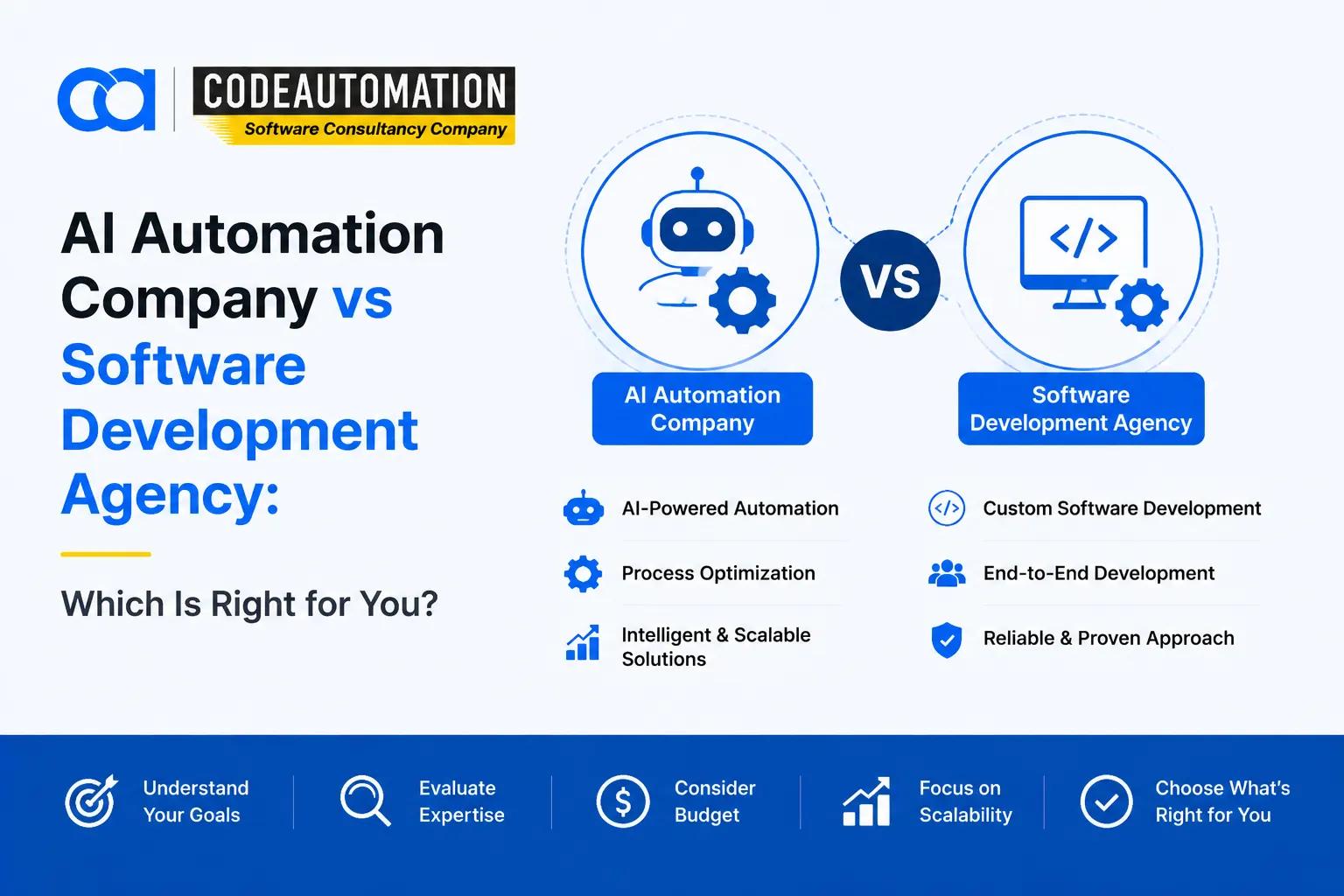
AI Automation Company vs Software Agency: Which Is Right for You?
22/08/2026
What are the benefits of custom software?

02/10/2026