





















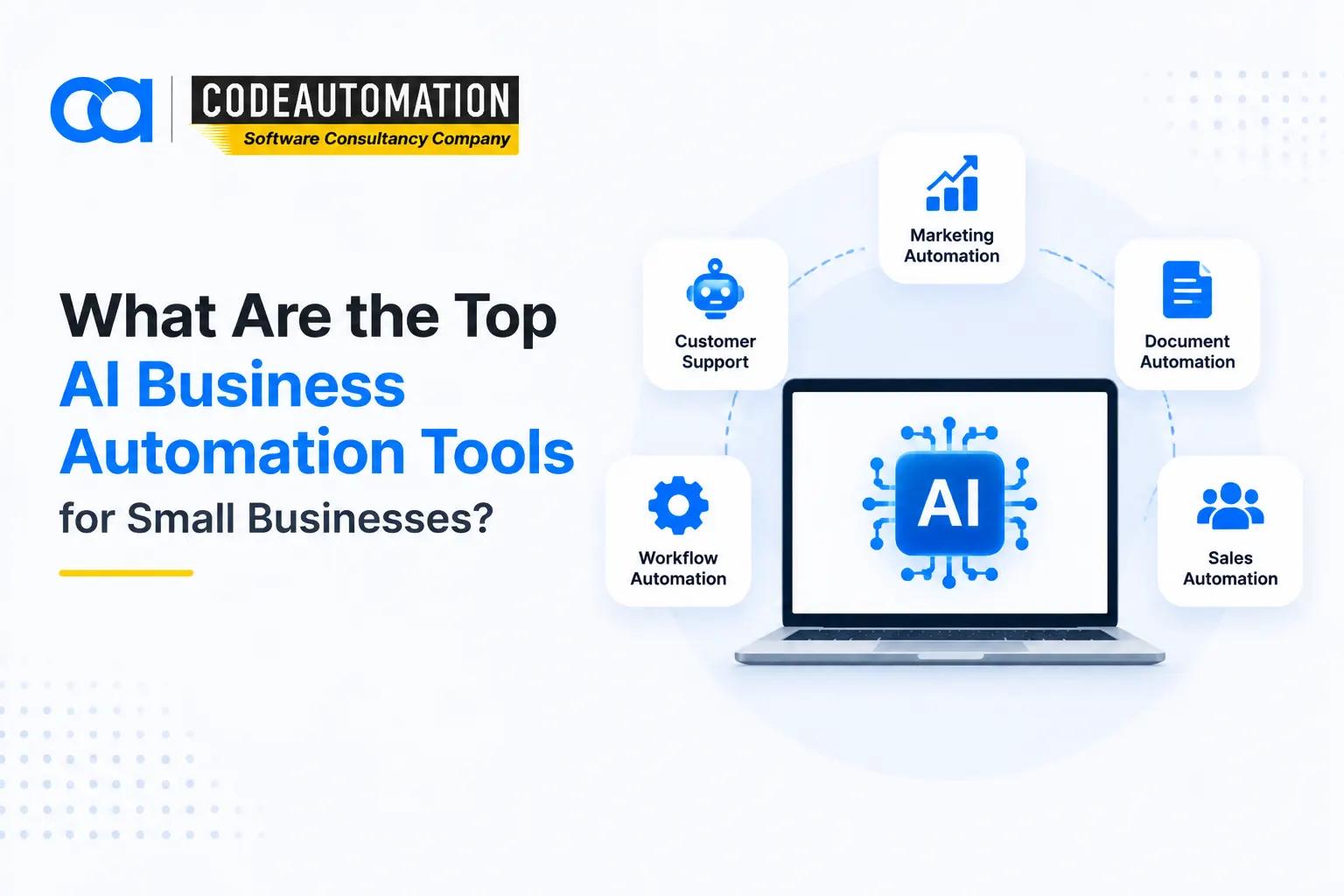
What Are the Top AI Business Automation Tools for Small Businesses
Published 09/09/2026
Small businesses are adopting AI business automation tools to reduce repetitive work, improve productivity, and manage daily operations more efficiently. From automating customer communication and sales follow-ups to connecting business applications and analyzing data, AI-powered tools help small teams accomplish more without increasing operational complexity.

Ready to Automate Your Success?
From AI-powered applications to scalable software development, we help businesses automate workflows and accelerate growth.
Book a Free ConsultationSmall businesses are adopting AI business automation tools to reduce repetitive work, improve productivity, and manage daily operations more efficiently. From automating customer communication and sales follow-ups to connecting business applications and analyzing data, AI-powered tools help small teams accomplish more without increasing operational complexity.
The best AI automation tools for small businesses are not necessarily the ones with the most features. The right choice depends on the business problem you want to solve, the applications you already use, and the workflows you want to automate.
Popular options include:
- Zapier for connecting business applications and automating workflows
- Make for building flexible visual automations
- HubSpot AI for CRM, sales, and marketing automation
- n8n for customizable AI workflows
- Gumloop for AI-powered workflow automation
- ChatGPT and Claude for AI-assisted productivity
This guide compares the top AI business automation tools for small businesses, explains what each tool is best for, and helps you choose the right solution based on your needs.
How We Selected the Best AI Business Automation Tools
With hundreds of AI tools available, choosing the right platform can become confusing. A useful automation tool should solve real business problems instead of adding another complicated system.
The tools in this guide are evaluated based on:
Ease of Use
Small businesses often do not have dedicated automation engineers. Tools should provide simple setup options, intuitive interfaces, and accessible workflows.
Automation Capabilities
The tool should automate meaningful business processes such as:
- Lead management
- Customer communication
- Data entry
- Reporting
- Internal workflows
Integration Options
A useful AI automation platform should connect with existing business systems, including:
- CRM platforms
- Email tools
- Accounting software
- Project management systems
- Communication platforms
Scalability
The best tools should support business growth without requiring a complete workflow rebuild later.
Business Use Cases
The tool should have practical applications across areas such as:
- Sales
- Marketing
- Customer support
- Operations
- Finance
Top AI Business Automation Tools for Small Businesses
1. Zapier — Best Overall AI Workflow Automation Tool
Best for: Small businesses that want simple automation between different applications.
Zapier is one of the most widely used workflow automation platforms because it allows businesses to connect thousands of applications without building custom integrations.
Businesses can create automated workflows using triggers and actions.
Example:
A customer submits a contact form →
Lead information is added to CRM →
Sales notification is created →
Follow-up email is sent automatically.
Key Features:
- Application integrations
- AI-assisted workflow creation
- Multi-step automation
- No-code workflow builder
Best Use Cases:
- Lead management
- Marketing workflows
- Customer notifications
- Internal task automation
Best Fit:
Zapier is ideal for small businesses that want quick automation without technical complexity.
2. Make — Best Visual AI Automation Platform
Best for: Businesses that need more flexible workflow customization.
Make provides a visual workflow builder that allows businesses to create more advanced automation scenarios.
Instead of simple trigger-based automation, businesses can design complex workflows involving multiple applications and data processes.
Key Features:
- Visual workflow builder
- Advanced automation scenarios
- Data transformation
- Application connections
Best Use Cases:
- Operations automation
- Data processing
- Multi-step workflows
- Business process automation
Best Fit:
Make works well for growing businesses that need more control than basic automation tools provide.
3. HubSpot AI — Best for CRM and Sales Automation
Best for: Small businesses focused on customer relationships and sales growth.
HubSpot combines CRM functionality with AI capabilities to help businesses manage leads, automate communication, and improve customer engagement.
Key Features:
- AI-powered CRM assistance
- Lead management
- Email automation
- Customer insights
- Marketing workflows
Best Use Cases:
- Sales pipeline automation
- Lead qualification
- Customer communication
- Marketing campaigns
Best Fit:
HubSpot AI is a strong option for businesses where customer acquisition and relationship management are priorities.
4. n8n — Best for Custom AI Workflows
Best for: Businesses that need greater flexibility and customization.
n8n allows teams to build customized workflows by connecting APIs, applications, and AI models.
Unlike simpler automation tools, n8n provides more control over workflow logic.
Key Features:
- Flexible workflow automation
- API integrations
- AI workflow support
- Custom automation logic
Best Use Cases:
- Complex workflows
- Data automation
- Internal business processes
- Custom AI integrations
Best Fit:
n8n is suitable for businesses that need customized automation and have technical resources available.
5. Gumloop — Best AI-Powered Workflow Automation Tool
Best for: Businesses looking for AI-driven workflows.
Gumloop focuses on combining AI capabilities with automation workflows, allowing users to create processes that analyze information, complete tasks, and work with business data.
Key Features:
- AI workflow creation
- Automated research
- Data processing
- AI-powered task execution
Best Use Cases:
- Research automation
- Data workflows
- Knowledge-based tasks
Best Fit:
Gumloop is useful for businesses that want AI involved directly in workflow execution rather than only basic task automation.
6. ChatGPT and Claude — Best AI Assistants for Business Productivity
Best for: Businesses looking to improve everyday productivity.
AI assistants help small teams complete knowledge-based tasks faster.
Examples:
- Writing emails
- Creating proposals
- Summarizing documents
- Preparing reports
- Generating ideas
Best Use Cases:
- Content creation
- Research
- Documentation
- Internal productivity
Best Fit:
AI assistants are useful for almost every business, especially teams looking to improve daily productivity before implementing larger automation systems.
Best AI Automation Tools by Business Need
Best AI Tools for Customer Support Automation
Customer support automation helps businesses respond faster and manage customer requests efficiently.
Recommended tools:
- HubSpot AI
- ChatGPT-powered assistants
- AI chatbot platforms
Common workflows:
Customer inquiry →
AI categorizes request →
Response generated →
Ticket created if required.
Best AI Tools for Sales Automation
Sales teams can use AI automation to reduce manual follow-ups and improve lead management.
Common use cases:
- Lead qualification
- CRM updates
- Email personalization
- Sales reminders
Recommended tools:
- HubSpot AI
- Zapier
- Make
Best AI Tools for Marketing Automation
Marketing automation helps small businesses create campaigns and manage customer engagement.
Common workflows:
- Content creation
- Email campaigns
- Customer segmentation
- Campaign reporting
Recommended tools:
- Zapier
- HubSpot AI
- ChatGPT
Best AI Tools for Workflow Automation
Businesses looking to automate internal processes should consider:
- Zapier
- Make
- n8n
- Gumloop
Examples:
- Employee onboarding
- Document processing
- Data synchronization
- Task management
Which AI Business Automation Tool Is Best for Your Small Business?
Best AI Automation Tool for Simple Business Workflows
Recommended Tool: Zapier
Zapier is a strong choice for small businesses that need quick automation without technical complexity.
Best suited for:
- Connecting everyday business applications
- Automating repetitive tasks
- Creating simple workflows
- Managing notifications and data transfers
Example:
A customer fills out a contact form → Zapier creates a CRM entry → Sales team receives an alert.
Best AI Automation Tool for Complex Workflows
Recommended Tool: Make
Make is better suited for businesses that need more advanced workflow customization.
Best suited for:
- Multi-step workflows
- Data processing
- Connecting multiple applications
- Visual workflow management
Example:
A customer order is received → Data is processed → Inventory is updated → Customer receives confirmation.
Best AI Automation Tool for CRM and Sales Automation
Recommended Tool: HubSpot AI
HubSpot AI works well for businesses focused on managing customers, leads, and sales activities.
Best suited for:
- Lead management
- Customer communication
- Email automation
- Sales pipeline workflows
Best AI Automation Tool for Custom Workflows
Recommended Tool: n8n
n8n is suitable for businesses that require more control and customization.
Best suited for:
- Custom integrations
- API-based workflows
- AI-powered automation
- Technical teams
Best AI Tool for Business Productivity
Recommended Tools: ChatGPT and Claude
AI assistants are useful for improving daily productivity.
Best suited for:
- Writing documents
- Creating reports
- Research
- Brainstorming
- Internal knowledge tasks
Best AI Workflow Tool for AI-Powered Processes
Recommended Tool: Gumloop
Gumloop is useful for businesses that want AI involved directly in workflow execution.
Best suited for:
- AI-powered research
- Data processing
- Automated information workflows
How to Choose the Right AI Automation Tool for Your Small Business
The best AI automation tool depends on your current challenges.
Choose Zapier If:
You need:
- Simple automation
- Quick integrations
- Easy setup
Choose Make If:
You need:
- More complex workflows
- Visual process building
- Greater customization
Choose HubSpot AI If:
You need:
- CRM automation
- Sales workflow improvement
- Customer engagement
Choose n8n If:
You need:
- Custom workflows
- API integrations
- Technical flexibility
Choose AI Assistants If:
You need:
- Productivity improvement
- Content support
- Research assistance
Common AI Automation Workflows for Small Businesses
Lead Management Automation
Example workflow:
Website form submission
↓
AI analyzes customer information
↓
CRM record created
↓
Sales notification sent
↓
Follow-up email generated
Customer Support Automation
Example workflow:
Customer message received
↓
AI identifies request type
↓
Response generated
↓
Support ticket created if needed
Reporting Automation
Example workflow:
Business data collected
↓
AI analyzes information
↓
Report generated
↓
Insights shared with team
Challenges of Using AI Automation Tools
Although AI automation provides significant benefits, businesses should consider several challenges.
Choosing Too Many Tools
Using multiple disconnected tools can create complexity instead of reducing it.
Businesses should start with important workflows and expand gradually.
Data Privacy Considerations
Businesses should understand:
- What data the AI processes
- Where information is stored
- Who can access business data
Integration Limitations
Some workflows may require custom development when existing tools cannot support specific business requirements.
Human Oversight
AI should support business decisions, not replace important judgment.
Future of AI Business Automation for Small Businesses
AI automation is moving toward more intelligent systems that can understand goals, manage workflows, and complete complex tasks.
Future developments include:
- AI agents managing business processes
- More personalized automation
- Intelligent workflow recommendations
- Automated decision support
Small businesses that adopt AI strategically can improve efficiency while maintaining flexibility and control.
Final Thoughts
The best AI business automation tool for a small business is the one that solves a specific operational problem. Instead of adopting multiple platforms at once, businesses should identify repetitive tasks, choose the right automation approach, and scale gradually.
For simple workflows, tools like Zapier and Make may be enough. For more customized processes, platforms like n8n or AI-powered automation solutions can provide greater flexibility.
As businesses grow, combining automation tools with customized AI workflows can help create more efficient, scalable operations.
Need a Custom AI Automation Solution for Your Business?
AI automation tools can help small businesses streamline workflows, but many companies eventually need customized solutions that connect multiple systems, automate complex processes, and support unique business requirements.
If your business needs more than standard automation tools, CodeAutomation helps design and implement AI-powered automation solutions tailored to your workflows.
Our AI automation solutions can help businesses:
- Automate repetitive business processes
- Connect existing software and applications
- Build AI-powered workflows
- Improve operational efficiency
- Create scalable automation systems
Whether you need workflow automation, AI integrations, or intelligent business solutions, our team can help you identify the right automation approach for your goals.
Explore our AI Business Automation Solutions to build smarter, scalable workflows for your business.
Frequently Asked Questions (FAQs)
Everything you need to know about our products and services
The top AI business automation tools for small businesses include Zapier, Make, HubSpot AI, n8n, Gumloop, and AI assistants such as ChatGPT and Claude. The best option depends on the business workflow you want to automate.
Zapier is often considered one of the easiest automation tools for beginners because it provides simple workflows and connects many popular business applications.
Yes. Many AI automation tools provide no-code or low-code interfaces that allow small businesses to automate workflows without programming experience.
AI automation tools can automate customer support, sales follow-ups, marketing workflows, reporting, document processing, scheduling, and internal operations.
Costs vary depending on the platform, number of workflows, and required features. Many tools offer affordable plans suitable for small teams, while advanced automation may require higher-tier plans.





Adnan Ghaffar is the visionary CEO of CodeAutomation.ai, a platform dedicated to transforming how businesses build software through cutting-edge automation. With over a decade of experience in software development, QA automation, and team leadership, Adnan has built a reputation for delivering scalable, intelligent, and high-performance solutions.
Under his leadership, CodeAutomation.ai has grown into a trusted name in AI-driven development, empowering startups and enterprises alike to streamline workflows, accelerate time-to-market, and maintain top-tier product quality. Adnan is passionate about innovation, process improvement, and building products that truly solve real-world problems.
More Articles

08/09/2026
How Does Artificial Intelligence Work? A Simple Guide

02/10/2026
What Is an Intelligence Explosion and How Could It Happen?
20/08/2026
Custom Software vs. Off-the-Shelf Software: Which Is Right for Your Business?

25/ 08/ 2025
How to Hire an AI Developer: Your Ultimate Guide for 2026

29/09/2026
What Is Superintelligence? What Makes AI Superintelligent