























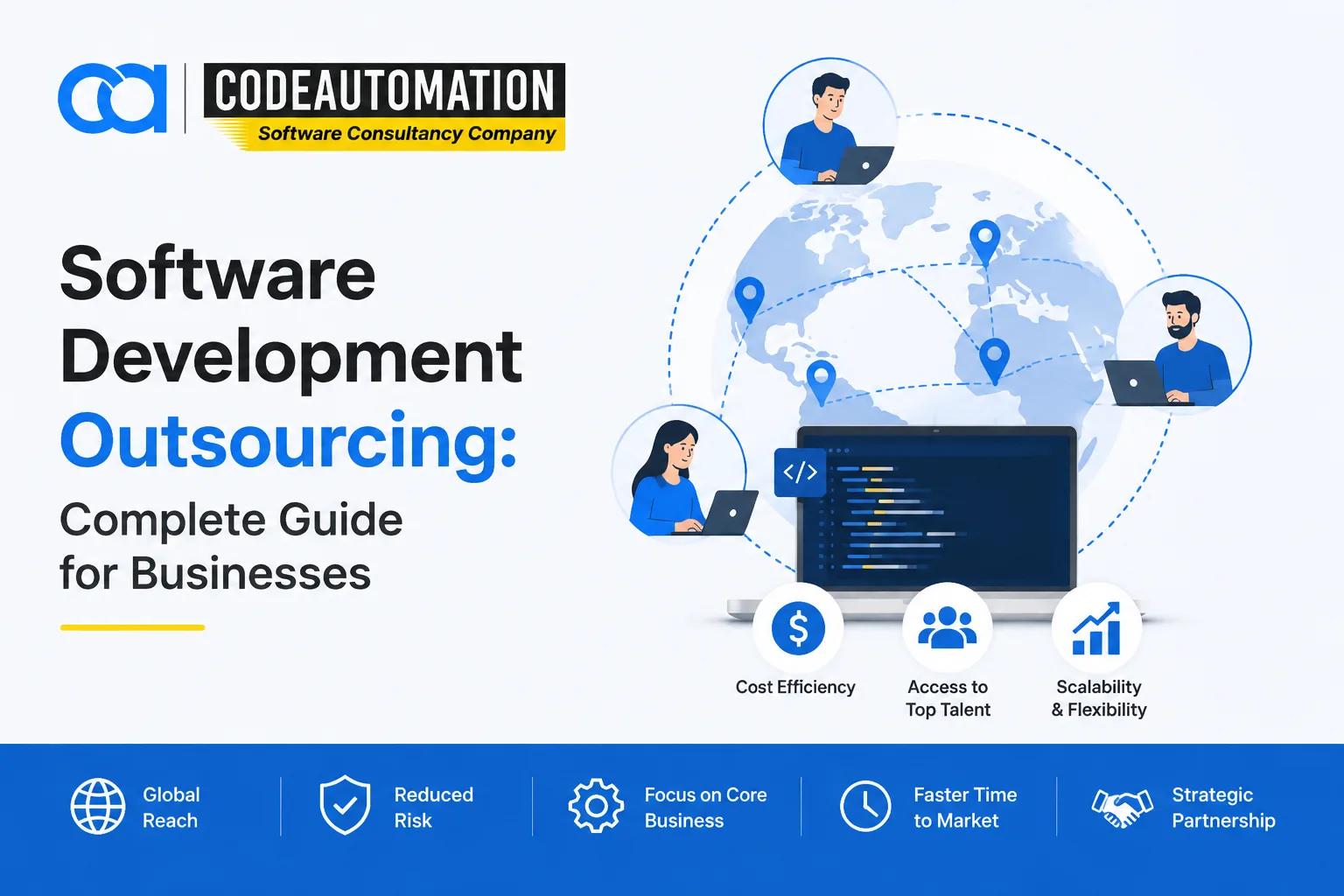
Software Development Outsourcing: Complete Guide for Businesses
Published 27/08/2026
Building and scaling software products requires more than technical expertise. Businesses need the right combination of engineering talent, development processes, technology capabilities, and strategic planning to deliver successful digital solutions.

Ready to Automate Your Success?
From AI-powered applications to scalable software development, we help businesses automate workflows and accelerate growth.
Book a Free ConsultationBuilding and scaling software products requires more than technical expertise. Businesses need the right combination of engineering talent, development processes, technology capabilities, and strategic planning to deliver successful digital solutions.
However, many organizations face challenges when relying only on internal teams, including limited technical resources, long hiring cycles, increasing development costs, and difficulty finding specialized expertise.
Software development outsourcing provides a flexible approach by allowing businesses to collaborate with external engineering teams and technology partners to design, build, test, and maintain software applications.
Modern outsourcing has evolved beyond traditional offshore development. Today, companies work with specialized software development partners to access cloud engineering, artificial intelligence, DevOps, cybersecurity, automation, and scalable product development capabilities.
What Is Software Development Outsourcing?
Software development outsourcing is the practice of hiring external software developers, engineering teams, or technology companies to handle some or all stages of software development.
Instead of building every capability internally, organizations can partner with external experts for:
- Custom software development
- Web and mobile application development
- Cloud application development
- Software testing and quality assurance
- DevOps implementation
- AI and automation solutions
- Software maintenance and support
Software outsourcing enables businesses to access specialized skills, accelerate development timelines, and scale engineering capacity based on project requirements.
How Does Software Development Outsourcing Work?
A successful software outsourcing engagement follows a structured process that aligns business objectives with technical execution.
Discovery and Requirement Analysis
The process begins by understanding:
- Business goals
- User requirements
- Technical expectations
- Project scope
- Development timelines
This stage helps create a clear roadmap before development begins.
Partner Selection and Evaluation
Businesses evaluate potential outsourcing partners based on:
- Technical expertise
- Industry experience
- Portfolio quality
- Client reviews
- Security practices
- Communication processes
Choosing the right software development outsourcing company is critical for project success.
Selecting the Right Engagement Model
Organizations select an outsourcing model based on their project requirements, budget, and level of control needed.
Common models include:
- Fixed-price projects
- Dedicated development teams
- Staff augmentation
- Managed development services
Team Onboarding and Planning
After selecting a partner, teams establish:
- Communication channels
- Development workflows
- Project management tools
- Sprint schedules
- Reporting processes
Common tools include Jira, Slack, GitHub, and collaboration platforms.
Agile Development and Delivery
Development teams follow iterative approaches that include:
- Sprint planning
- Code reviews
- Continuous integration
- Testing
- Product demonstrations
This allows businesses to review progress and provide feedback throughout development.
Quality Assurance and Deployment
Before launch, software undergoes testing for:
- Functionality
- Performance
- Security
- Usability
- Compatibility
After deployment, teams continue monitoring, maintaining, and improving the application.
Why Do Businesses Outsource Software Development?
Organizations outsource software development for several strategic reasons.
Access to Specialized Expertise
Technology evolves rapidly, and many companies struggle to hire specialists in areas such as:
- Artificial intelligence
- Cloud computing
- Data engineering
- Cybersecurity
- DevOps
- Advanced software architecture
Outsourcing provides access to experienced professionals without long recruitment cycles.
Reduce Development Costs
Building an internal engineering team requires significant investment in:
- Hiring
- Salaries
- Benefits
- Infrastructure
- Training
- Employee retention
Software outsourcing allows businesses to optimize development costs while accessing skilled professionals.
Faster Time-to-Market
External development teams can help businesses launch products faster by providing immediate access to experienced engineers and established development processes.
This enables companies to:
- Build MVPs faster
- Release new features sooner
- Respond quickly to market changes
Scale Development Teams Easily
Software projects often change over time. Businesses may need additional engineers during development phases and fewer resources after launch.
Outsourcing provides flexible scalability without long-term hiring commitments.
Improve Focus on Core Business Activities
By delegating software development activities to experienced partners, internal teams can focus on business strategy, customers, and growth initiatives.
Software Development Outsourcing Models
Project-Based Outsourcing
This model works best for projects with:
- Clearly defined requirements
- Fixed deliverables
- Predictable timelines
The outsourcing partner manages development and delivers the completed solution according to agreed requirements.
Dedicated Development Team
A dedicated team provides businesses with an exclusive group of professionals, including:
- Software developers
- QA engineers
- Product managers
- Technical specialists
The client manages priorities while the outsourcing partner handles hiring and operational support.
Staff Augmentation
Staff augmentation allows businesses to add external specialists directly into their existing teams.
This approach is useful when organizations need:
- Additional engineering capacity
- Specific technical skills
- Temporary project support
Managed Development Services
Managed development services provide complete ownership of software development activities, including:
- Planning
- Engineering
- Quality assurance
- Deployment
- Maintenance
In-House vs Outsourced Software Development
Choosing between internal development and outsourcing depends on business goals, budget, timeline, and technical requirements.
Factor In-House Development Outsourced Development Time to Start Requires recruitment and onboarding Faster access to experienced teams Cost Structure Higher fixed expenses Flexible operational costs Technical Expertise Limited by internal hiring Access to global specialists Scalability Requires hiring changes Teams can expand or reduce easily Management Direct internal control Collaborative management model
Nearshore vs Offshore Software Development
Businesses often evaluate outsourcing locations based on cost, communication, and collaboration requirements.
Nearshore Outsourcing
Nearshore outsourcing involves working with teams in nearby regions or similar time zones.
Benefits:
- Easier communication
- Better time overlap
- Cultural alignment
Offshore Outsourcing
Offshore outsourcing involves partnering with teams in distant locations.
Benefits:
- Larger talent pools
- Cost efficiency
- Access to specialized expertise
Successful offshore partnerships require strong communication processes, documentation, and project management.
Benefits and Challenges of Software Development Outsourcing
Benefits
Software outsourcing provides:
- Faster product delivery
- Access to specialized talent
- Flexible engineering capacity
- Reduced recruitment challenges
- Ability to focus on core business goals
Challenges
Businesses should consider:
- Communication differences
- Time zone management
- Security concerns
- Intellectual property protection
- Vendor selection risks
Choosing the right outsourcing partner helps minimize these challenges.
How Much Does Software Development Outsourcing Cost?
Software development outsourcing costs depend on:
- Project complexity
- Technology stack
- Development location
- Team experience
- Engagement model
Typical hourly rates include:
Region Average Hourly Rate North America$100–$250+Western Europe$80–$200Eastern Europe$45–$95Latin America$40–$90Asia$25–$60
Businesses should evaluate total value, technical capability, and long-term partnership potential rather than selecting providers based only on price.
How to Outsource Custom Software Development Successfully
A successful outsourcing strategy requires careful planning.
Define Requirements Clearly
Document:
- Business objectives
- Features
- User requirements
- Technical expectations
Establish a Realistic Budget
Consider:
- Development costs
- Maintenance
- Infrastructure
- Future improvements
Select the Right Technology Partner
Evaluate:
- Technical expertise
- Previous projects
- Industry experience
- Communication approach
Prioritize Security and Ownership
Ensure agreements include:
- Confidentiality agreements
- Data protection requirements
- Intellectual property ownership
- Security standards
Create Effective Communication Processes
Successful partnerships require:
- Regular meetings
- Transparent reporting
- Agile workflows
- Clear ownership
How to Choose a Software Development Outsourcing Partner
Selecting the right partner is one of the most important decisions in a software outsourcing project.
Consider:
Technical Expertise
Review:
- Technology experience
- Engineering practices
- Architecture capabilities
- Quality processes
Portfolio and Case Studies
Evaluate whether the company has built solutions similar to your project requirements.
Communication and Collaboration
A reliable partner should provide:
- Transparent updates
- Clear documentation
- Responsive communication
Security Practices
Verify experience with:
- Secure development practices
- Compliance requirements
- Data protection standards
Long-Term Support Capability
A strong software development partner should support:
- Maintenance
- Enhancements
- Scaling
- Future development needs
Common Mistakes When Outsourcing Software Development
Choosing Based Only on Price
The cheapest option often creates risks related to:
- Poor code quality
- Delayed delivery
- Technical debt
Poor Requirements Definition
Unclear requirements can result in:
- Scope changes
- Increased costs
- Misaligned expectations
Ignoring Communication Processes
Without proper communication, projects may face delays and misunderstandings.
Neglecting Security and IP Protection
Contracts should clearly define:
- Ownership rights
- Confidentiality
- Security responsibilities
Treating the Vendor as a Temporary Supplier
The best outsourcing relationships are strategic partnerships where teams collaborate toward shared goals.
Conclusion
Software development outsourcing is no longer only a cost-saving strategy. For modern businesses, it provides access to specialized engineering expertise, flexible development capacity, and the ability to accelerate digital innovation.
By selecting the right outsourcing model and partnering with an experienced technology provider, organizations can build scalable software solutions while maintaining control over quality, security, and long-term success.
If your business needs a reliable partner to design, develop, and scale software products, explore our custom software development services to build solutions aligned with your goals.
Frequently Asked Questions (FAQs)
Everything you need to know about our products and services
Software development outsourcing is the process of partnering with external developers or software companies to design, build, test, and maintain software applications.
Companies outsource software development to access specialized expertise, reduce hiring challenges, accelerate delivery, and scale engineering resources efficiently.
Costs vary depending on project complexity, technology requirements, location, and engagement model. Outsourcing rates can range from $25 to $250+ per hour.
The best model depends on project requirements. Fixed-price works for defined projects, while dedicated teams and staff augmentation provide flexibility for evolving products.
Businesses should evaluate technical expertise, portfolio experience, communication practices, security standards, and long-term support capabilities before selecting a partner.





Adnan Ghaffar is the visionary CEO of CodeAutomation.ai, a platform dedicated to transforming how businesses build software through cutting-edge automation. With over a decade of experience in software development, QA automation, and team leadership, Adnan has built a reputation for delivering scalable, intelligent, and high-performance solutions.
Under his leadership, CodeAutomation.ai has grown into a trusted name in AI-driven development, empowering startups and enterprises alike to streamline workflows, accelerate time-to-market, and maintain top-tier product quality. Adnan is passionate about innovation, process improvement, and building products that truly solve real-world problems.
More Articles
08/09/2026
Applications of Artificial Intelligence: Uses, Examples, and Business Impact

15/ 09/ 2025
How CodeAutomation’s AI Software Development Solutions Can Transform Your Business

05/ 05/ 2026
How Enterprise AI Powers Intelligent Automation

10 April 2025
Why QA Testers Are Essential in Software Development – Especially in the Age of AI ?
09/09/2026
What Are the Top AI Business Automation Tools for Small Businesses

29/09/2026