























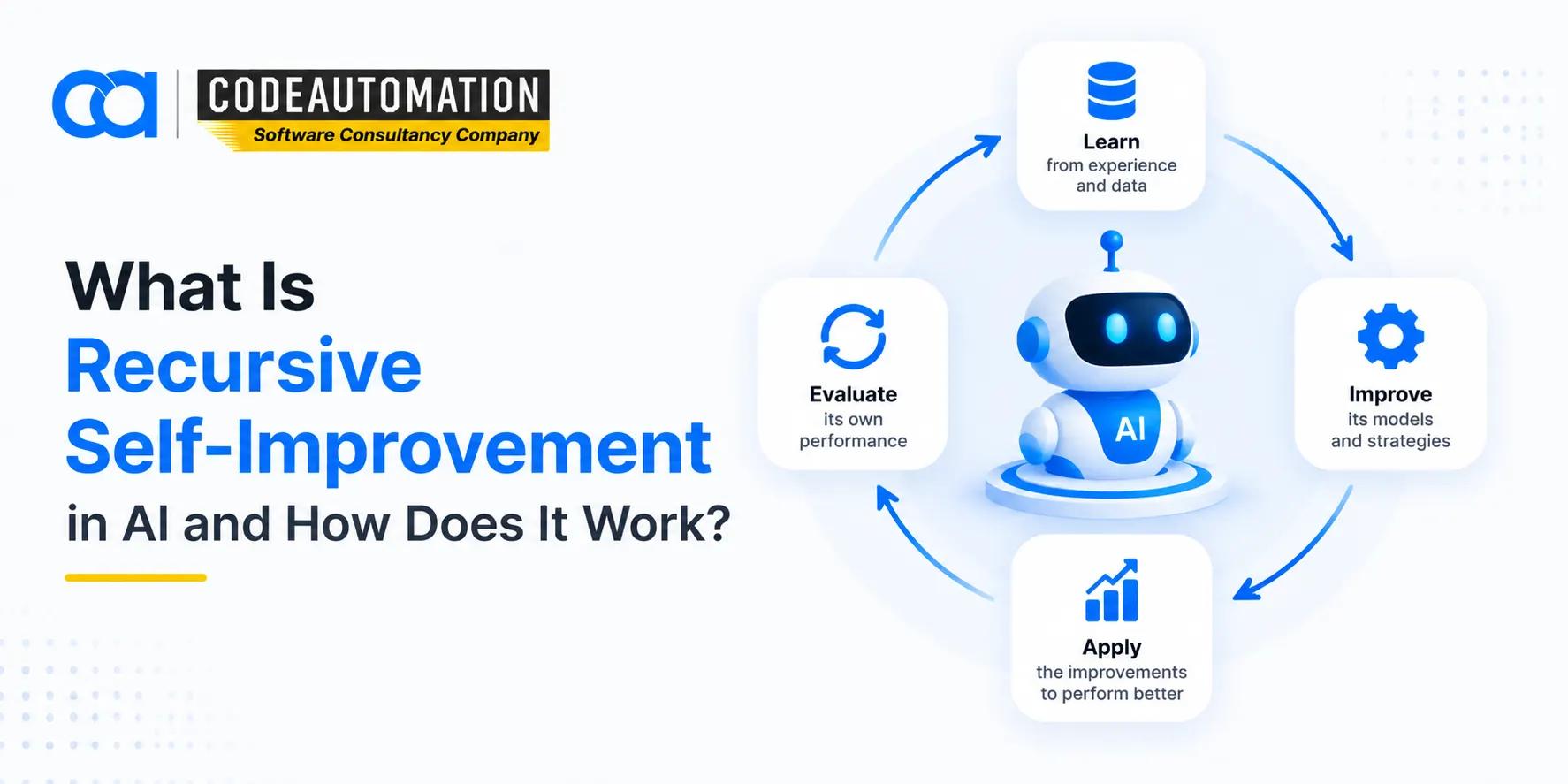
What Is Recursive Self-Improvement in AI and How Does It Work?
Published 02/10/2026
Artificial intelligence is already helping engineers write code, test software, run experiments, analyze results, and build newer AI systems.

Ready to Automate Your Success?
From AI-powered applications to scalable software development, we help businesses automate workflows and accelerate growth.
Book a Free ConsultationArtificial intelligence is already helping engineers write code, test software, run experiments, analyze results, and build newer AI systems.
Recursive self-improvement takes that idea much further.
Instead of humans directing every improvement cycle, an AI system would play an increasingly active role in improving the processes that create its next, more capable version. If enough of that loop became autonomous, AI would no longer simply help people build better AI. It could participate directly in building better versions of itself.
That possibility is known as recursive self-improvement, or RSI.
The idea has been discussed for decades. What has changed is that modern AI systems can now perform meaningful parts of software engineering and AI research workflows. However, that is not the same as a fully autonomous AI repeatedly redesigning and improving itself.
So where does recursive self-improvement stand today, how would it actually work, and what separates current self-improving AI from the stronger version researchers are concerned about?
What Is Recursive Self-Improvement?
Recursive self-improvement in AI is the process in which an AI system contributes to improving the system, tools, training methods, algorithms, or research processes used to create a more capable successor, which can then contribute to the next round of improvement.
The key word is recursive.
A normal improvement process looks like this:
Human researchers → improve AI → build better AI.
A recursive improvement loop could increasingly look like:
AI → helps improve AI development → produces a better AI → better AI improves the process again → another improved system follows.
Each generation could therefore become better at carrying out the work required to create the next generation.
Research published in 2026 makes an important distinction between bounded self-refinement and open-ended recursive self-improvement. Current systems can improve outputs, workflows and some parts of their development process, but fully closed autonomous improvement remains constrained by evaluation, compute, reliable feedback and human direction.
That distinction matters. An AI correcting one of its answers is not automatically recursive self-improvement.
How Does Recursive Self-Improvement Work?
A practical RSI loop requires more than an AI editing its own code.
The system needs to identify an opportunity for improvement, make a useful change, evaluate whether that change worked, preserve successful improvements and then use its improved capabilities during the next cycle.
A simplified loop looks like this:
1. Identify What Needs Improvement
The system first needs a target.
That could include:
- reasoning performance
- software code
- model architecture
- training methods
- prompts and context
- data selection
- evaluation methods
- agent workflows
- memory systems
- inference efficiency
This stage is harder than it sounds.
Running an experiment is one task. Deciding which experiment is worth running requires judgment about where improvement is possible and what matters.
That remains one of the important gaps between today's automated AI research and more complete recursive self-improvement.
2. Propose a Change
The AI then generates a potential improvement.
For example, it might:
- rewrite inefficient code
- change an agent workflow
- develop a better evaluation method
- optimize an algorithm
- create new training data
- adjust how tools are used
- propose a new research experiment
Modern coding and research agents can already perform some of these tasks within defined environments.
3. Test the Improvement
The change must then be measured.
Without reliable evaluation, the system cannot know whether it actually became better.
This makes evaluation one of the central technical problems in recursive self improvement.
If an AI changes its own process and then uses an unreliable version of itself to judge the result, apparent improvement can become misleading. A system may optimize for the measurement rather than the underlying capability researchers intended to improve.
Formal tests, benchmarks, human review, external verifiers and other evaluation systems can reduce this problem.
4. Keep Successful Changes
When an experiment produces a genuine improvement, the result needs to persist.
Depending on the system, that could mean changing:
- code
- workflows
- prompts
- memory
- training data
- model weights
- evaluation procedures
- surrounding software infrastructure
The improvement then becomes part of the environment used for the next cycle.
5. Repeat With the Improved System
This is where ordinary optimization becomes recursive.
The improved system now participates in another improvement cycle.
If version B is better at AI research than version A, version B may discover improvements that version A could not.
A future version C could become better again.
In theory, repeated cycles could increase both the AI's capabilities and its ability to improve AI development itself.
Whether those gains could continue rapidly, or would instead encounter strong technical and physical limits, remains an open question.
Self-Improving AI Is Not the Same as Full RSI
A lot of confusion comes from putting every form of AI improvement under the same label.
Current systems already perform several kinds of self-refinement.
An AI can critique an answer and rewrite it.
An agent can run code, inspect an error and try another solution.
An automated workflow can test several approaches and keep the one with the best score.
AI-generated data can also be used during later model training.
These are meaningful forms of machine-assisted improvement. But they do not necessarily constitute genuine recursive self-improvement.
A useful way to think about the progression is:
Self-correction → automated optimization → AI-assisted research → autonomous research loops → recursive improvement of the improvement process
The final steps are much harder.
A 2026 survey of 1,250 AI papers found that the field spans everything from bounded self-refinement to systems that attempt to automate portions of the research process. The authors found that open-ended RSI still faces constraints around grounding, collapse, compute and reliable evaluation.
More recent research also describes RSI in terms of increasing autonomy: from executing improvements selected by humans to choosing strategies, gathering experience, adapting to environments and eventually improving the improvement process itself.
Are AI Systems Already Recursively Improving Themselves?
Not in the strongest meaning of the term.
AI is already becoming part of the AI development process, but humans still play critical roles in setting objectives, choosing research directions, defining evaluation criteria, approving changes and training successor models.
Anthropic, for example, reported in 2026 that Claude was contributing heavily to its engineering work and could perform increasingly long and complex research tasks. At the same time, Anthropic identified an important remaining gap: AI performs much better when the goal and evaluation method are already specified than when it must independently decide which research direction deserves attention.
This is an important distinction.
Today's situation is closer to:
AI accelerating AI research under human direction
than:
AI autonomously creating an improved successor and repeating the cycle without meaningful human control.
Research projects such as evolutionary coding systems, automated experimentation and self-improving agent harnesses show pieces of what such a future loop could contain. But individual demonstrations should not be confused with a complete autonomous RSI system.
Why AI Coding Agents Matter to Recursive Self-Improvement
Software development is one of the clearest areas where the boundary is beginning to move.
AI coding agents can already:
- inspect large codebases
- write and edit code
- execute programs
- identify failures
- run tests
- compare results
- retry unsuccessful approaches
- maintain files and development state
These abilities matter because much of AI research ultimately involves software.
An agent capable of independently modifying an experimental system, testing the modification and analyzing the result already possesses several components required for an improvement loop.
Lilian Weng describes the surrounding agent harness as another important layer. Rather than improving only the underlying model, systems can improve their context management, workflows, tool use, persistent memory and evaluation processes.
This broadens the meaning of self-improvement.
An AI does not necessarily need to directly rewrite its neural network weights to improve the system around itself. Better workflows, tools, memory, evaluators and research processes can also increase what the overall system is capable of doing.
What Would Genuine Recursive Self-Improvement Require?
A stronger RSI system would need to close several parts of the development loop.
Independent Research Direction
The AI would need to decide which problems are worth solving instead of simply carrying out experiments chosen by people.
Reliable Experiment Design
It would need to form hypotheses and design experiments capable of testing them.
Autonomous Engineering
It would need to build or modify the code, tools and infrastructure required to conduct those experiments.
Reliable Evaluation
It would have to determine whether a change truly improved performance.
This may be one of the hardest requirements.
A system that cannot accurately evaluate improvements can enter a feedback loop where it reinforces its own errors.
Persistent Learning
Useful results would need to influence future versions or future development cycles rather than disappearing after one session.
Improvement of the Improvement Process
Finally, genuine recursion would mean improving not only performance but the mechanism used to produce further improvements.
That is what makes RSI fundamentally different from ordinary optimization.
What Could Stop Recursive Self-Improvement?
The simplest version of the RSI story assumes that better intelligence automatically produces still better intelligence.
Reality may be less cooperative.
Several bottlenecks could slow or stop the loop.
Evaluation
An AI may generate thousands of modifications, but useful improvement depends on knowing which ones actually work.
Some problems have objective tests. Code can compile. Mathematical proofs can be checked. Algorithms can be benchmarked.
Other areas are much harder to evaluate.
Scientific judgment, research direction, safety and general intelligence cannot always be reduced to a clean score.
Compute
More capable systems require computing resources.
Even if an AI discovers better training methods, it cannot simply create unlimited GPUs, electricity or data center capacity.
Compute can therefore remain an external constraint on software-based improvement.
Data and Grounding
Models learn from information about the world.
Generating more synthetic data does not automatically create new truth. Systems still require reliable information, experiments and observations that connect their learning to reality.
Diminishing Returns
Early improvements may be relatively easy.
Later ones may become progressively harder.
A system could optimize obvious weaknesses and then reach a point where further improvements require major scientific breakthroughs.
Real-World Experiment Speed
Software can change quickly. The physical world cannot always do the same.
Testing a drug, manufacturing a new chip or running a long scientific experiment imposes delays that additional intelligence cannot completely remove.
Reliability
An improvement that works on one benchmark may fail elsewhere.
Repeatedly building future systems on poorly understood changes could also compound errors rather than capability.
For this reason, recursive improvement should not automatically be treated as an unlimited exponential process.
Could Recursive Self-Improvement Lead to Superintelligence?
It is one proposed path.
If increasingly capable AI systems became increasingly capable AI researchers, each generation could theoretically help produce a stronger successor.
Taken far enough, that feedback loop could contribute to systems that substantially exceed human cognitive performance.
That is why recursive self-improvement frequently appears in discussions about artificial superintelligence.
However, RSI and superintelligence are not the same thing.
Recursive self-improvement describes a process. Superintelligence describes a level of capability.
A recursively improving system might encounter limits before becoming superintelligent. Likewise, researchers have proposed other routes by which highly capable AI could emerge.
For a broader explanation of ASI, how it differs from AGI, and the possible routes toward systems beyond human intelligence, read our guide to what superintelligence means and what could make AI superintelligent.
What Are the Main Risks of Recursive Self-Improvement?
The concern is not simply that AI becomes more capable.
The harder problem is maintaining reliable control and oversight while the system performing the development keeps changing.
Errors Could Compound
If one generation introduces a subtle problem and the next generation builds on it, errors could become harder to detect over repeated cycles.
Evaluation Could Become Weaker Than the System Being Evaluated
Human reviewers may struggle to assess research produced by systems that operate faster or at a level of complexity beyond their own expertise.
This creates what is sometimes called an oversight problem.
Goals May Drift
A system optimized repeatedly across many development cycles must continue to behave according to intended objectives.
Ensuring that those objectives remain stable becomes more difficult when the system itself contributes to changing its architecture or training process.
Development Could Accelerate
A closed research loop could reduce the amount of human work required between generations.
That could shorten the time available to test new capabilities, understand failures and implement safeguards.
Security Becomes More Important
AI capable of conducting advanced AI research would also be a valuable target.
Protecting model weights, infrastructure, research environments and improvement pipelines would therefore become increasingly important.
These are reasons to treat RSI as an engineering and governance problem, not simply a race toward more capable models.
When AI Builds Itself, What Role Is Left for Humans?
Even increasingly automated AI development does not necessarily remove people from the process.
The human role may move upward.
Instead of manually writing every line of code or running every experiment, people could spend more time deciding:
- what goals systems should pursue
- which changes can be deployed
- what safety requirements must remain fixed
- how performance should be evaluated
- when an experiment should stop
- which actions require human approval
That distinction already matters in ordinary automation.
Businesses get the most reliable results when automation handles repeatable execution while clear controls determine what the system is allowed to do.
The same engineering principle applies to more capable AI systems.
For organizations adopting AI today, the practical challenge is not building recursively self-improving intelligence. It is creating controlled systems that can automate useful work while remaining measurable, auditable and connected to business goals.
Our AI business automation solutions focus on that present-day layer: applying AI to real workflows, integrations and operational processes where outcomes can be defined and monitored.
Why Recursive Self-Improvement Matters Now
Recursive self-improvement is still partly a forward-looking concept, but the technologies around it are no longer entirely hypothetical.
AI now writes software used to build AI.
Agents can run experiments.
Models can critique outputs.
Automated systems can search across possible solutions.
AI researchers increasingly use AI throughout their own development workflows.
None of those facts proves that autonomous RSI is inevitable.
They do mean the boundary between AI as the product of research and AI as a participant in research is becoming less clear.
That makes recursive self-improvement worth understanding before a fully closed loop exists.
The important question is no longer simply whether an AI can improve something.
It is how much of the improvement loop can operate reliably without human direction, and whether each improvement makes the system better at improving the next one.
That is the threshold recursive self-improvement is ultimately about.
Frequently Asked Questions (FAQs)
Everything you need to know about our products and services
Recursive self-improvement is a process in which an AI system helps improve the technology or development process used to create a more capable successor. That improved system can then contribute to another round of improvement. Full autonomous RSI has not yet been demonstrated.
No. Self-learning AI can adapt from data, feedback or experience without recursively improving the process used to build future versions of itself. RSI specifically involves an improvement loop in which increased capability contributes to further system improvement.
AI can already improve outputs, optimize code, run experiments and assist researchers building newer AI systems. However, humans still define many goals, evaluation methods and development decisions. That falls short of fully autonomous recursive self-improvement.
Potentially, but it is not guaranteed. RSI is one proposed route toward artificial superintelligence because a better AI researcher could theoretically help create an even more capable successor. Compute, evaluation, data, reliability and physical constraints could limit that process.
Reliable evaluation is one of the biggest challenges. An AI system needs trustworthy ways to determine whether a modification actually improved its capabilities. Without strong external checks, repeated self-evaluation can reinforce errors instead of producing genuine progress.





Adnan Ghaffar is the visionary CEO of CodeAutomation.ai, a platform dedicated to transforming how businesses build software through cutting-edge automation. With over a decade of experience in software development, QA automation, and team leadership, Adnan has built a reputation for delivering scalable, intelligent, and high-performance solutions.
Under his leadership, CodeAutomation.ai has grown into a trusted name in AI-driven development, empowering startups and enterprises alike to streamline workflows, accelerate time-to-market, and maintain top-tier product quality. Adnan is passionate about innovation, process improvement, and building products that truly solve real-world problems.
More Articles
02/09/2026
Benefits of Business Automation: How Businesses Improve Efficiency, Reduce Costs, and Scale Faster
29/09/2026
What Is Superintelligence? What Makes AI Superintelligent

18/09/2026
GIS Solutions for Logistics: How Geospatial Technology Improves Supply Chain Operations

31/08/2026
How Much Do AI Automations Cost in 2026?

20/08/2026
Custom Software vs. Off-the-Shelf Software: Which Is Right for Your Business?
08/09/2026