



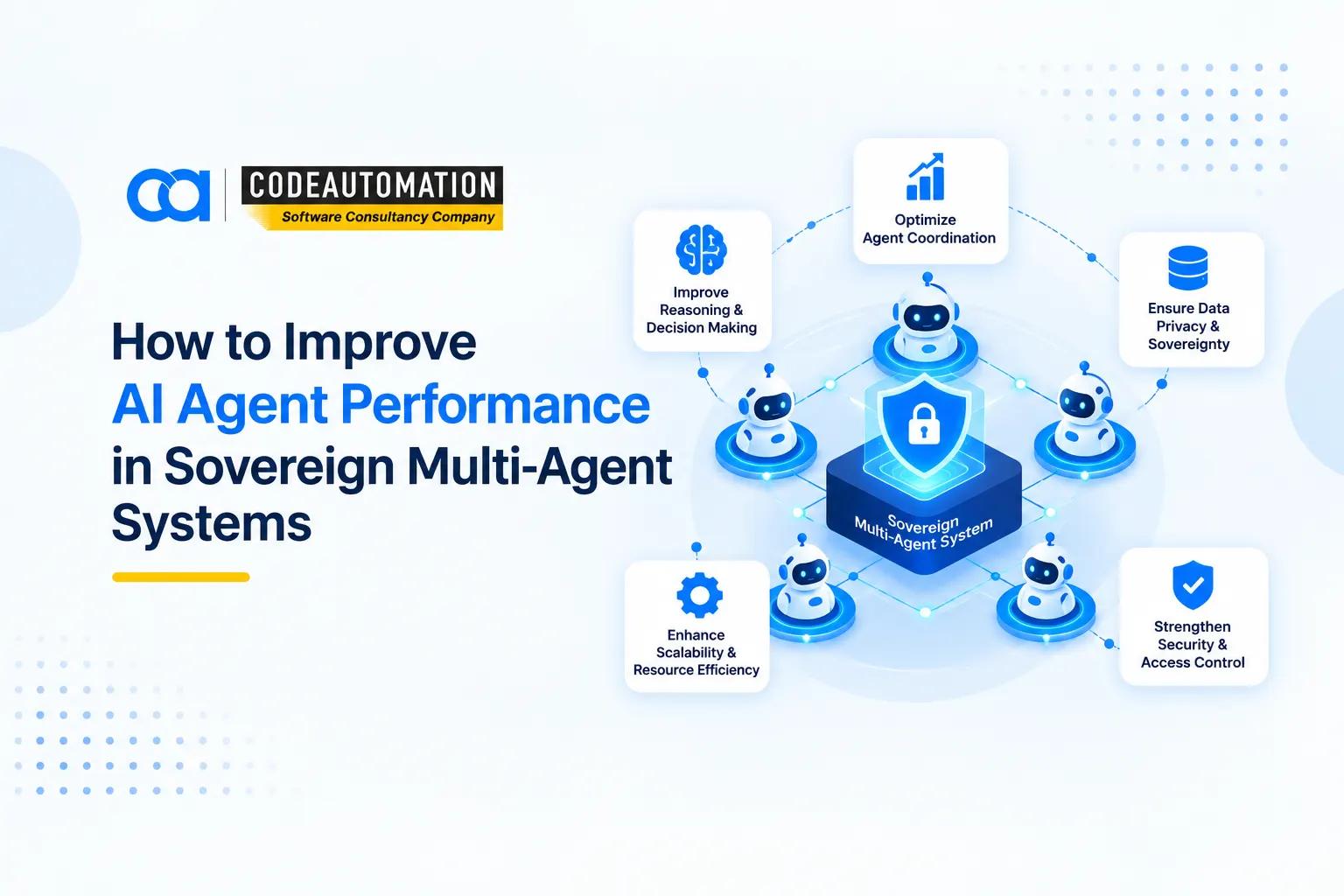
How to Improve AI Agent Performance in Sovereign Multi-Agent Systems
How to Improve AI Agent Performance in Sovereign Multi-Agent Systems
Published 04/11/2026
Improve AI agent performance in sovereign multi-agent systems by defining permitted data flows, benchmarking the complete workflow, and removing unnecessary coordination. Test changes to model routing, context size, and concurrency against the same evaluation set, accepting them only when quality and sovereignty controls meet your requirements.
Improve AI agent performance in sovereign multi-agent systems by defining permitted data flows, benchmarking the complete workflow, and removing unnecessary coordination. Test changes to model routing, context size, and concurrency against the same evaluation set, accepting them only when quality and sovereignty controls meet your requirements.
For enterprise teams, performance means more than speed. A workflow must deliver a useful result at an acceptable cost while keeping data, tools, and automated actions within approved boundaries.
What Is a Sovereign Multi-Agent System?
In this guide, a sovereign multi-agent system means specialized AI agents working under explicit controls over data processing, deployment, model access, and operations. Sovereignty requirements vary by organization and jurisdiction; the term alone does not establish compliance.
Map where prompts, retrieved documents, embeddings, outputs, logs, and backups are stored and processed. Identify who administers each component and which external services may receive information. Private hosting alone does not answer all these questions.
For an invoice-review workflow, define which agents can read supplier records, which models may process invoice data, and where audit records remain. Apply those boundaries before optimizing latency or cost.
Why Multi-Agent Performance Often Falls Short
Every added agent introduces model calls, handoffs, and possible failures. Diagnose the bottleneck before changing the architecture.
If responses are slow, inspect tool wait times and the longest dependency chain. If token usage is high, examine repeated histories and oversized handoffs. If agents repeat actions, inspect retry loops and ownership of shared state.
Sovereignty constraints can limit model choices or external processing. Optimize within those constraints rather than silently bypassing them to improve a benchmark.
1. Give Every AI Agent a Clear Responsibility
Start with a single agent and add specialized agents only when testing demonstrates a benefit or distinct access boundaries require separation.
Choose sequential orchestration when each stage needs the previous result, parallel execution for independent reads, and an orchestrator-worker pattern when task allocation changes with the request. Microsoft's AI agent orchestration patterns explain these choices and their tradeoffs.
In invoice review, retrieval must precede validation, while independent checks of supplier status and purchase-order records may run together. Give each agent an objective, permitted tools, expected output, and stopping condition. Keep payment approval outside the review agent's permissions.
2. Improve Communication Between Agents
Pass task-specific evidence instead of complete interaction histories. An invoice handoff might contain invoice_id, supplier_id, extracted_total, currency, source_reference, and validation_status. Preserve relevant qualifications and source locations so downstream agents can verify the result.
Validate required fields and data types in application code. Reject malformed messages and return a defined error when essential information is missing.
A compact message can still contain sensitive data. Enforce the receiving agent's authorization before sending it. Set handoff deadlines and bounded retries so an unresponsive agent cannot stall the workflow indefinitely.

Ready to Automate Your Success?
From AI-powered applications to scalable software development, we help businesses automate workflows and accelerate growth.
Book a Free Consultation3. Manage Memory Without Overloading Context
Separate current task state from reusable knowledge. Retrieve only the records the requesting identity is permitted to access, and keep source references attached to retrieved evidence.
For invoice review, provide the relevant purchase order, supplier record, and policy version. Avoid loading unrelated customer or employee histories.
Cache reusable results only where permissions and freshness allow. Scope cache access by tenant and authorization context, invalidate entries when source records or permissions change, and apply retention limits. Test whether summarization drops exceptions that affect the final decision.
4. Choose Models According to Task Complexity
Evaluate models on representative tasks before assigning them to agents. A smaller approved model may handle extraction, while ambiguous exceptions may require a more capable model or human review.
Define routing rules using observed task difficulty and evaluation results. Keep every fallback destination on the approved list; an outage must not trigger an unauthorized external model call.
Compare quality, latency, hosting requirements, and cost per successful task. Include idle infrastructure costs where relevant. A cheaper model that causes more retries or manual corrections may increase the total workflow cost.
5. Use Parallel Processing Carefully
Run independent checks together, then combine their outputs at a defined synchronization point. Keep dependent steps sequential.
Increase concurrency gradually under representative load. Watch queue time, latency percentiles, rate-limit errors, and compute utilization. Stop increasing it when contention or failures outweigh the benefit.
Give shared records a clear owner or use appropriate concurrency controls. Require idempotency for repeatable write operations so retries do not duplicate business actions. Anthropic's multi-agent research system illustrates why parallel architectures also need explicit delegation and resource budgets.
6. Maintain Security and Data Sovereignty
Use separate agent identities, least-privilege tool access, encrypted communication, and controlled outbound traffic. Enforce access in tools and infrastructure rather than relying on prompt instructions alone.
Treat retrieved documents and tool responses as untrusted data. An instruction embedded in an invoice must not change agent permissions or authorize an action. Test attempts to redirect tools, reveal restricted records, or send data to an unapproved destination.
Collect enough telemetry to diagnose failures while minimizing sensitive payloads. Apply access restrictions, redaction, retention rules, and approved storage locations to traces and backups. Make human approval mandatory for actions your policy identifies as sensitive.
7. Measure Performance Across the Entire Workflow
Define success before measuring speed: for example, correctly reconcile an invoice or escalate a documented exception without accessing unauthorized records.
Track task success rate against a written rubric; p50 and p95 end-to-end latency; tokens, model calls, and cost per successful task; tool failures, retries, and handoff delays; and results of policy-enforcement tests. Count a correctly blocked unauthorized request separately from a failed legitimate task.
Use a shared trace identifier across agents and tools to locate delays. If most time is spent waiting for an API, investigate that dependency before changing prompts.
AWS's agent evaluation framework demonstrates how to connect business outcomes to evaluation metrics and release gates.
8. Test Real-World Failures, Not Just Successful Demonstrations
Test missing fields, conflicting totals, stale records, tool outages, timeouts, and malicious document instructions alongside ordinary successful tasks.
For invoice review, require escalation when the purchase order is missing, rejection of an unauthorized record request, and prevention of duplicate writes after a retry. Define a total deadline and maximum attempts based on the workflow's needs.
Use checkpoints where restarting would repeat expensive or consequential work. If an approved model or tool is unavailable, pause, fail clearly, or escalate according to policy. Resume only through an authorized path.
How Do You Know Optimization Is Working?
Use this illustrative invoice-review experiment; it describes a test method, not measured CodeAutomation results.
Baseline: run a fixed evaluation set with full-document handoffs. Record correct reconciliations, correct escalations, p95 latency, cost per successful task, and policy-test results.
Change: replace those handoffs with validated invoice fields and authorized source references. Keep model versions, task inputs, and test load consistent.
Retest: repeat runs to account for variable model behavior. Check whether omitted clauses or exceptions create new errors.
Release decision: accept the change only if it meets predefined quality and latency targets, stays within budget, and passes mandatory policy tests. Record failures and rollback criteria alongside the result.
Keep a worksheet with task ID, expected outcome, authorized resources, baseline, change, retest result, and release decision. This makes improvements reviewable and repeatable.
Put the Next Improvement Into Practice
Start with one workflow, map its permitted data flows, and identify the largest measured bottleneck. Make one change, rerun the evaluation, and keep the result only when it satisfies your acceptance criteria.
CodeAutomation.ai's custom AI agent development services can help you plan agent responsibilities and integrations around your workflow. For broader integration planning, explore its AI business automation solutions.
Frequently Asked Questions (FAQs)
Everything you need to know about our products and services
The defining feature is explicit control over the system's data processing, infrastructure, model access, and operations. Assess prompts, tools, memory, telemetry, backups, and administrative access against your requirements. Keeping the model on private infrastructure addresses only part of that assessment.
Track task success, p50 and p95 latency, cost per successful task, token consumption, tool failures, retries, and handoff delays. Evaluate policy enforcement separately. Define what counts as a correct result or escalation so a faster but incomplete answer cannot appear successful.
A single agent can be more efficient when tasks share most of their context, have tightly ordered dependencies, or require little specialization. Multiple agents add coordination costs. Compare both designs on the same tasks, quality rubric, and resource budget before choosing.
It can if the organization's requirements permit that provider, processing location, data handling, and access arrangement. Verify the complete data path, including logging and subprocessors. Where external processing is prohibited, enforce that restriction for normal routing and fallback behavior.
First locate the delay with traces. Then test smaller authorized payloads, permission-aware caching, approved model routing, and parallel independent reads. Keep authorization checks in place, test under realistic load, and reject optimizations that introduce data exposure or unacceptable quality loss.





Adnan Ghaffar is the visionary CEO of CodeAutomation.ai, a platform dedicated to transforming how businesses build software through cutting-edge automation. With over a decade of experience in software development, QA automation, and team leadership, Adnan has built a reputation for delivering scalable, intelligent, and high-performance solutions.
Under his leadership, CodeAutomation.ai has grown into a trusted name in AI-driven development, empowering startups and enterprises alike to streamline workflows, accelerate time-to-market, and maintain top-tier product quality. Adnan is passionate about innovation, process improvement, and building products that truly solve real-world problems.
More Articles
09/09/2026
What Is Geospatial Data Engineering? A Complete Guide for Businesses

11/09/2026
Remote Sensing AI How Artificial Intelligence Is Transforming Earth Observation
17/09/2026
GeoAI for Real Estate: How Artificial Intelligence Is Transforming Property Decisions
26/10/2026
ArcGIS Development Services: Building Custom GIS Applications and Solutions
16/09/2026
Mapbox Development Services: Building Custom Mapping and Location Solutions
04/09/2026


