


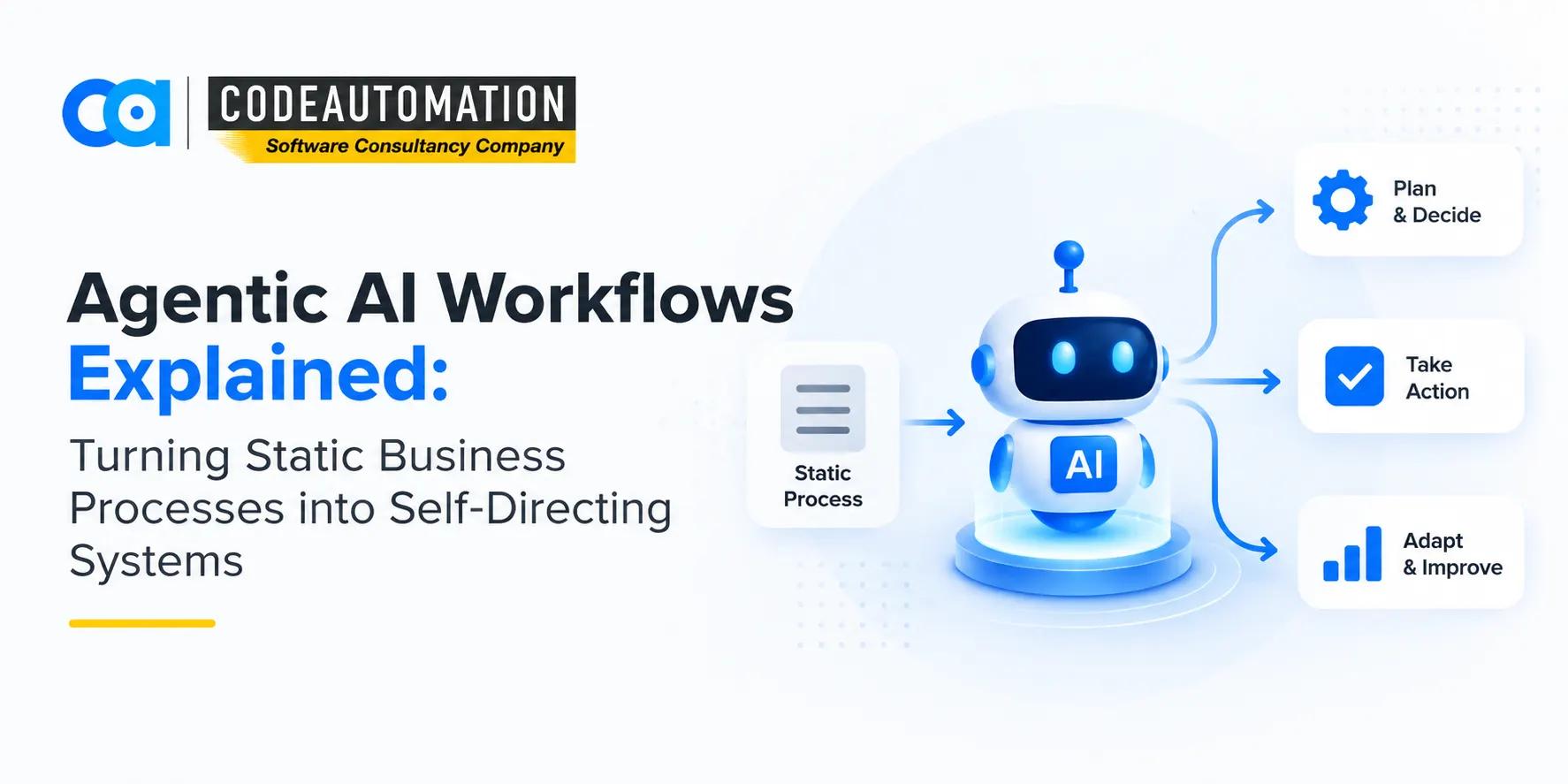
Agentic AI Workflows Explained: Turning Static Business Processes into Self-Directing Systems
Published 18/10/2026
Traditional automation follows rules. Agentic AI workflows think beyond them. Discover how AI agents handle complex tasks, adapt to unexpected changes, and turn rigid business processes into intelligent, self-directing systems.

Ready to Automate Your Success?
From AI-powered applications to scalable software development, we help businesses automate workflows and accelerate growth.
Book a Free ConsultationEvery automation team knows the pattern. A Zapier Zap, n8n flow, or RPA bot works perfectly for months, then a vendor changes an invoice layout or a customer writes an email nobody anticipated, and the flow silently fails. Static automation encodes steps. Agentic AI workflows encode goals, constraints, and tools, and let large language models (LLMs) work out the steps at runtime.
That shift is moving fast. Gartner forecasts that 40% of enterprise applications will integrate task-specific AI agents by the end of 2026, up from under 5% in 2025. Most of those agents will not live in standalone chat interfaces. They will sit inside business processes. This guide covers how a single run actually executes, how much autonomy to grant, and which processes are worth converting first.
What Is an Agentic Workflow?
In simple terms, it is a business process defined by an outcome rather than a script. You specify the goal ("onboard this vendor"), the constraints (approval limits, compliance rules), and the tools (APIs, databases, SaaS platforms). An AI agent then plans, acts, checks its work, and escalates when it hits the edge of its permissions.
The practical difference: a traditional flow breaks on the first unexpected input, while agentic AI workflows treat unexpected input as something to reason about. That is why AI agentic workflows outperform rule-based process automation on unstructured, exception-heavy work.
Anatomy of an Agentic AI Workflow Run
Every production run moves through six stages. Designing each one explicitly is what separates a dependable workflow AI agent from a demo.
Trigger and intake. An event (a webhook, an inbound email, or a new CRM record) starts the run. The agent normalizes the payload and pulls context from knowledge bases through retrieval-augmented generation (RAG).
Plan. The model performs task decomposition, turning the goal into an ordered list of agentic tasks with success criteria for each.
Act. The agent executes through function calling or the Model Context Protocol (MCP), querying an ERP, updating records, or calling internal APIs.
Verify. Outputs are validated against schemas, business rules, and source data. Failed checks trigger self-correction or retries before anything moves forward.
Commit. Writes to systems of record happen through idempotent operations, with human-in-the-loop approval for anything irreversible.
Learn. Outcomes, human corrections, and edge cases feed back into evaluation datasets and agent workflow memory, so the next run starts smarter.
Most failed pilots skip stage four or six. Agentic AI workflows without verification ship confident errors; without a learning loop, they never improve past launch quality.
The Autonomy Ladder: How Much Control to Hand Over
Autonomy is not binary. Mature agentic AI workflows climb a ladder, earning each level through measured performance.
Level
What the agent does
Human role
L1: Assist
Classifies or extracts within a fixed flow
Owns every decision
L2: Propose
Drafts the full action plan
Approves before execution
L3: Act with guardrails
Executes within limits, escalates exceptions
Reviews exceptions and audit logs
L4: Autonomous
Runs end to end
Audits samples after the fact
Most enterprise processes should launch at L2 and graduate to L3 once task success rate, escalation accuracy, and rollback rate hold steady for several weeks. Very few should reach L4.
Which Processes Should Become Agentic First?
Not every process benefits from reasoning. Score candidates on five factors:
- Input variability: do formats, languages, or document types change often?
- Decision density: how many judgment calls per run?
- Reversibility: can a wrong action be rolled back cheaply?
- Volume: is there enough throughput to justify evaluation and observability work?
- Data access: are the needed systems reachable through APIs or MCP servers?
High variability, high decision density, and easy reversibility point to strong candidates. Proven agentic workflows examples that score well include insurance first-notice-of-loss intake, vendor onboarding and KYC checks, IT access requests, healthcare prior authorization packets, and e-commerce returns adjudication. Agentic document workflows sit at the center of most of these.
Retrofit, Don't Rip and Replace
Enterprises already run thousands of deterministic flows. The fastest path to ROI is inserting agents at the decision points those flows can't handle, and leaving the stable plumbing alone. A common architecture keeps the RPA bot or iPaaS flow for data movement and hands exceptions to an agent, which reasons over the case and returns a structured decision.
Teams with a large bot estate often start with RPA services that pair existing bots with LLM-based decision agents, then extend the same pattern across CRM and ERP processes with AI process automation that layers reasoning agents onto existing back-office workflows. This approach to agentic AI process automation protects existing investments while adding judgment where rules ran out.
Long-Running Runs Need Durable State
Real business processes wait. A vendor takes two days to send a tax form; a manager approves a request on Monday. Agentic AI workflows that span hours or days need durable execution: checkpointed state, event-sourced history, and the ability to resume exactly where they paused after a timeout or deployment.
This is where agent workflow memory has three distinct jobs: run state (where this case stands), episodic memory (what happened in similar past cases), and semantic knowledge (policies and reference data via RAG). Keeping them separate keeps context windows lean and makes state management debuggable. For processes like this, AI agent development for long-running, approval-gated business processes is a different engineering problem from building a chat assistant.
How to Build Agentic AI Workflows: A Phased Rollout
Shadow mode. The agent runs on live inputs but writes nothing. Compare its decisions with human outcomes to build a baseline.
Assisted (L2). Promote to proposals with one-click approval. Track approval rate and edit distance on each proposal.
Supervised autonomy (L3). Grant write permissions with least-privilege access control, spend limits, and automatic escalation on low-confidence cases.
Scale. Extend the proven setup into agentic AI workflows for adjacent processes, reusing the same tool layer, guardrails, and observability stack.
At every phase, gate promotion on numbers, not demos: task success rate, cost per run, cycle time, and how often humans override the agent.
The Takeaway
Agentic AI workflows reward process thinking more than model selection. Define the outcome, instrument every stage of the run, start on the low rungs of the autonomy ladder, and let production data decide when agents earn more control. Teams that treat agentic AI workflows this way turn operational efficiency gains into a compounding advantage.
Frequently Asked Questions (FAQs)
Everything you need to know about our products and services
They are business processes where AI agents pursue a defined goal by planning steps, calling tools, and verifying results instead of following a fixed script. Because agentic workflows adapt at runtime, they handle unstructured inputs and exceptions that break rule-based automation.
It is the use of LLM-powered agents to run multi-step processes across CRMs, ERPs, and other enterprise systems. AI agents for workflow automation decide the next action from context, operate within permissions and guardrails, and escalate to people when confidence is low.
Zapier and n8n flows execute predefined triggers and actions. Agentic AI workflows choose their own path toward a goal and recover from errors. In practice, the two are complementary: iPaaS tools move data reliably, while agents handle the judgment calls inside the flow.
Start at the "propose" level, where the agent drafts actions and a human approves. Expand to guarded autonomy only after metrics like task success rate and rollback rate stay stable over several weeks of production traffic.
A scoped pilot on a single process typically takes several weeks, including shadow-mode testing. Timelines depend mostly on API access to the underlying systems, data quality, and how quickly the evaluation baseline stabilizes, not on the model itself.





Adnan Ghaffar is the visionary CEO of CodeAutomation.ai, a platform dedicated to transforming how businesses build software through cutting-edge automation. With over a decade of experience in software development, QA automation, and team leadership, Adnan has built a reputation for delivering scalable, intelligent, and high-performance solutions.
Under his leadership, CodeAutomation.ai has grown into a trusted name in AI-driven development, empowering startups and enterprises alike to streamline workflows, accelerate time-to-market, and maintain top-tier product quality. Adnan is passionate about innovation, process improvement, and building products that truly solve real-world problems.
More Articles
09/09/2026
What Is Geospatial Data Engineering? A Complete Guide for Businesses

03/ 23/ 2026
CMS development services: How to manage content efficiently
10 April 2025
Why QA Testers Are Essential in Software Development – Especially in the Age of AI ?
7 Benefits of Using Agentic AI in Your Business in 2026

03/ 10/ 2026
AI Automation Services That Help Businesses Grow and Scale
06/ 03/ 2026


