


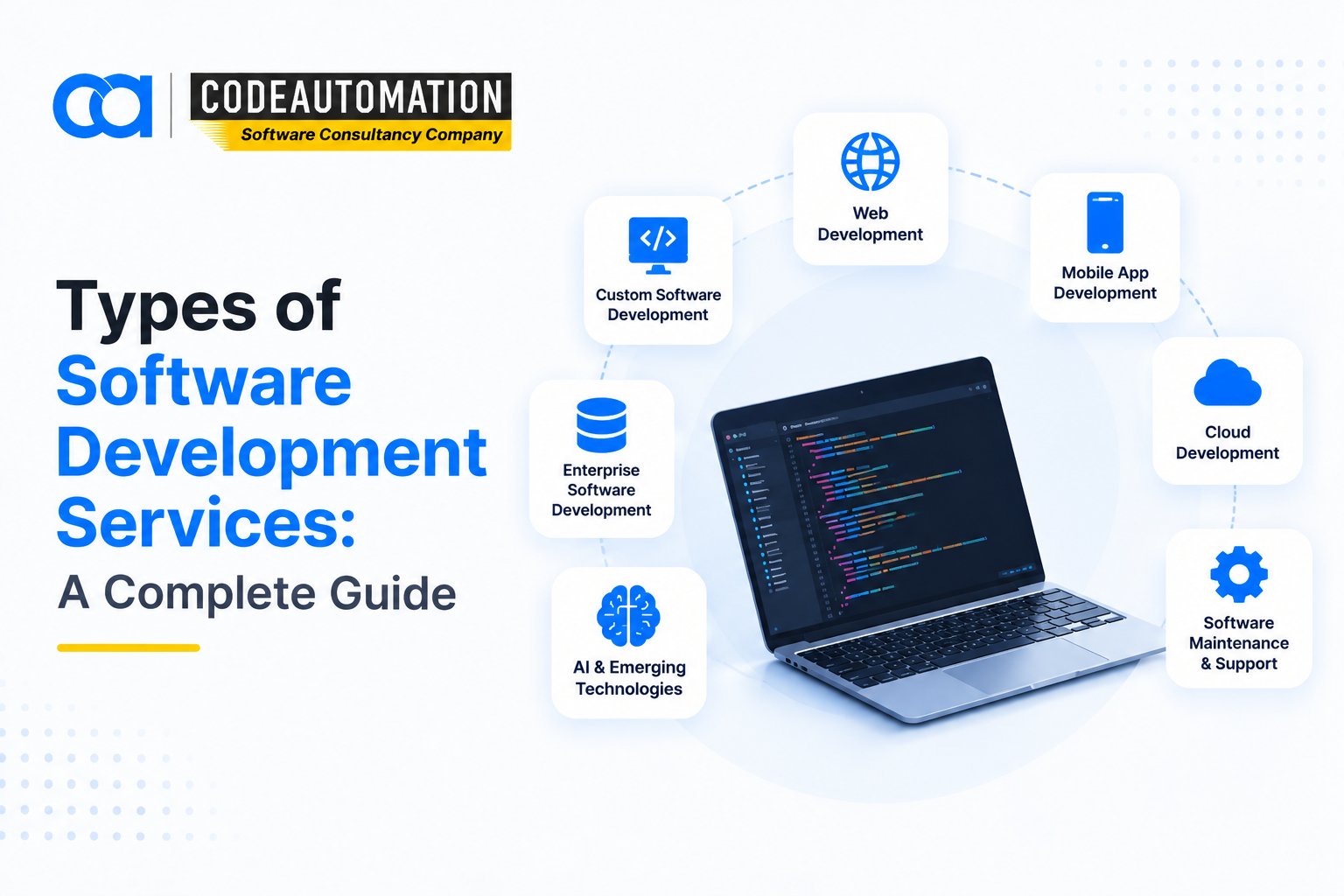
Types of Software Development Services: A Complete Guide
Types of Software Development Services: A Complete Guide
Published 23/10/2026
In today's digital economy, software powers everything from startup MVPs to Fortune 500 enterprise platforms. But not every software project is the same, and neither are the services built to deliver them. Whether you're a founder launching a new product or an enterprise CTO planning a digital transformation, understanding the different types of software development services is the first step to making the right investment.
In today's digital economy, software powers everything from startup MVPs to Fortune 500 enterprise platforms. But not every software project is the same, and neither are the services built to deliver them. Whether you're a founder launching a new product or an enterprise CTO planning a digital transformation, understanding the different types of software development services is the first step to making the right investment.
This guide breaks down every major category, what each one covers, and how to choose the right one for your goals.
What Are Software Development Services?
Software development services refer to the full spectrum of professional activities involved in designing, building, testing, deploying, and maintaining software solutions. These services are offered by development companies, digital agencies, and specialized technology partners who bring engineering expertise, project management discipline, and domain knowledge to transform business requirements into functional, scalable software.
The category spans everything from building a brand-new product from scratch to modernizing a legacy codebase, integrating third-party platforms, or setting up cloud infrastructure. Understanding the distinctions between each service type is what allows businesses to make the right investment and choose the right partner to execute it.
Custom Software Development
Custom software development is the process of engineering a solution designed specifically around your organization's unique processes, workflows, and competitive requirements rather than adapting your operations to fit an off-the-shelf product.
Unlike generic tools built to serve the broadest possible audience, custom software is architected to fit your business exactly. No unnecessary features, no workarounds for missing capabilities, and no licensing constraints that limit how you scale. Businesses choose custom development when their needs have outgrown what standard software can deliver or when proprietary logic represents a genuine competitive moat.
Custom Application Development
It spans three primary disciplines, each serving different contexts and user needs.
Web Application Development
Web applications are software accessed through a browser—no installation required. From customer portals and eCommerce platforms to internal dashboards and content management systems, web apps deliver powerful functionality with universal accessibility. Modern web development leverages frameworks like React, Angular, and Vue.js on the frontend, paired with robust backends in Node.js, Python, or Java, hosted on scalable cloud infrastructure.
Mobile Application Development
With over 7 billion smartphone users worldwide, mobile applications have become a primary channel for customer engagement. Mobile app development covers native iOS and Android apps, as well as cross-platform solutions built with Flutter or React Native. A well-crafted mobile app extends your product into users' daily lives—enabling push notifications, offline functionality, location services, and hardware integrations that web apps simply cannot replicate.
Enterprise Application Development
Enterprise applications are large-scale, mission-critical software systems built for internal use across departments or thousands of employees. ERP systems, CRM platforms, HR management tools, and supply chain software all fall into this category. They demand rigorous security, role-based access control, audit logging, and the ability to handle massive concurrent workloads—requirements that sharply distinguish enterprise development from standard application work.

Ready to Automate Your Success?
From AI-powered applications to scalable software development, we help businesses automate workflows and accelerate growth.
Book a Free ConsultationSoftware Product Development
Software product development is the end-to-end process of taking a product idea from concept to a market-ready, commercially viable software product. This includes discovery and ideation, UX research, architecture design, iterative development, and go-to-market preparation.
Unlike building internal tools, product development requires a commercial lens: the software must delight end users, drive retention, and scale to serve a growing customer base. It's the model behind every successful SaaS platform, B2B tool, and consumer app on the market today.
SaaS Development
Software as a Service (SaaS) development is the specialized discipline of building cloud-hosted, subscription-based software products served to many customers from a single codebase. SaaS applications must be engineered for high availability, tenant data isolation, elastic scaling under load, and frictionless self-serve onboarding.
Beyond pure engineering, SaaS development involves billing integration, usage analytics, feature flagging, and the operational infrastructure that keeps a multi-tenant platform reliable at scale. Getting the architecture right from the beginning significantly reduces technical debt as the product grows and as your customer count climbs into the thousands.
Enterprise Software Development
Enterprise software development goes beyond building applications—it's about solving the systemic, structural challenges that large organizations face at scale. This includes workflow automation, compliance management, data governance, identity management, and cross-department system coordination.
Enterprise projects typically involve longer discovery phases, multiple stakeholder groups, and frequent integration with legacy systems. A competent enterprise development partner brings not just engineering depth but project governance capability, domain expertise, and the organizational fluency needed to navigate complex internal environments and competing priorities.
Software Integration Services
Modern businesses rarely operate on a single platform. CRM, ERP, marketing automation, payment gateways, and logistics APIs- each system holds critical data that becomes exponentially more valuable when connected. Software integration services bridge these systems through APIs, middleware, and custom connectors, enabling data to flow seamlessly across your entire technology stack.
Integration eliminates data silos, reduces manual reconciliation work, and creates a unified operational view of your business. Whether it's syncing Salesforce with HubSpot, connecting an internal ERP to a third-party logistics provider, or automating data handoffs between departments, integration services are the connective tissue of a modern technology ecosystem.
Software Modernization
Outdated software is one of the most underestimated risks in business. Legacy systems built on deprecated technologies accumulate technical debt, attract security vulnerabilities, and become progressively more expensive to maintain as finding engineers who know the old stack grows harder every year.
Software modernization—also called legacy migration or re-platforming—moves these aging systems onto modern architectures. This often means migrating from monoliths to microservices, from on-premises to cloud, or from deprecated frameworks to current runtimes. Executed well, modernization dramatically improves performance, maintainability, and the speed at which new features can be shipped without breaking existing functionality.
Software Testing and QA
Shipping software without rigorous testing is like sending a product to market without a quality inspection. Software testing and QA services encompass unit testing, integration testing, end-to-end testing, performance testing, security audits, and user acceptance testing (UAT).
Modern QA also includes test automation, building suites of automated tests that run on every code change, catching regressions before they ever reach production. A dedicated QA function isn't just about finding bugs; it's about building organizational confidence in every release and protecting the user experience that your business reputation depends on.
Software Maintenance and Support
Software is never truly done. Post-launch, applications require ongoing maintenance: bug fixes, dependency updates, security patches, performance optimization, and feature enhancements informed by real-world usage and evolving user expectations.
Software maintenance and support services keep your product reliable, secure, and competitive without requiring a fully staffed in-house engineering team. Many development partners offer retainer-based support models, providing a dedicated team on standby to handle issues quickly. This is particularly valuable for businesses that need enterprise-grade reliability but cannot justify the headcount to staff it internally.
Cloud Software Development
Cloud software development means building applications natively for cloud environments, leveraging managed services, serverless compute, container orchestration, and globally distributed infrastructure from providers like AWS, Azure, and Google Cloud.
Cloud-native development unlocks capabilities that were once prohibitively expensive on-premises: auto-scaling to handle traffic spikes, multi-region deployments for global latency, pay-per-use cost models, and managed databases that eliminate operational overhead. For any software expected to grow, cloud-native architecture is less a preference and more a prerequisite for long-term viability.
AI-Powered Software Development
AI is no longer a future capability. It's a present-day competitive differentiator. AI-powered software development integrates machine learning models, natural language processing, computer vision, and intelligent automation directly into software products and business workflows.
From AI agents that handle customer support queries autonomously to recommendation engines that personalize user experiences to predictive analytics informing strategic decisions, AI capabilities are reshaping what software can do. Working with a development partner that has genuine AI expertise means your product doesn't just automate tasks; it learns, adapts, and compounds value over time.
How to Choose the Right Software Development Service
With this range of options available, the right choice comes down to four factors specific to your situation.
Your business problem. Is this an internal efficiency challenge (integration, enterprise software) or a market opportunity (SaaS, product development)? The nature of the problem points clearly to the right service category.
Your existing technology stack. Greenfield projects have maximum flexibility. Organizations with existing systems need a partner experienced in integration and modernization to avoid disrupting what's already working.
Your growth trajectory. Expecting rapid user growth? Cloud-native and SaaS architectures are non-negotiable. Stability-focused businesses may prioritize maintenance and ongoing support over net-new development.
Your internal capabilities. Supplement what you lack. Strong product vision but no engineering? You need a full-stack development partner. Engineers in place but no QA? A dedicated testing service fills the gap efficiently.
The right development partner doesn't just execute on requirements—they help you ask the right questions before a single line of code is written. That's the difference between software that ships and software that scales.





Adnan Ghaffar is the visionary CEO of CodeAutomation.ai, a platform dedicated to transforming how businesses build software through cutting-edge automation. With over a decade of experience in software development, QA automation, and team leadership, Adnan has built a reputation for delivering scalable, intelligent, and high-performance solutions.
Under his leadership, CodeAutomation.ai has grown into a trusted name in AI-driven development, empowering startups and enterprises alike to streamline workflows, accelerate time-to-market, and maintain top-tier product quality. Adnan is passionate about innovation, process improvement, and building products that truly solve real-world problems.
More Articles
16 April 2025
Can You QA Test an API? Here’s Everything You Need to Know

25 March 2025
Outsourcing Software Development: Is It Good or Bad?

15 January 2026
Maximizing Business Efficiency with Software Outsourcing: A Complete Guide

17 January 2026
Regression Testing in Software Testing: A Comprehensive Guide

02/ 02/ 2026
RevOps and Marketing Ops Workflow Automation for Scalable Business Growth
26/ 08/ 2026


