























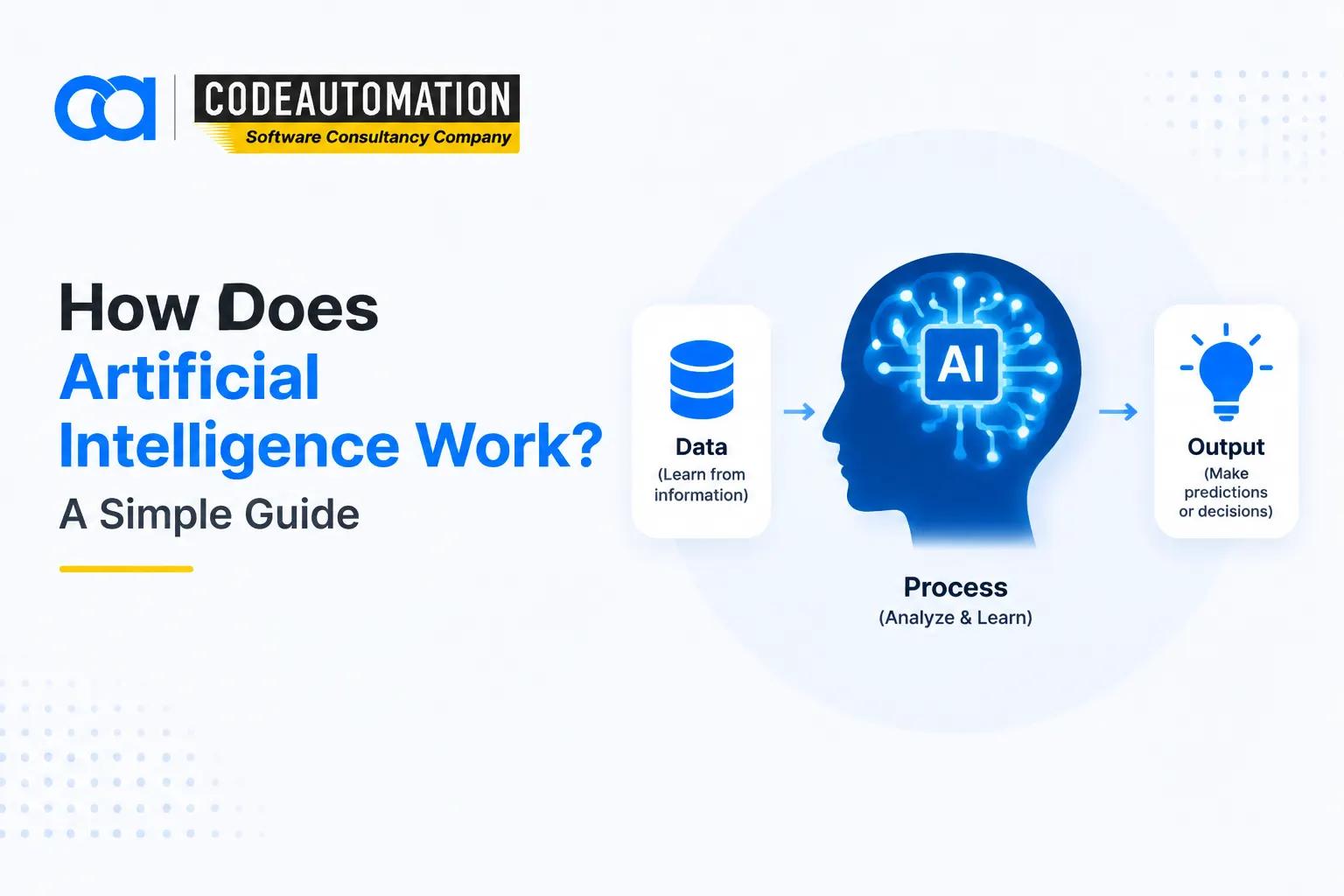
How Does Artificial Intelligence Work? A Simple Guide
Published 08/09/2026
Artificial intelligence (AI) works by using data, algorithms, and computational models to recognize patterns, generate predictions, understand information, or produce outputs based on new inputs.

Ready to Automate Your Success?
From AI-powered applications to scalable software development, we help businesses automate workflows and accelerate growth.
Book a Free ConsultationArtificial intelligence (AI) works by using data, algorithms, and computational models to recognize patterns, generate predictions, understand information, or produce outputs based on new inputs.
At a high level, an AI system learns from examples during training. The resulting model can then process new information and produce an output, such as a prediction, recommendation, classification, generated response, or decision.
The basic process is:
Data → Training → AI Model → New Input → Processing → Output → Evaluation
The exact process depends on the type of AI being used. A fraud detection system, image recognition model, and generative AI application may work differently internally, but they all rely on models processing information to produce useful results.
For businesses, understanding this process is important because AI is most valuable when it is connected to a specific problem, reliable data, and an appropriate workflow.
How Does Artificial Intelligence Work?
AI typically starts with data. The data may include text, images, audio, numbers, customer records, transactions, or other information relevant to the task.
During training, an AI model analyzes examples and learns patterns or relationships within that data. The model is then tested to determine how well it performs on information it has not previously encountered.
Once deployed, the model receives new input and processes it using what it learned during training. The resulting output could be a prediction, classification, recommendation, generated piece of content, or another type of result.
AI systems can then be evaluated and adjusted when their performance does not meet the required standard.
This means AI is not simply "thinking" like a person. It uses computational methods to process information and produce results based on patterns learned from data and the design of the system.
What Does AI Need to Work?
An AI system depends on several fundamental elements, and the importance of each varies according to the application.
Data
Data provides the examples from which many AI models learn. The quality, relevance, quantity, and structure of that data can influence the quality of the resulting system.
For a business, this could include customer interactions, sales records, documents, product information, or operational data.
Poor-quality or incomplete data can limit an AI system even when the underlying technology is sophisticated.
Algorithms and Models
Algorithms provide the methods used to process information and learn patterns. A trained model represents what the system has learned and uses that knowledge when processing new inputs.
Different problems require different approaches. A model designed to classify images, for example, will not necessarily be suitable for forecasting sales.
Computing Power
Training and operating modern AI models can require substantial computing resources, particularly for deep learning and large generative models.
Computing infrastructure provides the processing capacity needed to train models, handle inputs, and generate results at the required speed and scale.
How Does AI Learn From Data?
AI learns by processing examples and adjusting its model to recognize useful patterns in the information it receives.
For example, a model trained to identify fraudulent transactions can analyze historical transactions that have been classified as legitimate or fraudulent. During training, it learns relationships between different characteristics of those transactions.
When it later receives a new transaction, the model uses those learned patterns to estimate whether the transaction resembles previously identified fraudulent activity.
The important point is that AI does not simply memorize every example. Machine learning models are designed to generalize from training data so they can produce useful results for new inputs.
Training
Training is the stage where a model learns from data.
Depending on the approach, the training process may involve labeled examples, patterns discovered without predefined labels, or feedback used to improve the model.
The model repeatedly processes training information and adjusts internal parameters to improve its performance against the objective it was designed to achieve.
Testing and Validation
A model should be evaluated using data that was not used to train it.
Testing helps determine whether the model can generalize beyond its training examples. Validation can also help teams compare approaches and adjust model settings before deployment.
This stage is important because strong performance on training data does not automatically mean that an AI system will perform reliably in real-world situations.
Inference: How AI Produces an Answer
Inference happens when a trained AI model processes new information.
For example, a trained customer-support model might receive a new customer message. It processes the input and produces an appropriate classification, prediction, or response.
In generative AI, inference is the stage where the model processes a prompt and generates new content.
Training teaches the model patterns; inference is when those learned patterns are applied to new inputs.
What Technologies Make AI Work?
Artificial intelligence includes several technologies and techniques rather than one single method.
Machine Learning
Machine learning enables systems to learn patterns from data and use those patterns to make predictions or decisions without requiring every rule to be explicitly programmed.
It is used for applications such as forecasting, recommendation systems, fraud detection, and classification.
Deep Learning
Deep learning is a type of machine learning that uses neural networks with multiple layers.
It has been particularly useful for complex tasks involving large amounts of data, including image recognition, speech processing, and language-related applications.
Neural Networks
Neural networks are computational models made up of interconnected processing units arranged in layers.
They can learn complex relationships within data and form the foundation of many modern deep learning systems.
Natural Language Processing
Natural language processing (NLP) allows computers to work with human language.
NLP supports applications such as language translation, sentiment analysis, search, speech-related systems, and conversational applications.
Computer Vision
Computer vision enables AI systems to analyze and interpret visual information.
Businesses can use it for applications such as quality inspection, object detection, document analysis, and medical image processing.
How Does Generative AI Work?
Generative AI creates new content based on patterns learned during training.
A generative model may receive a prompt containing text or another type of input. It then processes that input and generates an output such as text, an image, audio, code, or other content.
Large language models, for example, process text as tokens and use learned relationships to generate a sequence of likely subsequent tokens. The process repeats until the requested output is produced.
This differs from a traditional predictive model whose primary purpose might be assigning a category or estimating a numerical value.
Generative AI can therefore be used for tasks such as drafting content, summarizing information, generating code, and assisting employees with knowledge-based work.
How Does AI Make Predictions and Decisions?
AI makes predictions or decisions by processing an input through a trained model and producing an output based on patterns represented within that model.
Consider a customer churn model. It might analyze factors such as customer activity, subscription history, and previous interactions to estimate the likelihood that a customer will leave.
The model does not know with certainty what the customer will do. Instead, it produces an estimated outcome based on the information and patterns it has learned.
Business applications can then use that output as part of a larger workflow, sometimes alongside predefined rules or human review.
How Is AI Used in Business?
Businesses use AI when analyzing information, predicting outcomes, generating content, or automating tasks can improve an existing process.
Common applications include customer service, fraud detection, recommendation systems, document processing, forecasting, quality control, and business analytics.
For example, an AI system can classify incoming support requests and route them to the appropriate team. A separate system might analyze customer data to identify potential churn risks.
AI can also work alongside business automation. An AI model can interpret information or make a prediction, while an automation workflow carries out the resulting action.
This combination becomes particularly useful when a process contains both repetitive tasks and decisions that depend on context.
What Are the Limitations and Risks of AI?
AI systems are not automatically accurate or unbiased.
Their performance can be affected by poor training data, incomplete information, inappropriate model selection, or changes in the environment where they operate.
Businesses also need to consider privacy and security when AI systems process sensitive information. Outputs should be evaluated carefully when they influence financial, operational, customer, or other important decisions.
For these reasons, responsible AI implementation typically includes appropriate access controls, testing, monitoring, and human oversight.
The right level of control depends on the potential impact of the AI system and the type of information it handles.
How Can Businesses Use AI Effectively?
Effective AI adoption starts with the business problem rather than the technology.
A company should first identify a process where better predictions, information processing, content generation, or decision support could create measurable value.
The next step is determining what data and systems the solution requires. Some applications can use existing AI products, while others may need integration with internal databases, CRM platforms, business applications, or automation workflows.
A controlled implementation allows the business to evaluate accuracy, operational impact, and user acceptance before expanding the solution.
The objective should be to use AI where it improves a genuine business process—not simply to add AI to an existing workflow because the technology is available.
How Can AI Be Integrated Into Business Workflows?
AI can become part of an existing business workflow by connecting an AI model with the applications and systems employees already use.
For example:
Customer request → AI analyzes request → CRM retrieves customer data → AI determines next action → Workflow executes action → Employee reviews when required
APIs and integrations allow these components to exchange information.
This approach can combine AI's ability to interpret information with conventional automation's ability to execute predictable actions.
For businesses with complex processes, the integration layer can be just as important as the AI model itself.
When Do Businesses Need Custom AI Solutions?
Off-the-shelf AI tools can be useful for common tasks, but they may not fit workflows involving proprietary data, specialized processes, or multiple internal systems.
A custom AI solution can be designed around the company's existing applications, data, security requirements, and operational processes.
For example, a business may need an AI system that reads internal documents, retrieves information from its database, analyzes customer records, and then triggers actions in its CRM.
In these situations, custom AI development can provide greater control over how AI fits into the wider business environment.
Put AI to Work in Your Business
Artificial intelligence works by combining data, computational methods, and trained models to process information and produce useful outputs. The technology becomes more valuable when it is applied to a clearly defined business problem and integrated into the workflow around it.
If your business is exploring AI for automation, decision support, data processing, or operational workflows, CodeAutomation can help design and integrate AI solutions around your specific requirements.
Ready to explore an AI solution for your business?
Frequently Asked Questions (FAQs)
Everything you need to know about our products and services
Artificial intelligence is technology that enables computer systems to process information, recognize patterns, make predictions, generate content, or perform tasks that normally require aspects of human intelligence.
AI models learn by processing examples during training and adjusting their internal parameters to recognize useful patterns. The trained model can then apply those patterns to new information.
No. AI does not think or understand the world in exactly the same way humans do. It processes information using computational models and produces outputs based on learned patterns, data, and system design.
AI is the broader field of creating systems capable of performing tasks associated with intelligent behavior. Machine learning is one approach within AI that enables systems to learn patterns from data.
Businesses use AI for applications such as customer support, forecasting, fraud detection, document processing, recommendations, analytics, content generation, and workflow automation.





Adnan Ghaffar is the visionary CEO of CodeAutomation.ai, a platform dedicated to transforming how businesses build software through cutting-edge automation. With over a decade of experience in software development, QA automation, and team leadership, Adnan has built a reputation for delivering scalable, intelligent, and high-performance solutions.
Under his leadership, CodeAutomation.ai has grown into a trusted name in AI-driven development, empowering startups and enterprises alike to streamline workflows, accelerate time-to-market, and maintain top-tier product quality. Adnan is passionate about innovation, process improvement, and building products that truly solve real-world problems.
More Articles
02/09/2026
Benefits of Business Automation: How Businesses Improve Efficiency, Reduce Costs, and Scale Faster
7 Benefits of Using Agentic AI in Your Business in 2026
01/10/2026
Multi-Agent AI Systems: Architecture, Orchestration, and Enterprise Use Cases

25/08/2026
How to Choose a Custom Software Development Company
29/09/2026
What Is Superintelligence? What Makes AI Superintelligent
16/09/2026