






















Applications of Artificial Intelligence: Uses, Examples, and Business Impact
Published 08/09/2026
Artificial intelligence is no longer limited to research labs or experimental projects. Today, AI applications are used across industries to analyze information, automate tasks, improve decision-making, and create better customer experiences.

Ready to Automate Your Success?
From AI-powered applications to scalable software development, we help businesses automate workflows and accelerate growth.
Book a Free ConsultationArtificial intelligence is no longer limited to research labs or experimental projects. Today, AI applications are used across industries to analyze information, automate tasks, improve decision-making, and create better customer experiences.
From healthcare systems detecting diseases to businesses using AI for automation and analytics, artificial intelligence is helping organizations solve complex problems faster and more efficiently. AI applications are becoming increasingly common across industries such as healthcare, finance, retail, and manufacturing.
However, AI is not a single technology with one purpose. Different AI capabilities, including machine learning, natural language processing, computer vision, and generative AI, are applied to different business and industry challenges.
Understanding these applications helps businesses identify where AI can create measurable improvements rather than adopting technology without a clear purpose.
What Are Applications of Artificial Intelligence?
Applications of artificial intelligence are practical uses of AI technologies to perform tasks that traditionally require human intelligence, such as analyzing information, recognizing patterns, understanding language, making predictions, or generating content.
AI applications combine different technologies depending on the problem being solved.
For example:
- Machine learning can analyze historical data and predict future outcomes.
- Natural language processing can understand and generate human language.
- Computer vision can analyze images and videos.
- Generative AI can create text, images, code, and other content.
The application itself is the real-world use case, while AI technologies are the capabilities that make those applications possible.
For example, fraud detection is an AI application. Machine learning is the technology used to identify unusual transaction patterns.
AI Technology vs AI Applications: What Is the Difference?
AI technology refers to the methods and systems that allow machines to perform intelligent tasks.
Examples include:
- Machine learning
- Deep learning
- Neural networks
- Natural language processing
- Computer vision
AI applications are the practical solutions built using these technologies.
Examples include:
- AI customer support systems
- Recommendation engines
- Fraud detection platforms
- Predictive maintenance systems
- AI-powered business automation
This difference matters because businesses usually do not invest in AI technology itself. They invest in applications that solve specific operational problems.
How Are AI Applications Used in Business?
Businesses use artificial intelligence to improve efficiency, analyze large amounts of information, automate repetitive work, and support better decisions.
Modern business AI applications are moving beyond simple automation. They combine data analysis, prediction, and intelligent decision-making to improve workflows across different departments.
Common business applications include:
AI-Powered Business Automation
AI can help automate processes that require understanding, classification, or decision-making.
Examples include:
- Document processing
- Invoice extraction
- Customer request handling
- Workflow routing
- Data entry automation
Unlike traditional automation that follows fixed rules, AI-powered systems can handle more complex situations where information needs to be interpreted before action is taken.
AI Analytics and Decision Support
Businesses generate large amounts of data, but extracting useful insights manually can be difficult.
AI analytics applications can help organizations:
- Identify trends
- Forecast demand
- Detect unusual activity
- Predict customer behavior
- Support strategic decisions
For example, retailers can use AI to predict product demand, while financial organizations can analyze transaction patterns to identify potential risks.
AI Customer Experience Applications
Companies use AI to improve how they interact with customers.
Common examples include:
- AI chat assistants
- Personalized recommendations
- Automated customer support
- Sentiment analysis
AI allows businesses to provide faster responses while creating more personalized experiences.
Applications of Artificial Intelligence Across Industries
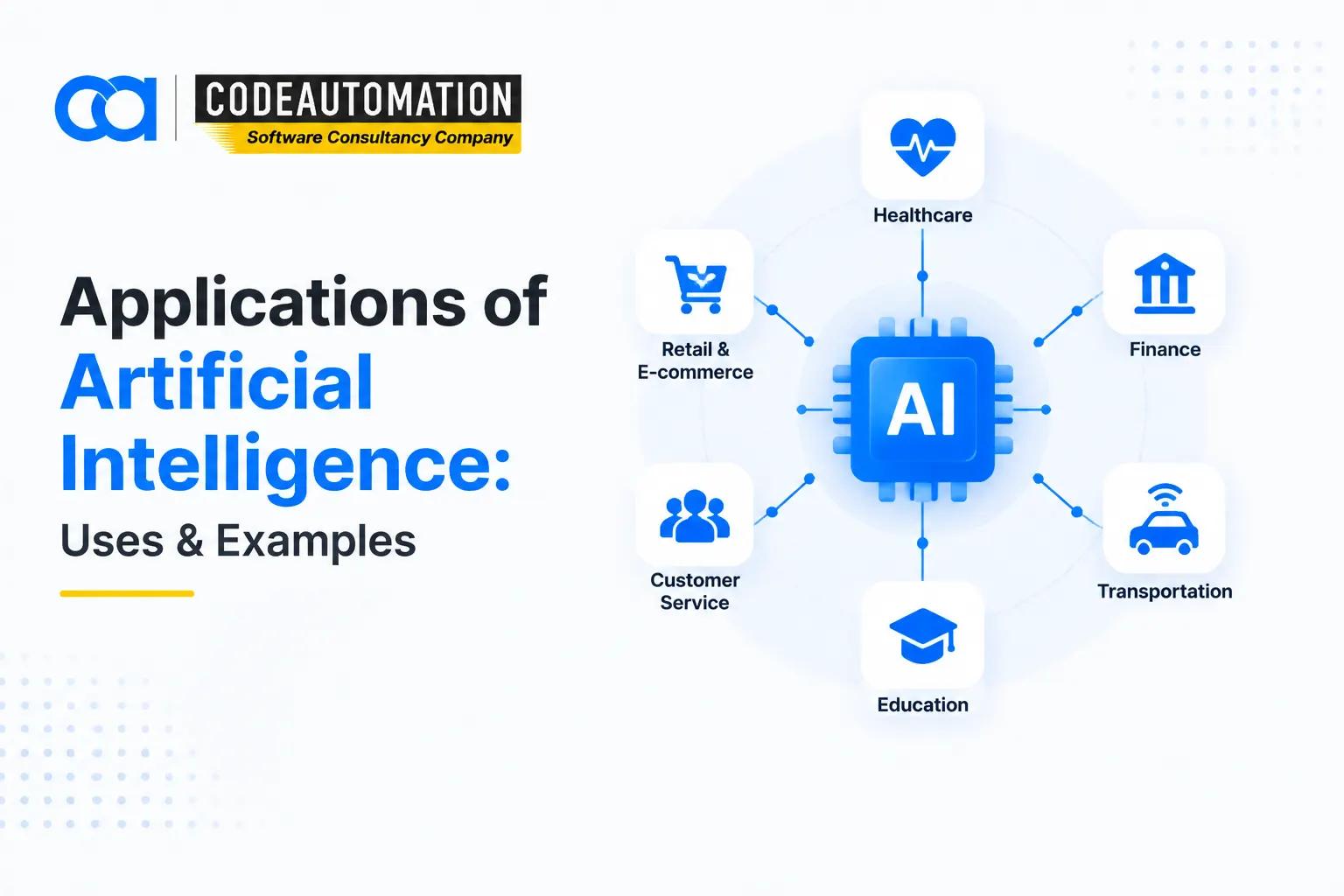
Artificial intelligence is being adopted across many industries because different sectors can apply AI to improve decision-making, automation, and customer experiences.
AI Applications in Healthcare
Healthcare is one of the most important areas where AI is being applied.
AI applications in healthcare include:
Medical Diagnosis
AI systems can analyze medical images, patient information, and clinical data to assist healthcare professionals in identifying potential health conditions.
Drug Discovery
Researchers use AI to analyze biological data and accelerate the discovery of potential treatments.
Patient Support
AI-powered systems can assist with:
- Appointment scheduling
- Patient communication
- Healthcare information access
AI does not replace medical professionals but provides tools that help improve efficiency and decision support.
AI Applications in Finance
Financial organizations use AI to analyze large volumes of transactions and identify patterns that may be difficult for humans to detect.
Common applications include:
Fraud Detection
AI models analyze transaction behavior to identify unusual activity and potential fraud.
Risk Analysis
Financial institutions use AI to evaluate risk, improve forecasting, and support lending decisions.
Automated Processing
AI can assist with:
- Document review
- Customer verification
- Financial reporting
3.AI Applications in Manufacturing
Manufacturing companies use AI to improve production efficiency and reduce operational issues.
Common applications include:
Predictive Maintenance
AI analyzes equipment data to predict when maintenance may be required before failures occur.
Quality Inspection
Computer vision systems can inspect products and identify defects during production.
Supply Chain Optimization
AI helps businesses improve:
- Inventory planning
- Demand forecasting
- Logistics decisions
4.AI Applications in Retail and E-commerce
Retail businesses use AI to improve customer experiences and optimize operations.
Applications include:
Product Recommendations
AI analyzes customer behavior to suggest relevant products.
Inventory Management
Businesses use AI to forecast demand and maintain appropriate stock levels.
Customer Service
AI assistants can help customers find information, track orders, and resolve common questions.
5.AI Applications in Transportation
Transportation companies use AI to improve safety, efficiency, and planning.
Applications include:
- Route optimization
- Traffic prediction
- Autonomous vehicle systems
- Logistics planning
AI helps transportation providers analyze large amounts of real-time information and make faster operational decisions.
6.AI Applications in Education
Education organizations use AI to create more personalized learning experiences.
Applications include:
- AI tutoring systems
- Personalized learning paths
- Automated assessment
- Educational content assistance
AI can help educators provide additional support while allowing students to learn at their own pace.
7.AI Applications in Agriculture
Agriculture uses AI to improve productivity and resource management.
Examples include:
- Crop monitoring
- Disease detection
- Precision irrigation
- Yield prediction
AI helps farmers make better decisions by analyzing environmental and operational data.
Popular AI Applications Powered by Modern Technologies
Modern AI advancements have expanded the number of practical applications available to businesses and individuals.
Generative AI Applications
Generative AI creates new content based on patterns learned from large datasets.
Applications include:
- Content generation
- Code assistance
- Document summarization
- Image creation
- Business knowledge assistants
Businesses are using generative AI to improve productivity and support employees with content and information-based tasks.
AI Agent Applications
AI agents represent a newer category of AI application where systems can understand goals, make decisions, use tools, and complete multi-step tasks.
Business applications include:
- Customer service agents
- Sales assistants
- Workflow automation agents
- Internal knowledge assistants
AI agents are especially useful for processes where simple automation is not enough and decisions require context.
Computer Vision Applications
Computer vision allows AI systems to interpret visual information.
Applications include:
- Security monitoring
- Manufacturing inspection
- Medical imaging
- Document analysis
- Object detection
Natural Language Processing Applications
Natural language processing allows computers to understand and work with human language.
Applications include:
- Translation
- Search systems
- Voice assistants
- Document analysis
- Text classification
How Businesses Identify the Right AI Applications
Not every business problem requires AI. Successful implementation starts by identifying where AI can create meaningful value.
Businesses should consider:
Identify Operational Challenges
Look for processes involving:
- Repetitive manual work
- Large amounts of data
- Time-consuming decisions
- Frequent customer interactions
Evaluate Available Data
AI applications depend on reliable information.
Businesses should understand what data is available and whether it can support the intended use case.
Choose the Right AI Approach
Different problems require different solutions.
A company may need:
- Predictive analytics
- Generative AI
- Computer vision
- AI automation
- AI agents
The right choice depends on the business objective.
Benefits of Implementing AI Applications
AI applications can create value across different areas of an organization.
Improved Efficiency
AI reduces manual effort by automating repetitive tasks and helping employees complete work faster.
Better Decision-Making
AI analyzes large amounts of information and identifies patterns that support better decisions.
Enhanced Customer Experiences
Personalization and faster responses help businesses provide better customer interactions.
Scalable Operations
AI allows companies to handle increasing workloads without increasing manual processes at the same rate.
Challenges of AI Applications
Although AI provides significant opportunities, businesses should consider several challenges.
Data Quality
AI systems depend on accurate and relevant data.
Security and Privacy
Organizations must protect sensitive information used by AI systems.
Integration
AI applications often need to connect with existing software, databases, and workflows.
Human Oversight
Businesses should maintain appropriate review processes, especially when AI influences important decisions.
Build AI Solutions Around Your Business Needs
The most valuable AI applications are not simply the ones using advanced technology. They are the ones that solve real business problems.
Whether the goal is automating workflows, improving customer experiences, analyzing data, or building intelligent systems, businesses need AI solutions designed around their specific requirements.
CodeAutomation helps businesses develop AI-powered solutions that integrate with existing systems, automate operational processes, and create scalable digital workflows.
Ready to Explore AI Opportunities for Your Business?
Discuss your business challenges and discover how AI solutions can help improve efficiency, automate processes, and create new opportunities.
Frequently Asked Questions (FAQs)
Everything you need to know about our products and services
The main applications of AI include healthcare diagnosis, fraud detection, recommendation systems, customer support, automation, predictive analytics, computer vision, and generative AI.
Businesses use AI for automation, customer service, forecasting, data analysis, personalization, fraud detection, and workflow optimization.
Industries using AI include healthcare, finance, manufacturing, retail, transportation, agriculture, education, and technology.
Examples include search engines, voice assistants, recommendation systems, navigation apps, spam filters, translation tools, and personalized online experiences.
Companies can start by identifying business problems, evaluating available data, selecting the right AI approach, integrating solutions with existing systems, and measuring results.





Adnan Ghaffar is the visionary CEO of CodeAutomation.ai, a platform dedicated to transforming how businesses build software through cutting-edge automation. With over a decade of experience in software development, QA automation, and team leadership, Adnan has built a reputation for delivering scalable, intelligent, and high-performance solutions.
Under his leadership, CodeAutomation.ai has grown into a trusted name in AI-driven development, empowering startups and enterprises alike to streamline workflows, accelerate time-to-market, and maintain top-tier product quality. Adnan is passionate about innovation, process improvement, and building products that truly solve real-world problems.
More Articles

03/ 09/ 2026
QA Testing Ensuring Software Excellence in USA Businesses
15/ 09/ 2025
How CodeAutomation’s AI Software Development Solutions Can Transform Your Business

26 November 2024
Competitors and Insights for Your QA Strategy

17 January 2026
Regression Testing in Software Testing: A Comprehensive Guide

10 March 2026
How End-to-End Software Testing Ensure Better Software Quality

27/ 04/ 2026