






















What Is Business Automation?
Published 31/08/2026
Business automation is the use of technology to perform repetitive tasks and manage business processes with minimal manual intervention. It can connect applications, move data, trigger actions, and route work automatically based on defined rules or business conditions.

Ready to Automate Your Success?
From AI-powered applications to scalable software development, we help businesses automate workflows and accelerate growth.
Book a Free ConsultationBusiness automation is the use of technology to perform repetitive tasks and manage business processes with minimal manual intervention. It can connect applications, move data, trigger actions, and route work automatically based on defined rules or business conditions.
Instead of employees repeatedly entering data, sending routine emails, updating records, or moving information between systems, automation handles those steps so teams can focus on higher-value work.
Modern business automation can combine workflow automation, APIs, robotic process automation (RPA), artificial intelligence (AI), and business applications to streamline processes across an organization.
How Does Business Automation Work?
A typical automation starts with a business trigger, processes information according to defined rules, and performs one or more actions automatically.
For example, when a new lead submits a website form, an automated workflow could create a CRM record, assign the lead to a salesperson, send a confirmation email, and schedule a follow-up task.
This becomes more powerful when multiple systems are connected, allowing information to move between CRM, ERP, email, finance, customer service, and other business platforms.
Types of Business Automation
Business automation can range from simple task automation to intelligent, end-to-end workflows.
Workflow automation connects tasks and systems based on predefined rules.
RPA automates repetitive, rule-based interactions with software applications.
AI-powered automation adds capabilities such as document understanding, prediction, natural-language processing, and decision support.
Business process automation (BPA) focuses on automating broader processes that may involve multiple tasks, employees, and systems.
What Are the Benefits of Business Automation?
Businesses typically automate processes to improve operational performance rather than simply eliminate manual work.
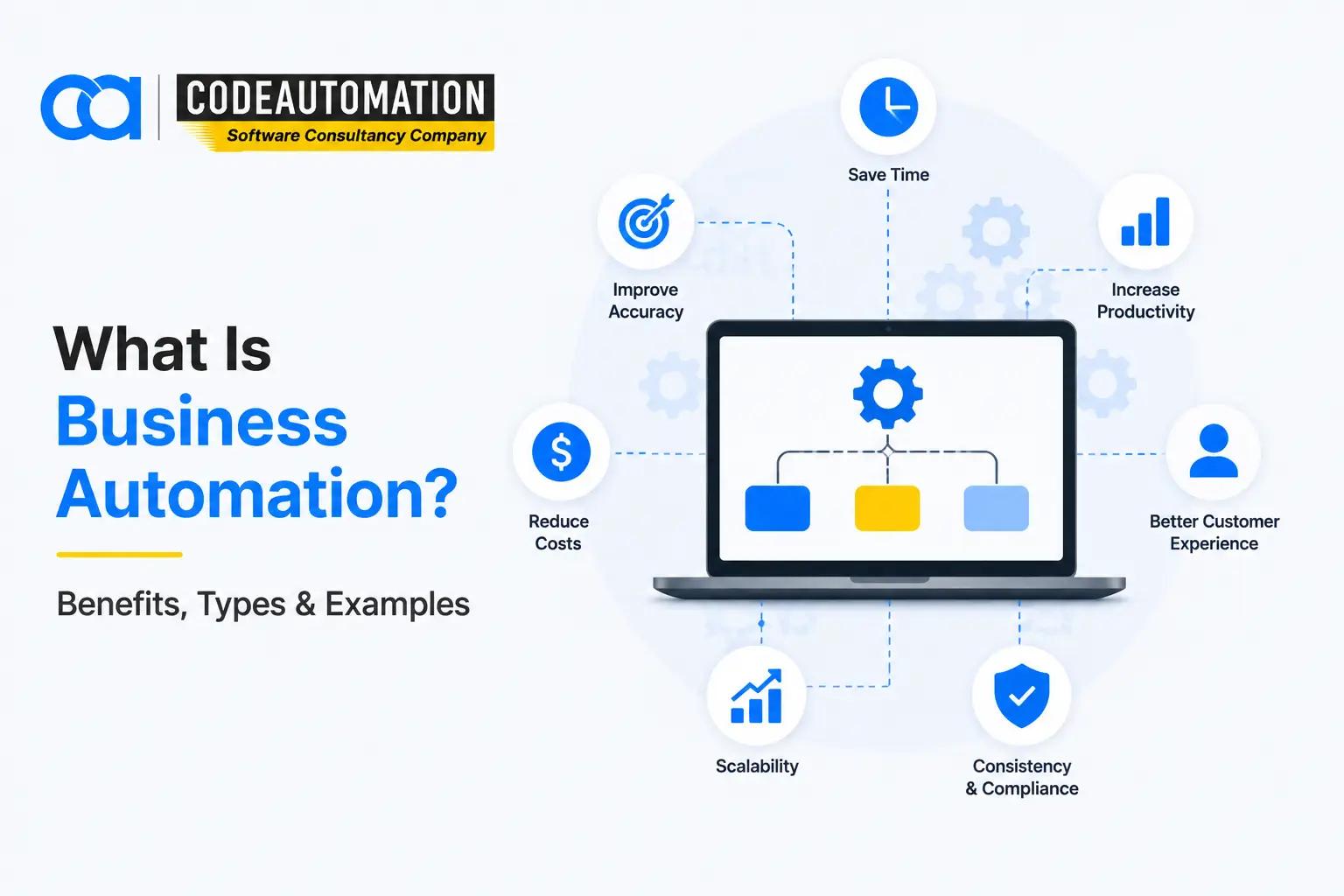
Key benefits include:
- Higher productivity: Employees spend less time on repetitive administrative work.
- Fewer errors: Automated workflows follow consistent rules and reduce manual data-entry mistakes.
- Lower operating costs: Less manual effort can reduce the resources required to complete recurring processes.
- Faster processes: Automated actions can happen immediately instead of waiting for manual handoffs.
- Better customer experiences: Faster responses and smoother workflows can improve service delivery.
- Greater scalability: Automated processes can handle increasing transaction or workload volumes without proportionally increasing manual effort.
Business Automation Examples
Business automation can be applied across almost every department.
Sales: Automatically capture leads, update CRM records, qualify prospects, and trigger follow-ups.
Customer service: Route support requests, answer routine questions, and escalate complex cases.
Finance: Automate invoice processing, approvals, payment workflows, and reporting.
Human resources: Streamline employee onboarding, document collection, approvals, and notifications.
Marketing: Automate campaign workflows, customer segmentation, email sequences, and lead nurturing.
Operations: Connect business systems and automate repetitive data movement, approvals, and reporting.
Business Automation vs. RPA vs. AI Automation
These terms overlap but are not identical.
Business automation is the broader approach to improving business processes through technology.
RPA is a specific automation technology focused primarily on repetitive, rules-based tasks.
AI automation adds artificial intelligence to automation workflows so systems can work with less-structured information and support more complex decisions.
In practice, businesses can combine all three rather than choosing only one.
How to Start Automating Your Business
Start by identifying processes that are repetitive, high-volume, time-consuming, or prone to manual errors. Then map the existing workflow, identify the systems involved, and determine where automation can create measurable value.
From there, select the appropriate technology, integrate it with existing applications, test the workflow, and monitor results after deployment.
The best automation strategy is not about automating everything. It is about automating the right processes in a way that improves measurable business outcomes.
For businesses looking to connect systems, automate workflows, and reduce manual operational work, AI business automation solutions can provide a tailored approach based on existing processes, applications, and growth objectives.
Frequently Asked Questions (FAQs)
Everything you need to know about our products and services
A common example is automatically sending a new website lead to a CRM, assigning it to a salesperson, and triggering a follow-up email without manual data entry.
Automation projects typically require process analysis, workflow design, system integration, API knowledge, and familiarity with automation platforms. More advanced projects may also require AI, data, or software development expertise.
No. AI is expanding what automation can accomplish. Traditional automation handles predictable, rules-based tasks, while AI can help automation work with unstructured information and more complex decisions.
Common categories include basic task automation, process automation, advanced automation, and intelligent automation. The exact classification varies between platforms and organizations.
Yes. Automation can be designed around a company's existing workflows, software, data, approval processes, and business requirements rather than forcing the organization to change everything around a generic tool.





Adnan Ghaffar is the visionary CEO of CodeAutomation.ai, a platform dedicated to transforming how businesses build software through cutting-edge automation. With over a decade of experience in software development, QA automation, and team leadership, Adnan has built a reputation for delivering scalable, intelligent, and high-performance solutions.
Under his leadership, CodeAutomation.ai has grown into a trusted name in AI-driven development, empowering startups and enterprises alike to streamline workflows, accelerate time-to-market, and maintain top-tier product quality. Adnan is passionate about innovation, process improvement, and building products that truly solve real-world problems.
More Articles

03/ 05/ 2026
AI Agent for Operations: Simplify Complex Workflows in 2026

05/ 05/ 2026
How Enterprise AI Powers Intelligent Automation
15/09/2026
AI Supply Chain Optimization How Businesses Use AI to Reduce Costs and Improve Efficiency

18/ 12/ 2025
Why Odoo ERP is the Game-Changer Your Business Needs: Unlock Its Power for Growth with CodeAutomation

02/10/2026
What Is an Intelligence Explosion and How Could It Happen?

24/ 04/ 2026