






















How Can AI Business Automation Improve Customer Service Efficiency
Published 14/09/2026
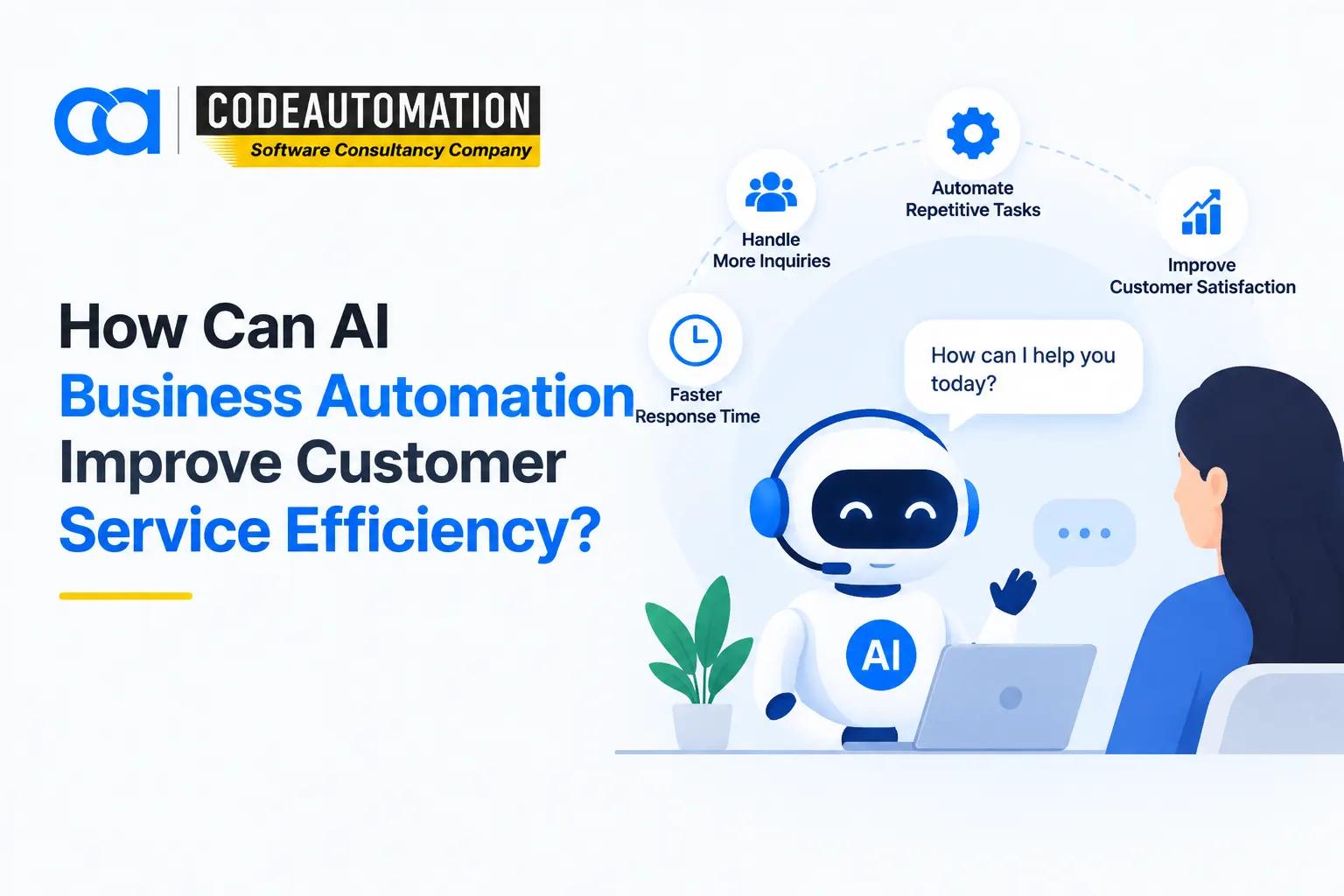
AI business automation can improve customer service efficiency by handling repetitive inquiries, routing tickets, assisting support agents, generating responses, and automating follow-ups. This allows customer service teams to spend less time on repetitive tasks and more time resolving complex customer issues.

Ready to Automate Your Success?
From AI-powered applications to scalable software development, we help businesses automate workflows and accelerate growth.
Book a Free ConsultationAI business automation can improve customer service efficiency by handling repetitive inquiries, routing tickets, assisting support agents, generating responses, and automating follow-ups. This allows customer service teams to spend less time on repetitive tasks and more time resolving complex customer issues.
The biggest improvements typically come from connecting AI to the workflows that already consume support teams' time. For example, AI can classify an incoming request, retrieve relevant information, draft or deliver a response, escalate the issue when necessary, and record the interaction in the CRM.
The result is not simply faster customer support. A well-designed AI automation workflow can also reduce ticket backlogs, improve agent productivity, shorten resolution times, and provide more consistent customer experiences.
How AI Business Automation Improves Customer Service Efficiency
Automates Repetitive Customer Inquiries
Many support teams repeatedly answer the same questions about orders, account access, pricing, policies, billing, and product features.
AI can identify these common requests and provide relevant answers using an approved knowledge base. Simple requests can be resolved automatically, while more complicated questions can be transferred to a human agent.
This reduces the number of repetitive conversations that agents need to handle manually.
Speeds Up Ticket Classification and Routing
Support teams can lose valuable time determining what a ticket is about and which department should handle it.
AI can analyze the customer's message, identify its intent, determine priority, and route the request to the appropriate team.
For example:
Customer message → AI identifies billing issue → checks priority → routes to billing team → creates support record
This reduces manual triage and helps customers reach the right person faster.
Improves Agent Productivity
AI does not need to handle the entire customer interaction to create value.
It can assist agents by:
- Summarizing previous conversations
- Retrieving relevant knowledge
- Suggesting responses
- Identifying customer intent
- Extracting important information
Agents can then review the recommendation and focus on the actual customer problem rather than searching through multiple systems.
Reduces Customer Response and Resolution Times
AI automation can operate continuously and respond to customer requests without waiting for an available agent.
For simple issues, an automated response may resolve the request immediately. For complex cases, AI can collect information and prepare the case before a human agent takes over.
This can reduce both initial response time and the amount of work required to reach resolution.
Enables 24/7 Customer Support
AI-powered workflows can continue operating outside normal business hours.
Customers can receive immediate assistance with common questions, submit requests, check information, or initiate support processes without waiting for the support team to return.
When human involvement is required, the system can collect relevant details and create a properly categorized case for the next available agent.
Personalizes Customer Interactions at Scale
AI can use available customer context to make automated interactions more relevant.
For example, instead of providing a generic response, an AI workflow can consider:
- Customer history
- Previous conversations
- Account information
- Product or service information
- Current request
This allows businesses to provide more personalized support without requiring agents to manually gather the same information for every interaction.
Which Customer Service Workflows Can AI Automate?
AI automation is most valuable when it is connected to specific customer service workflows rather than used as a standalone chatbot.
Customer Inquiry and FAQ Handling
AI can automatically respond to common questions using information from an approved knowledge base.
Typical examples include:
- Product information
- Account questions
- Shipping information
- Billing policies
- Service availability
- Basic troubleshooting
Requests that require judgment or access to restricted information can be escalated to a human agent.
Ticket Triage and Routing
AI can analyze incoming tickets and determine:
- What the customer needs
- Which department should handle it
- How urgent the issue is
- What information is missing
The ticket can then be routed automatically instead of waiting for manual review.
Knowledge Retrieval and Response Generation
Support agents often spend time searching documentation before responding to customers.
AI can retrieve relevant information from approved knowledge sources and use it to generate a response or recommendation.
This is particularly useful for businesses with large documentation libraries.
Conversation Summarization and Follow-Ups
Long customer conversations can be difficult for agents to review.
AI can summarize previous interactions and highlight important details before an agent takes over.
After the interaction, automation can also trigger:
- Follow-up messages
- Case updates
- Customer feedback requests
- Internal notifications
Customer Feedback and Sentiment Analysis
AI can analyze customer conversations and feedback to identify sentiment and recurring issues.
Businesses can use these insights to identify:
- Frustrated customers
- Common complaints
- Product problems
- Service-quality issues
This turns customer conversations into operational feedback rather than treating every interaction as an isolated support ticket.
AI Automation vs AI Assistance in Customer Service
AI automation and AI assistance are related but not identical.
When AI Handles the Task
AI automation means the system performs a customer service task with little or no human intervention.
For example:
Customer asks a common question → AI finds the approved answer → AI responds → interaction is recorded
This approach works best for predictable, low-risk requests.
When AI Supports the Human Agent
AI assistance keeps the human agent responsible for the interaction while reducing the manual work around it.
For example:
Customer contacts support → AI summarizes history → retrieves relevant information → suggests response → agent reviews and sends
This is useful when customer issues require judgment or empathy.
Why Human Escalation Still Matters
Not every customer interaction should be fully automated.
A well-designed system should recognize when a request requires:
- Human judgment
- Sensitive handling
- Exception management
- Complex troubleshooting
- Escalation
The goal is to automate appropriate work while giving customers a clear path to human support when necessary.
How AI Automation Affects Customer Service Efficiency Metrics
AI automation should be measured by operational outcomes, not simply by the number of automated conversations.
First Response Time
AI can provide immediate responses to common questions and automatically acknowledge incoming requests.
This can reduce the time customers wait before receiving assistance.
Average Handling Time
Agent assistance can reduce the time required to search for information, review customer history, write responses, and document conversations.
Resolution Time
AI can collect information, identify the issue, recommend solutions, and route complex cases to the right team.
This can shorten the overall time required to resolve a customer request.
First-Contact Resolution
When AI provides accurate information or equips an agent with the right context during the first interaction, fewer customers need to contact support repeatedly.
Agent Productivity
Instead of measuring only how many conversations AI handles, businesses should also consider how much manual work AI removes from each agent's workload.
For example, an agent who previously spent several minutes reviewing a customer's history may receive an automated summary before responding.
Customer Satisfaction
Efficiency should not come at the expense of customer experience.
Businesses should monitor customer satisfaction alongside automation metrics to ensure that faster support is also useful and accurate.
Where Should Businesses Start With Customer Service Automation?
Businesses do not need to automate their entire support operation at once. Starting with the right workflows usually produces better results.
Identify Repetitive High-Volume Tasks
Look for activities that:
- Occur frequently
- Follow predictable patterns
- Consume significant agent time
- Require limited judgment
These are often the easiest starting points.
Prioritize High-Impact Workflows
Not every repetitive task deserves automation.
Prioritize workflows where automation can produce a measurable improvement in response time, workload, customer experience, or operating cost.
Connect AI With CRM and Support Systems
AI becomes more useful when it can access the information required to complete the workflow.
Depending on the business, this may include:
- CRM data
- Helpdesk records
- Knowledge bases
- Order systems
- Customer account information
Set Human Escalation Rules
Define which requests AI can handle independently and which ones require human intervention.
This prevents automation from creating poor customer experiences when a request falls outside the system's capabilities.
Measure Results and Improve Continuously
Track performance before and after automation.
Useful measurements include:
- Response time
- Resolution time
- Ticket volume
- Agent workload
- Customer satisfaction
- Automation resolution rate
These measurements help businesses determine whether an automation is actually improving customer service.
Challenges of AI Business Automation in Customer Service
AI automation can improve efficiency, but poorly designed automation can create additional problems.
Inaccurate or Outdated Knowledge
AI responses are only as reliable as the information available to the system.
Businesses should maintain accurate knowledge sources and establish processes for reviewing outdated information.
Data Privacy and Security
Customer service systems may contain sensitive personal and account information.
Businesses should carefully evaluate:
- Data access
- Permissions
- Storage
- Security controls
- Compliance requirements
Over-Automation
Automating every customer interaction can make support frustrating.
Customers should be able to reach a human when an issue is complex or requires personal assistance.
Integration Complexity
Customer service information is often distributed across several systems.
Connecting AI to CRM, helpdesk, order management, knowledge bases, and internal applications can require significant technical planning.
When Businesses Need Custom AI Customer Service Automation
Standard customer support platforms can handle many common workflows, but some businesses need more customized automation.
Custom AI automation becomes useful when a company has:
- Multiple disconnected business systems
- Complex customer service workflows
- Industry-specific processes
- Custom escalation rules
- Large internal knowledge bases
- Unique CRM or helpdesk integrations
Instead of forcing the business to change its processes around a generic tool, custom automation can connect existing systems and build workflows around the company's actual operating model.
For example, a custom workflow could connect a CRM, support platform, internal knowledge base, order system, and AI agent so that a customer request moves through the entire process automatically.
Build AI Business Automation for More Efficient Customer Service
AI can improve customer service efficiency when it is applied to the right workflows not simply added as another chatbot.
The strongest implementations combine automation with existing business systems, clear escalation rules, reliable data, and measurable performance goals.
CodeAutomation helps businesses design and implement AI-powered automation solutions that connect customer service workflows with the systems teams already use.
Explore our AI business automation solutions to build customized AI workflows for your business.
Final Takeaway
AI business automation improves customer service efficiency by connecting intelligence with the workflows that consume the most human effort.
The goal is not to automate every customer interaction. It is to automate the repetitive work, give agents better information, resolve straightforward requests faster, and escalate complex situations intelligently.
When businesses measure the results against response time, resolution time, agent productivity, and customer satisfaction, AI automation becomes an operational improvement rather than simply another customer service technology.
Frequently Asked Questions (FAQs)
Everything you need to know about our products and services
AI business automation uses artificial intelligence to automate customer service workflows such as inquiry handling, ticket routing, knowledge retrieval, response generation, follow-ups, and customer analysis.
AI reduces workload by handling repetitive requests, classifying tickets, retrieving information, summarizing conversations, and assisting agents with responses.
AI can automate FAQ responses, ticket classification, routing, knowledge retrieval, conversation summaries, follow-ups, sentiment analysis, and other repetitive support tasks.
Yes. AI can respond immediately to common requests and automatically process incoming tickets, reducing the time customers wait for an initial response.
Not necessarily. AI can automate repetitive tasks while human agents handle complex, sensitive, or exceptional customer issues. The most effective approach often combines AI automation with human oversight.
Businesses can measure first response time, average handling time, resolution time, first-contact resolution, ticket backlog, agent productivity, automation resolution rate, and customer satisfaction.





Adnan Ghaffar is the visionary CEO of CodeAutomation.ai, a platform dedicated to transforming how businesses build software through cutting-edge automation. With over a decade of experience in software development, QA automation, and team leadership, Adnan has built a reputation for delivering scalable, intelligent, and high-performance solutions.
Under his leadership, CodeAutomation.ai has grown into a trusted name in AI-driven development, empowering startups and enterprises alike to streamline workflows, accelerate time-to-market, and maintain top-tier product quality. Adnan is passionate about innovation, process improvement, and building products that truly solve real-world problems.
More Articles

26 November 2024
Competitors and Insights for Your QA Strategy

03/ 23/ 2026
CMS development services: How to manage content efficiently

10 April 2025
Why QA Testers Are Essential in Software Development – Especially in the Age of AI ?

26/ 08/ 2025
How to Hire an AI Agent Developer: A Detailed Guide 2026

25/ 08/ 2025
How to Hire an AI Developer: Your Ultimate Guide for 2026

17 January 2026