






















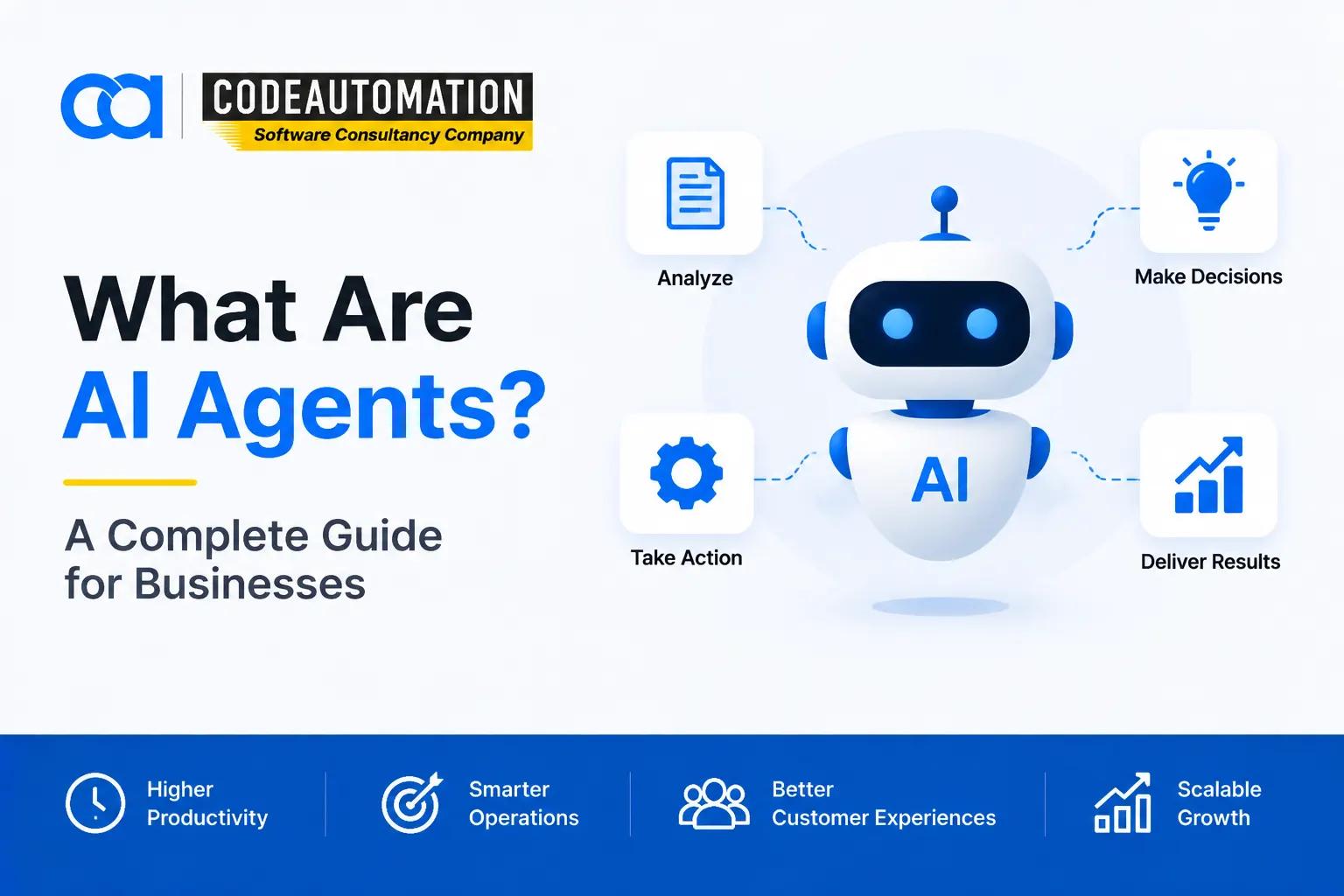
What Are AI Agents A Complete Guide for Businesses
Published 04/09/2026
Businesses have used software automation for years to reduce manual work and improve operational efficiency. However, traditional automation usually depends on predefined rules and workflows.

Ready to Automate Your Success?
From AI-powered applications to scalable software development, we help businesses automate workflows and accelerate growth.
Book a Free ConsultationBusinesses have used software automation for years to reduce manual work and improve operational efficiency. However, traditional automation usually depends on predefined rules and workflows.
AI agents introduce a different approach.
Instead of only following fixed instructions, AI agents can understand objectives, analyze information, make decisions, use connected tools, and complete multi-step tasks with limited human involvement.
For businesses, this creates new possibilities: automating complex workflows, improving customer interactions, assisting employees, and connecting disconnected systems.
But what exactly are AI agents, and where do they provide real business value?
What Are AI Agents?
An AI agent is a software system that can understand a goal, analyze available information, decide the required steps, and take actions to complete a task.
Unlike traditional software that requires every action to be explicitly programmed, AI agents can determine how to approach a problem based on the context available.
For example:
A traditional automation workflow may send an email after a customer submits a form.
An AI agent can analyze the customer request, review previous conversations, update CRM information, prepare a response, schedule follow-up actions, and escalate the request when needed.
AI agents combine artificial intelligence models with tools, data sources, and business applications to perform tasks more independently.
How Do AI Agents Work?
AI agents generally operate through four core capabilities:
Understanding Goals and Context
The first step is understanding what needs to be achieved.
Instead of receiving only a specific command, an AI agent interprets the desired outcome.
For example:
"Find qualified leads from our database and schedule meetings with potential customers."
The agent understands the objective and determines the actions required to complete it.
Planning and Reasoning
After understanding the goal, the AI agent creates a sequence of actions.
It may decide to:
- Gather information from different sources
- Analyze available data
- Select the appropriate tools
- Perform required actions
- Adjust the approach based on results
This planning ability allows AI agents to handle more complex workflows than traditional rule-based automation.
Using Tools and Business Systems
AI agents become more valuable when connected with existing business applications.
They can interact with:
- CRM systems
- Databases
- Internal applications
- APIs
- Communication platforms
- Knowledge bases
These integrations allow AI agents to perform actual business tasks instead of only generating responses.
Learning From Feedback
Many AI agent systems use feedback mechanisms to improve future performance.
Human reviews, previous interactions, and business rules can help agents produce more accurate and relevant results over time.
AI Agents vs Chatbots vs Automation: What Is the Difference?
Many businesses confuse AI agents with chatbots and traditional automation. Although they are related, they solve different problems.
AI Agents
AI agents are designed to achieve goals.
They can:
- Analyze situations
- Plan actions
- Use tools
- Complete multiple steps
Example:
An AI sales agent that identifies prospects, researches companies, updates CRM records, and schedules meetings.
Chatbots
Chatbots mainly focus on conversations.
They are useful for:
- Answering customer questions
- Providing information
- Handling common support requests
However, traditional chatbots usually wait for user input and do not independently complete business processes.
Traditional Automation
Traditional automation follows predefined workflows.
Example:
"When payment is completed, automatically send an invoice."
It works well for predictable processes but has limited flexibility when decisions require context.
Types of AI Agents
AI agents can be designed with different levels of capability depending on the business requirement.
Reactive AI Agents
These agents respond to specific inputs based on predefined conditions.
Example:
A customer support agent responding to common requests.
Goal-Based AI Agents
These agents work toward achieving a defined objective by selecting appropriate actions.
Example:
A sales agent finding qualified leads and arranging meetings.
Autonomous AI Agents
These agents can manage more complex workflows by planning tasks, using tools, and completing processes with limited supervision.
Example:
An operations agent monitoring business workflows and taking corrective actions.
Key Components of an AI Agent
AI Model
The AI model provides the reasoning capability that allows the agent to understand information and generate decisions.
Memory and Context
Memory allows AI agents to retain relevant information from previous interactions.
This helps businesses create more personalized and consistent experiences.
Tools and Integrations
AI agents require access to external systems to perform meaningful actions.
Examples include:
- CRM platforms
- ERP systems
- Business databases
- APIs
- Communication tools
Human Oversight
Businesses should define where human approval is required.
Important decisions involving customers, finances, security, or compliance should include appropriate controls.
How Businesses Use AI Agents
AI agents can support different departments by automating repetitive work and assisting employees with complex tasks.
Customer Support
AI agents can:
- Handle customer inquiries
- Retrieve account information
- Recommend solutions
- Escalate complex issues
This helps businesses improve response times while reducing repetitive support workload.
Sales and Marketing
AI agents can assist sales teams by:
- Qualifying leads
- Updating CRM records
- Preparing customer insights
- Creating follow-up workflows
Business Operations
Organizations can use AI agents for:
- Document processing
- Workflow management
- Data analysis
- Internal assistance
- Reporting automation
Software Development
Development teams can use AI agents to support:
- Code analysis
- Testing activities
- Documentation
- Issue investigation
Benefits of AI Agents for Businesses
Increased Productivity
AI agents reduce manual effort by handling repetitive and time-consuming tasks.
Employees can focus on higher-value activities that require creativity and decision-making.
Faster Business Decisions
AI agents can analyze information quickly and help teams make informed decisions faster.
Better Customer Experiences
Businesses can provide faster responses, personalized interactions, and consistent service across different channels.
Scalable Operations
AI agents allow companies to handle increasing workloads without increasing manual effort at the same pace.
Challenges Businesses Should Consider Before Implementing AI Agents
AI agents provide significant opportunities, but successful adoption requires careful planning.
Data Security and Privacy
AI agents often interact with business information. Proper access controls and security practices are essential.
Accuracy and Reliability
AI agents should be tested and monitored to ensure they produce reliable results.
Integration Complexity
Connecting AI agents with existing business systems may require technical expertise, API integration, and workflow redesign.
Governance and Human Control
Businesses should establish guidelines around:
- Data usage
- Approval processes
- Monitoring
- Accountability
How Businesses Can Start Implementing AI Agents
A successful AI agent strategy starts with identifying the right problems.
Businesses should:
Identify Suitable Workflows
Look for processes that are:
- Repetitive
- Time-consuming
- Data-heavy
- Rule-driven but require decisions
Start With a Focused Use Case
Instead of automating everything at once, companies should begin with a specific workflow where AI agents can create measurable value.
Connect Existing Systems
AI agents deliver more value when connected with existing business applications and data sources.
Measure and Improve
Businesses should monitor performance, collect feedback, and improve the workflow over time.
Why Businesses Need Custom AI Agent Development
Every organization has different workflows, systems, and operational challenges.
Pre-built AI tools can solve general tasks, but custom AI agents allow businesses to build solutions around their specific requirements.
Custom AI agents can help companies:
- Connect existing applications
- Automate unique workflows
- Improve operational efficiency
- Create industry-specific solutions
- Scale automation capabilities
For businesses looking to move beyond basic automation, custom AI agent development provides a way to build intelligent systems aligned with real business objectives.
Build AI Agents That Solve Real Business Problems
AI agents are changing how companies approach automation by moving from simple task execution toward intelligent systems capable of planning and taking action.
The businesses that gain the most value are those that identify the right processes, prepare their systems, and implement AI agents where they can create measurable improvements.
CodeAutomation helps businesses design and develop AI-powered solutions that connect workflows, automate operations, and support scalable growth.
Ready to Explore AI Agents for Your Business?
Discuss your workflow challenges and discover how custom AI agents can help automate complex processes and improve business efficiency.
Frequently Asked Questions (FAQs)
Everything you need to know about our products and services
An AI agent is a software system that can understand goals, make decisions, use tools, and complete tasks with limited human involvement.
Chatbots mainly provide conversational responses, while AI agents can plan actions, interact with systems, and complete multi-step workflows.
AI agents can automate customer support, sales workflows, document processing, reporting, data analysis, and internal operations.
AI agents are designed to support employees by reducing repetitive work. Human judgment remains important for strategic and sensitive decisions.
Companies can start by identifying repetitive workflows, selecting suitable use cases, integrating required systems, testing performance, and gradually expanding adoption.





Adnan Ghaffar is the visionary CEO of CodeAutomation.ai, a platform dedicated to transforming how businesses build software through cutting-edge automation. With over a decade of experience in software development, QA automation, and team leadership, Adnan has built a reputation for delivering scalable, intelligent, and high-performance solutions.
Under his leadership, CodeAutomation.ai has grown into a trusted name in AI-driven development, empowering startups and enterprises alike to streamline workflows, accelerate time-to-market, and maintain top-tier product quality. Adnan is passionate about innovation, process improvement, and building products that truly solve real-world problems.
More Articles

16/ 05/ 2026
What Is Agentic AI? Understanding Autonomous AI Systems in 2026

03/ 27/ 2026
From SEO to AEO & GEO: The evolution of search
02/ 21/ 2026
Clawdbot: AI Automation for Modern Businesses

05/ 11/ 2025
How Software and QA Testing Services help reduce post release chaos for scaling SaaS teams

30 March 2026
Essential Automation Testing Tools to Boost QA Game

25/ 08/ 2025