






















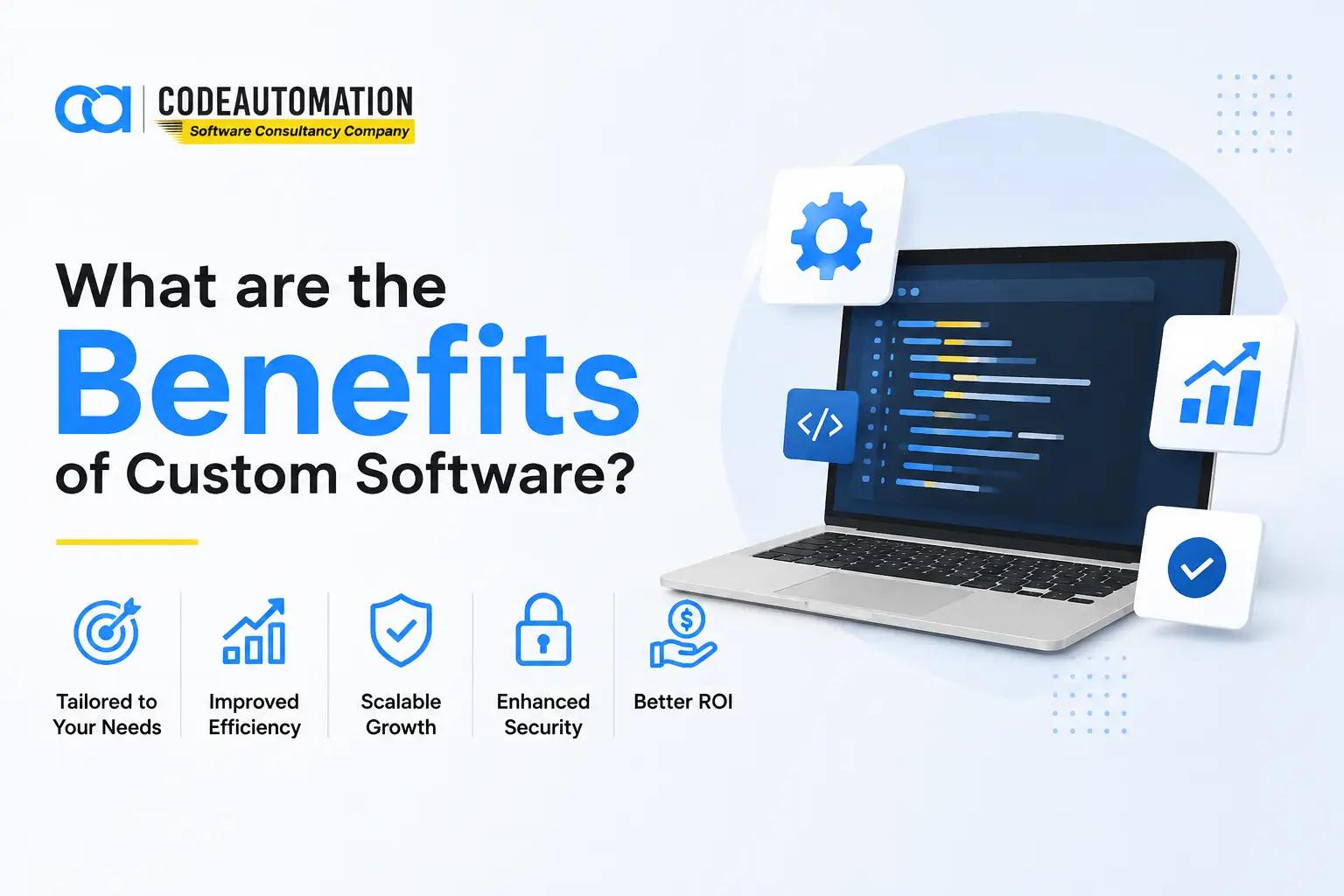
What are the benefits of custom software?
Published 22/08/2026
Businesses often outgrow generic software as their operations become more complex. Teams begin relying on disconnected tools, manual processes, and workarounds that slow productivity and limit growth. Custom software development helps organizations build technology around their unique workflows, goals, and long-term strategy.

Ready to Automate Your Success?
From AI-powered applications to scalable software development, we help businesses automate workflows and accelerate growth.
Book a Free ConsultationBusinesses often outgrow generic software as their operations become more complex. Teams begin relying on disconnected tools, manual processes, and workarounds that slow productivity and limit growth. Custom software development helps organizations build technology around their unique workflows, goals, and long-term strategy.
Custom software development offers a powerful alternative by providing tailored digital solutions built around your exact business model. By investing in custom software, companies can eliminate operational bottlenecks, secure proprietary intellectual property, and build a resilient foundation for long-term competitive advantage.
What is Custom Software Development?
Custom software development is the process of designing, building, deploying, and maintaining software applications tailored specifically to the unique needs of a particular business, user group, or organization.
Unlike Commercial Off-The-Shelf (COTS) software, which is designed for a broad audience with standardized needs, custom software is engineered from the ground up to fit existing business models, workflows, and strategic goals.
What Are the Benefits of Custom Software?
Building tailored software offers significant operational and financial advantages over generic applications:
- Business-Specific Functionality: Every feature, dashboard, and logic tree is engineered around your exact processes, eliminating unnecessary bloat while filling key functional gaps.
- Greater Flexibility: Modify features, update business logic, and add functionality on demand without waiting for third-party vendor release cycles.
- Scalability: Architected to handle growing transaction volumes, database sizes, and user accounts without facing artificial feature limits or software tier penalties.
- Better Integration: Seamlessly bridges legacy infrastructure, central databases, and third-party APIs into unified operational workflows to eliminate data silos.
- Improved Efficiency: Reduces manual workarounds, unifies system access, and automates daily tasks, freeing teams to focus on strategic execution.
- Enhanced Security: Enables dedicated security architecture, customized encryption protocols, and tailored compliance controls (such as HIPAA or GDPR) to protect sensitive data.
- Better User Experience (UX): Designed around the exact journeys of your employees or customers, reducing user friction, shortening onboarding times, and increasing overall software adoption.
When Should a Business Consider Custom Software?
A business should consider custom software when existing tools create operational limitations, require excessive manual work, or fail to support future growth. Common signs that indicate the need for a tailored solution include:
- Multiple disconnected systems affecting productivity and visibility
- Manual approval processes slowing daily operations
- Increasing software subscription costs as teams grow
- Lack of industry-specific features in existing tools
- Need for stronger security, compliance, or data control
- Business processes that cannot be effectively managed with generic platforms
Custom software becomes especially valuable when technology needs to adapt to the business rather than forcing the business to adapt to software limitations.
How Custom Software Improves Business Efficiency
Generic software often forces staff into inefficient routines such as managing external spreadsheets or manually moving data between incompatible platforms.
Custom software addresses these inefficiencies by directly supporting daily employee routines. By centralizing operations into unified dashboards and automating manual tasks, teams complete work faster and with fewer errors.
How Custom Software Supports Business Growth
Scaling an enterprise requires digital infrastructure capable of supporting increased volume without driving up operational overhead. As businesses grow, they often need technology that adapts to their processes instead of limiting them. Organizations looking for building scalable custom software solutions tailored to specific business workflows can create platforms that support automation, integration, and long-term growth.
Custom software supports sustainable business growth by:
- Facilitating Market Expansion: Quickly adapting to new product lines, languages, currencies, or regulatory environments.
- Eliminating Per-User Licensing Roadblocks: Scaling team sizes without exponential software licensing costs.
- Securing Proprietary Capabilities: Establishing unique technological advantages that competitors cannot replicate by purchasing the same off-the-shelf tools.
Custom Software and Workflow Automation
Manual operations slow down delivery speed and introduce human error. Custom software enables comprehensive workflow automation by linking multi-step business operations:
- Auto-generating invoices and documentation upon project milestone completions.
- Routing approval tasks automatically based on organizational hierarchy.
- Triggering inventory updates and logistics alerts in real time.
Automating these workflows reduces operational bottlenecks and increases overall processing speed.
Custom Software and Data Integration
Operating with disconnected tools leads to fragmented data and delayed decision-making. Custom software serves as a central integration hub. By utilizing tailored APIs and consolidated database structures, custom software aggregates data across departments into a single source of truth. This provides leadership with accurate real-time reporting and analytics.
Custom Software vs. Generic Business Tools
Feature / Metric
Custom Software
Generic Business Tools (COTS)
Upfront Cost
Higher initial development investment
Lower initial purchase or subscription setup
Ongoing Expenses
Predictable maintenance & hosting
Escalating per-user monthly subscription fees
Fit & Alignment
100% aligned with company processes
Requires operational workarounds and compromise
Ownership & IP
Full ownership of codebase and IP assets
Subscription model with vendor lock-in
Competitive Edge
High (proprietary feature set)
Low (identical functionality used by rivals)
Is Custom Software Worth the Investment?
While custom software typically requires a higher upfront investment, it can deliver a significantly lower total cost of ownership (TCO) over the long term. Off-the-shelf software may appear more affordable initially, but recurring subscription fees, per-user licensing costs, feature limitations, and expensive workarounds can quickly increase overall expenses as a business grows.
Custom software is designed specifically around your organization’s workflows, goals, and operational requirements. This reduces reliance on multiple disconnected tools, minimizes manual processes, and improves overall efficiency. Unlike subscription-based platforms, a custom solution gives your business greater control over the technology and eliminates many ongoing licensing costs.
Additionally, custom software can become a valuable long-term business asset. You retain ownership of the intellectual property, maintain greater control over future development, and can adapt the system as your needs evolve. When evaluated over several years, the increased efficiency, scalability, and independence can make custom software a strategic investment with measurable and lasting returns.
How to Measure the ROI of Custom Software
To assess the Return on Investment (ROI) of custom software, evaluate both direct financial returns and operational gains:
- Labor Hours Saved: Quantify the reduction in manual work hours enabled by workflow automation.
- Error Cost Reductions: Calculate financial savings achieved by reducing data-entry errors and rework.
- Software Consolidation: Sum up recurring SaaS subscription fees saved by replacing legacy tools.
- Increased Capacity: Measure added transaction or customer volume handled without increasing administrative headcount.
Which Businesses Benefit Most from Custom Software?
Organizations of all maturity stages leverage custom software to overcome specific growth bottlenecks:
- Startups: Build minimum viable products (MVPs) and proprietary technology platforms to gain immediate market differentiation.
- Small Businesses: Automate core operations to handle higher work volumes and compete effectively with larger market players without expanding headcount.
- Mid-Sized Businesses: Eliminate workflow bottlenecks, integrate fragmented software systems, and build scalable infrastructure to support expansion.
- Enterprises: Modernize legacy technology, maintain complex compliance standards, and enforce unified security frameworks across global operations.
How to Choose the Right Custom Software Development Partner
Selecting the right development partner is an important step because custom software becomes a long-term technology asset. The right partner should understand business objectives, technical requirements, and future scalability needs.
When evaluating a software development partner, businesses should consider:
- Experience building scalable software solutions
- Understanding of business workflows and industry requirements
- Strong development and quality assurance processes
- Security and compliance expertise
- Post-launch maintenance and support capabilities
A reliable technology partner helps transform business ideas into secure, scalable, and practical software solutions.
Conclusion
Choosing custom software development is a strategic investment in the future agility and independence of your business. While off-the-shelf tools provide a quick fix for basic operational tasks, they eventually create rigid constraints that hinder long-term growth and innovation. Custom software aligns technology directly with your business goals, allowing you to automate workflows, integrate critical systems, and own valuable intellectual property.
By eliminating recurring per-user licensing fees and maximizing daily operational efficiency, tailored software delivers measurable ROI. Embracing custom software ensures your organization remains adaptable, competitive, and fully equipped to thrive in an ever-evolving market landscape.
Ready to build software designed around your business processes? Explore how custom software can improve efficiency, automation, and scalability across your organization.
Discuss Your Custom Software Project
Frequently Asked Questions (FAQs)
Everything you need to know about our products and services
Custom software provides businesses with tailored functionality, improved scalability, stronger integrations, enhanced security, and greater control compared to generic software solutions.
Custom software is better for organizations with unique workflows, complex requirements, or long-term growth plans. Generic tools may work initially but can become restrictive as businesses expand.
Custom software improves efficiency by automating repetitive tasks, connecting disconnected systems, reducing manual processes, and creating workflows designed around business operations.
Although custom software requires a higher initial investment, it can provide stronger long-term ROI through improved productivity, reduced operational costs, and better scalability.
The timeline depends on project scope, complexity, features, integrations, and business requirements. Simple solutions may take weeks, while enterprise systems can require several months.





Adnan Ghaffar is the visionary CEO of CodeAutomation.ai, a platform dedicated to transforming how businesses build software through cutting-edge automation. With over a decade of experience in software development, QA automation, and team leadership, Adnan has built a reputation for delivering scalable, intelligent, and high-performance solutions.
Under his leadership, CodeAutomation.ai has grown into a trusted name in AI-driven development, empowering startups and enterprises alike to streamline workflows, accelerate time-to-market, and maintain top-tier product quality. Adnan is passionate about innovation, process improvement, and building products that truly solve real-world problems.
More Articles

04/ 04/ 2026
LLM-powered AI agents: The future of intelligent systems

02/ 02/ 2026
RevOps and Marketing Ops Workflow Automation for Scalable Business Growth

30 December 2025
Unlocking the Mystery: What Does a Software Developer Really Do and How Much Can You Earn?
20/08/2026
Custom Software vs. Off-the-Shelf Software: Which Is Right for Your Business?

16 April 2025
Can You QA Test an API? Here’s Everything You Need to Know

12 February 2026