





















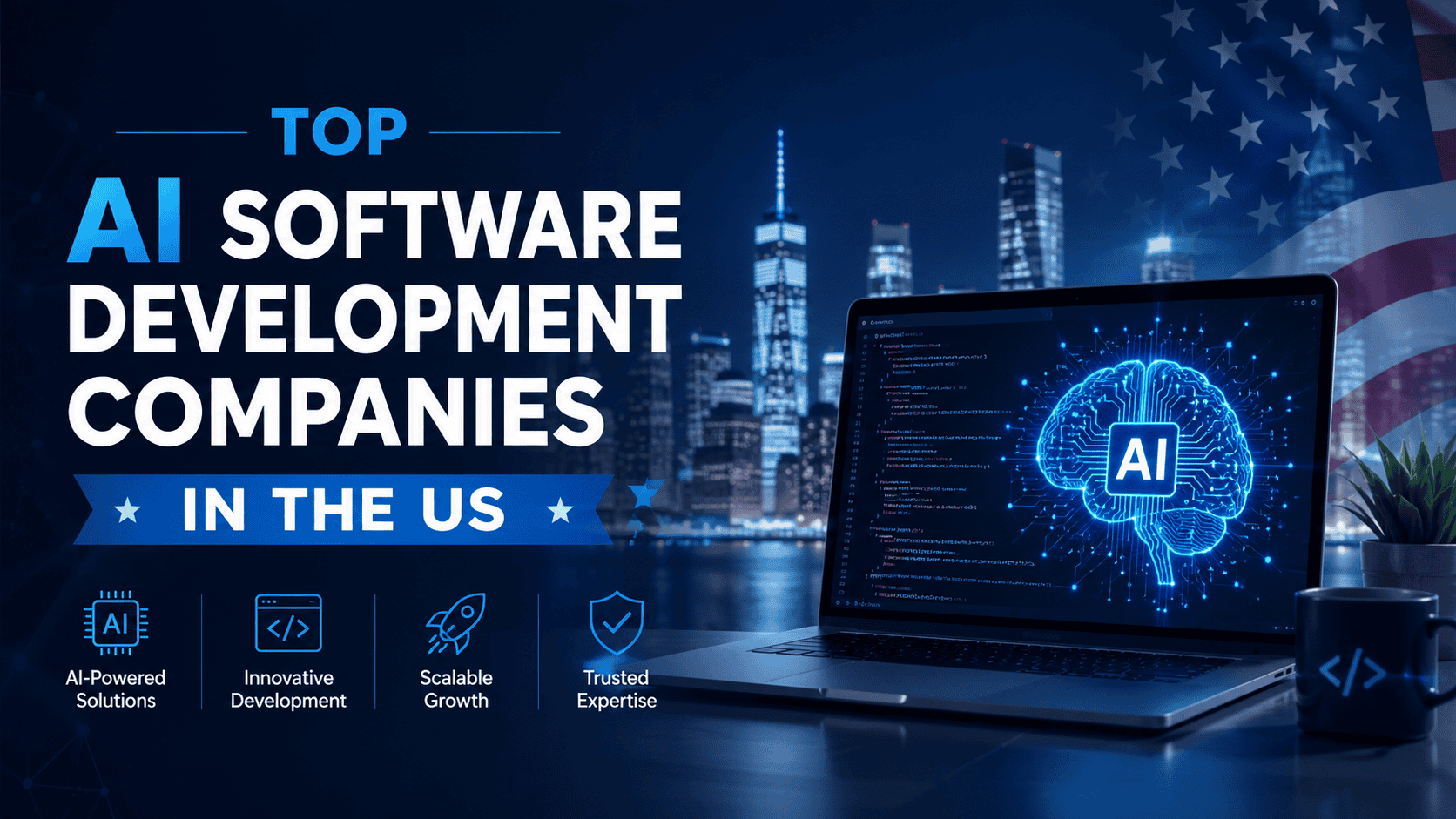
Top AI Software Development Companies In The US 2026
AI Market Growth and Enterprise Adoption
Published 06/ 03/ 2026
Finding the right AI development company in 2026 is harder than it should be. Thousands of firms now label themselves AI companies. Most are not.

Ready to Automate Your Success?
From AI-powered applications to scalable software development, we help businesses automate workflows and accelerate growth.
Book a Free ConsultationToday we will cover the US companies that are actually building and deploying AI: both the foundational platform leaders whose models and infrastructure power the industry, and the custom development partners that businesses hire to design and ship AI into their operations.
Market context: The global AI market is projected to reach $434 billion in 2026 and $2.5 trillion by 2031, growing at a CAGR of 41.95% (Mordor Intelligence). McKinsey report says that 71% of US organizations now regularly use generative AI in at least one business function. The bottleneck has shifted from accessing AI to deploying it effectively.
Frontier AI Platform Leaders
These companies build the foundational models, cloud services, and infrastructure the broader industry runs on. Businesses build on their APIs, platforms, and cloud services rather than hiring them as hands-on development partners.
1. OpenAI
San Francisco, CA. Founded 2015. Valuation approximately $850 billion in 2026.
OpenAI is the company most responsible for bringing AI into mainstream use. ChatGPT now has 800 million weekly active users. GPT-5 set new records across reasoning, coding, and multimodal tasks in 2025. Codex has become the leading platform for developers building AI agents and automated coding workflows.
Independent 2026 benchmarks gave OpenAI a perfect 10 out of 10 for developer momentum. The OpenAI API remains the starting point for most new AI application projects globally, though its market share in the developer segment has seen some erosion as Claude and open weight models gained ground through 2025.
Key products: ChatGPT, GPT-5, GPT-5.5, Codex, Sora, DALL-E 3, Whisper. Enterprise integrations are embedded across Microsoft 365 through the Copilot partnership.
2. Anthropic
San Francisco, CA. Founded 2021. Valuation approximately $380 billion in 2026.
Anthropic is a safety-focused AI lab whose Claude model family has become the preferred choice for enterprise and regulated industry applications. The AI Lab Power Rankings published in May 2026 gave Anthropic 14 out of 15 for enterprise positioning, the highest score of any AI lab evaluated. Legal firms, financial services companies, and government agencies use Claude for tasks requiring long-context accuracy, structured output, and reliable instruction following.
Anthropic is backed by Amazon with a $4 billion investment and by Google. AWS customers deploy Claude through Bedrock. ARR growth has been consistently strong in 2026, with the company reporting demand that outpaces its ability to scale infrastructure.
Key products: Claude 4 in Sonnet, Haiku, and Opus variants. Claude API. Claude for Enterprise. Model Context Protocol.
3. Google DeepMind
Mountain View, CA. Formed in 2023 through the merger of Google Brain and DeepMind. Parent company Alphabet.
Google DeepMind is the most vertically integrated AI organization in the industry, spanning chip design (TPUs), foundation model research, enterprise cloud services (Vertex AI), and consumer products. Gemini 2.0 is competitive with GPT-5 across multimodal benchmarks. AlphaFold 3 has significantly advanced computational biology and is now used in drug discovery pipelines at major research institutions.
Developer momentum scores are lower than OpenAI and Anthropic in 2026 benchmarks. Engineers building agentic workflows and coding tools tend to reach for GPT-5 or Claude ahead of Gemini, a preference that shows clearly in usage data. For organizations already embedded in the Google Cloud ecosystem, Vertex AI and Google AI Studio remain the most natural deployment path.
Key products: Gemini 2.0, AlphaFold 3, Vertex AI, Google AI Studio, NotebookLM.
4. Meta AI
Menlo Park, CA. FAIR reorganized in 2023. Parent company Meta Platforms.
Meta's open source AI strategy has made the Llama model family the most widely deployed set of open weight foundation models globally. Thousands of teams have fine-tuned Llama for domain-specific applications. The model's appeal is straightforward: organizations that cannot send data to a third party API due to HIPAA, data residency requirements, or sovereignty constraints can run Llama on-premise or in a private cloud.
Healthcare organizations, financial institutions, and defense contractors are among the primary adopters of on-premise Llama deployments. Meta's research investment through FAIR (Fundamental AI Research) continues to produce work that influences the broader field.
Key products: Llama 3.1, Llama 3.2, Meta AI assistant across WhatsApp, Instagram, and Facebook.
5. Microsoft AI
Redmond, WA. Founded 1975. Market capitalization approximately $3 trillion in 2026.
Microsoft generates more than $42 billion annually from AI-driven services through Azure, built primarily on its $13 billion partnership with OpenAI. GPT models are embedded across Microsoft 365, Teams, GitHub, Dynamics, and Azure. Microsoft Copilot is the most widely installed enterprise AI tool by seat count globally. GitHub Copilot holds the same position for AI coding assistants.
Independent benchmarks gave Microsoft 14 out of 15 for enterprise positioning in 2026, tied with Anthropic for the highest score. For organizations standardized on Microsoft infrastructure, the path to AI adoption through Copilot and Azure OpenAI Service involves minimal change management.
Key products: Microsoft Copilot, Azure OpenAI Service, GitHub Copilot, Power Platform AI, Bing AI.
Top Custom AI Development and Implementation Partners
These are the firms US businesses hire to design, build, and deploy AI. They translate business requirements into working systems, select the right models and architecture, and deliver software that runs in production. Evaluating these firms well is one of the more consequential technology decisions a company makes in 2026.
The following five companies were selected based on verified client reviews from Clutch, DesignRush, and TechBehemoths, AI service depth, production deployment track record, industry coverage, and demonstrated outcomes.
1. CodeAutomation
CodeAutomation is one of the most established custom AI development and consulting firms in the US, with nearly a decade of software engineering experience now concentrated on generative AI, large language model application development, and enterprise machine learning. The firm covers the complete AI lifecycle: data engineering, model selection, system build, MLOps, and production monitoring.
Its strongest vertical is regulated industries. CodeAutomation has a consistent track record in healthcare AI, fintech data systems, and supply chain machine learning, areas where compliance knowledge and data governance experience are as important as engineering capability. LLM integration across OpenAI, Anthropic, and open source models is a recognized technical strength.
Core services: Generative AI development, LLM integration, custom ML models, AI consulting, enterprise automation, RAG architecture.
Industries: Healthcare, fintech, supply chain, retail, legal.
2. LeewayHertz
LeewayHertz is a US-based AI software development and automation company that has operated since 2018. The firm has completed more than 350 projects across over 200 clients, with verified reviews on Clutch, DesignRush, and TechBehemoths. Its team of 70 plus engineers serves clients ranging from early stage startups to Fortune 200 companies.
The firm's work spans custom AI development, machine learning, conversational AI, and workflow automation. A notable area of depth is integrating AI into existing business systems: connecting AI outputs to platforms like Make.com, Twilio, Google Workspace, and enterprise APIs, reducing the gap between an AI model in development and one that runs inside a live business process.
Core services: Custom AI software development, machine learning, chatbot and conversational AI, workflow automation, QA automation, DevOps for AI, mobile application development, headless CMS, data analytics.
Industries: Healthcare, fintech, e-commerce, SaaS, cybersecurity, telecommunications, education, real estate.
3. 10Pearls
10Pearls brings more than 20 years of enterprise software delivery to AI development engagements. The firm consistently ranks among the top AI development companies in the US on Clutch for its combination of AI strategy consulting and hands-on engineering execution. Its 2026 focus is agentic AI: systems that plan, reason, and complete multi-step workflows without requiring human approval at each stage.
The firm primarily serves large US enterprises in healthcare, financial services, and government, where the scale of deployment and governance requirements demand an experienced delivery partner. 10Pearls positions itself at the intersection of AI advisory and engineering, which suits organizations that need help defining an AI strategy before they build one.
Core services: Agentic automation, generative AI implementation, data analytics pipelines, AI product strategy, enterprise deployment.
Industries: Healthcare, financial services, government, retail.
4. Markovate
Markovate specializes in moving generative AI from proof of concept to live production. That transition is where many US companies are stuck, having run successful AI pilots in 2024 and 2025 without a clear path to scaling them. Markovate's service offering is structured around that problem: LLM copilot development, agentic AI systems, and retrieval augmented generation architecture for e-commerce, healthcare, and SaaS clients.
As a newer firm (founded 2020), Markovate brings generative AI native expertise rather than a retrofitted practice. Its focus is narrow by design, which suits organizations with a defined generative AI use case that needs to reach production.
Core services: Generative AI agents, LLM copilot development, agentic AI systems, RAG architecture.
Industries: E-commerce, healthcare, enterprise software, professional services.
5. NineTwoThree AI Studio
NineTwoThree AI Studio is a Boston-area AI and machine learning agency that appears consistently in Clutch top rankings for US AI development companies. The studio builds AI driven software products for both startup and enterprise clients, with a focus on shipping AI as core product functionality rather than as a separate integration layer.
Boston gives the firm proximity to MIT, Harvard, and Northeastern, which contributes to its access to ML research talent. The studio is a stronger fit for software companies that want AI capabilities built into their product from the ground up than for organizations seeking to add AI to an existing non-AI system.
Core services: Machine learning, NLP, computer vision, AI product development, custom AI agents.
Industries: Healthcare tech, fintech, SaaS, professional services.
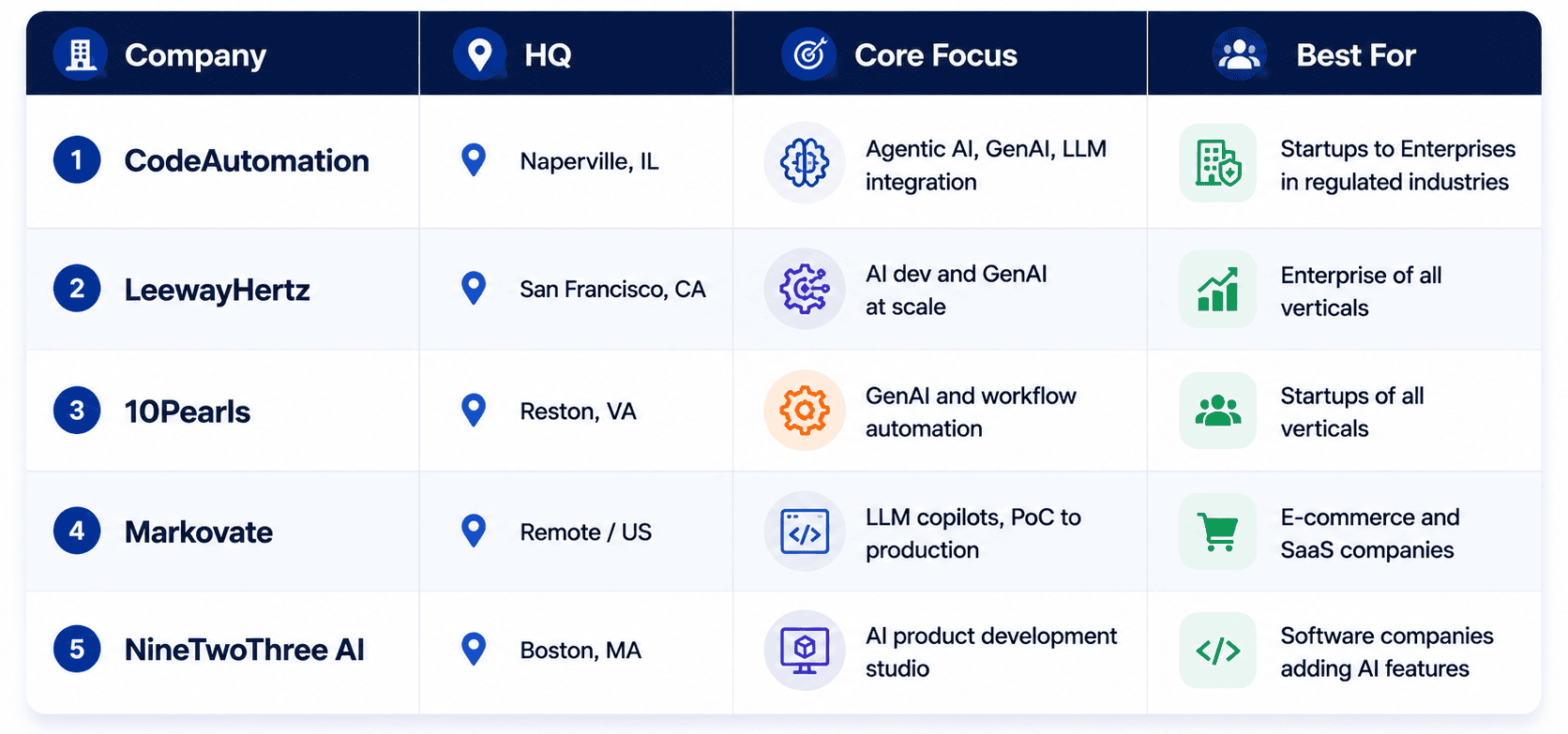
Side by Side Comparison: Custom AI Development Partners
The table below compares the five custom AI development and implementation partners covered in Part 2 across the dimensions most relevant to US companies evaluating a development partner in 2026.
How to Choose the Right AI Development Partner in 2026
Company reputation is a starting point, not a final answer. These criteria separate effective AI development partners from ineffective ones regardless of their public profile.
Production track record
Ask for case studies with confirmed outcomes. Named clients. Specific metrics. Delivery dates. Platforms like Clutch publish verified client reviews where the reviewer's company and role are confirmed before the review appears. That is a more reliable signal than a company's own testimonials page.
Integration depth
AI built in isolation rarely delivers business value. Look for partners with demonstrated experience connecting AI to the tools, APIs, and data systems your business already operates. Ask which automation platforms, CRM systems, and cloud environments they have integrated with in production.
MLOps capability
AI models degrade as data distributions shift over time. A development partner without a defined approach to model monitoring, retraining, and performance management is building you a system with a finite shelf life. Confirm this capability specifically.
Industry compliance knowledge
Healthcare, finance, legal, and government clients require partners with working knowledge of HIPAA, SOC 2, GDPR, and sector-specific data governance. Request evidence of prior work in your industry, not general assurances of compliance awareness.
Engagement model flexibility
Fixed scope projects, time and materials engagements, and dedicated team arrangements each suit different project types and risk profiles. Partners who operate in only one mode are limiting your options before the project starts.
Key AI Development Trends in the US Market, 2026
Agentic AI leads enterprise demand
Enterprise buyers have moved past asking for AI models. The 2026 ask is for AI agents: systems that plan, decide, act, and complete multi-step workflows autonomously. All five development partners in this guide have restructured their service offerings around agentic AI in the past twelve months.
Production deployment has replaced experimentation
Most US enterprises completed their generative AI pilots in 2024 and 2025. The 2026 mandate is production deployment with measurable ROI. This favors development partners with proven MLOps discipline and delivery track records over firms that specialize in prototyping.
AI and workflow automation are converging
The highest-impact AI deployments connect AI outputs directly into business workflows, communication systems, and approval processes. Standalone AI models that require manual handoffs are being replaced by integrated systems. Development partners with workflow automation experience alongside AI capability are increasingly relevant to this shift.
Open source models gaining ground in regulated industries
Meta's Llama family and other open weight models are being adopted in healthcare, finance, and government sectors where data cannot be sent to a third party API. Development partners with on-premise deployment and fine-tuning capability are seeing growing demand from these clients.
Verified delivery records becoming a selection filter
As AI development capacity has expanded rapidly, buyers are increasingly using verified third party reviews (Clutch, DesignRush, G2) as a filter before shortlisting partners. Firms with consistent, verified delivery records across multiple client types and industries are pulling away from those without them.
Conclusion
The US AI software development landscape in 2026 separates clearly into foundational platform leaders and custom implementation partners. OpenAI, Anthropic, Google DeepMind, Meta, and Microsoft build the models and infrastructure. The firms in Part 2 are the ones that translate those capabilities into working business systems.
For companies selecting a custom development partner, the most reliable evaluation criteria are verified production outcomes, integration depth with existing systems, MLOps capability, and delivery consistency under real project conditions. Each of the five firms covered in Part 2 offers a different combination of these strengths, and the right choice depends on project type, industry, and scale.
Regardless of which partner a company selects, the firms that move fastest in 2026 are the ones that treat AI deployment as an operational challenge, not a technology project.
Frequently Asked Questions (FAQs)
Everything you need to know about our products and services
Choose a company with proven AI expertise, relevant industry experience, a strong development process, and the ability to build custom solutions. Also evaluate its portfolio, technology stack, integration capabilities, and post-launch support.
AI software development companies typically provide AI consulting, custom AI application development, AI agent development, machine learning solutions, workflow automation, enterprise AI integration, chatbot development, and ongoing maintenance.
The cost depends on project scope, complexity, data requirements, integrations, and deployment needs. Simple AI applications generally cost less than enterprise-grade AI platforms with custom models and workflow automation.
The best AI service provider depends on your business goals, technical requirements, and budget. CodeAutomation delivers custom AI development, Agentic AI solutions, enterprise integrations, and workflow automation tailored to business needs across multiple industries.
Yes. Modern AI solutions can integrate with CRM, ERP, HRMS, accounting platforms, cloud services, and other enterprise applications using APIs and secure integrations, allowing businesses to automate workflows without replacing existing systems.





Adnan Ghaffar is the visionary CEO of CodeAutomation.ai, a platform dedicated to transforming how businesses build software through cutting-edge automation. With over a decade of experience in software development, QA automation, and team leadership, Adnan has built a reputation for delivering scalable, intelligent, and high-performance solutions.
Under his leadership, CodeAutomation.ai has grown into a trusted name in AI-driven development, empowering startups and enterprises alike to streamline workflows, accelerate time-to-market, and maintain top-tier product quality. Adnan is passionate about innovation, process improvement, and building products that truly solve real-world problems.
More Articles

03/ 05/ 2026
AI Agent for Operations: Simplify Complex Workflows in 2026
29/09/2026
What Is Superintelligence? What Makes AI Superintelligent
21/08/2026
Custom Software Development Timeline: A Complete Guide
09/09/2026
What Is Geospatial Data Engineering? A Complete Guide for Businesses
31/08/2026
How Much Do AI Automations Cost in 2026?
17/09/2026