























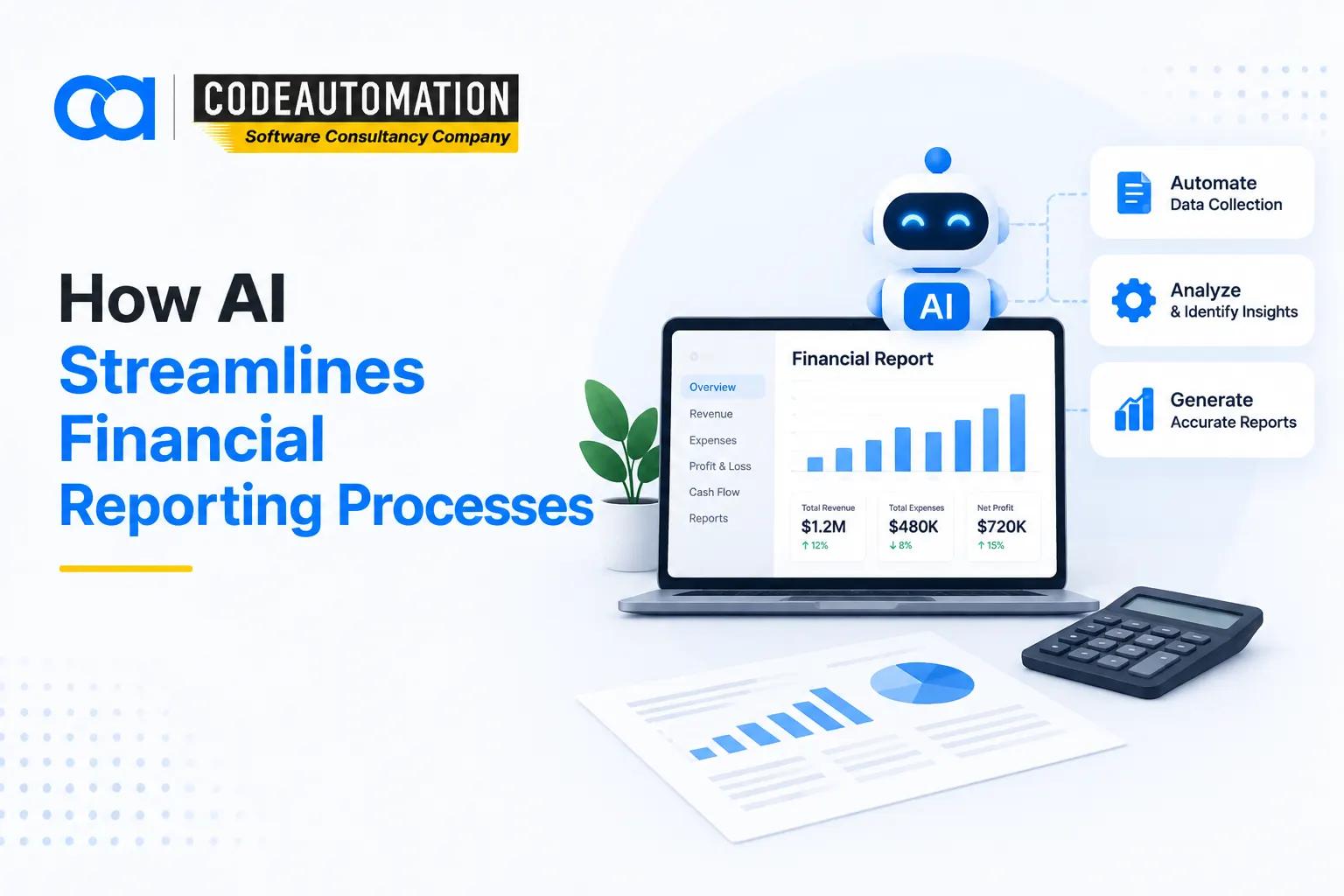
How AI Streamlines Financial Reporting: Processes, Benefits, and Use Cases
Published 10/09/2026
Financial reporting has traditionally depended on manual data collection, spreadsheet management, reconciliation, and review processes. As businesses grow, finance teams often spend significant time preparing reports instead of analyzing insights that support strategic decisions.

Ready to Automate Your Success?
From AI-powered applications to scalable software development, we help businesses automate workflows and accelerate growth.
Book a Free ConsultationFinancial reporting has traditionally depended on manual data collection, spreadsheet management, reconciliation, and review processes. As businesses grow, finance teams often spend significant time preparing reports instead of analyzing insights that support strategic decisions.
AI is changing this process by automating repetitive reporting tasks, improving data accuracy, identifying financial patterns, and helping teams generate insights faster.
AI-powered financial reporting can help organizations:
- Automate data collection and consolidation
- Reduce manual reporting errors
- Generate financial summaries
- Improve forecasting accuracy
- Identify unusual financial patterns
- Support compliance and audit processes
Instead of replacing finance teams, AI helps them move from manual report preparation toward higher-value analysis and decision-making.
What Is AI in Financial Reporting?
AI in financial reporting refers to the use of artificial intelligence technologies to automate, analyze, and improve financial reporting activities.
Traditional reporting relies heavily on:
- Manual spreadsheet updates
- Data extraction from multiple systems
- Human verification
- Repetitive calculations
AI-powered reporting introduces automation through technologies such as:
- Machine learning
- Generative AI
- Natural language processing
- Robotic process automation
- AI agents
These technologies allow financial systems to process large volumes of information, identify patterns, and generate actionable insights.
For example:
Traditional process:
Financial data collected → Spreadsheet preparation → Manual review → Report creation
AI-powered process:
Financial data collected → AI validates information → Detects anomalies → Generates report insights
How AI Streamlines Financial Reporting Processes
Automating Financial Data Collection
One of the biggest challenges in financial reporting is gathering information from multiple sources.
Finance teams often collect data from:
- Accounting systems
- ERP platforms
- CRM systems
- Spreadsheets
- Banking systems
- Operational databases
AI automation can connect these sources, extract relevant information, and prepare data for reporting.
This reduces the time spent on manual data gathering and allows finance teams to work with more accurate and up-to-date information.
Improving Financial Data Accuracy
Manual reporting processes often create risks such as:
- Data entry mistakes
- Duplicate records
- Missing information
- Calculation errors
AI can analyze financial data, detect inconsistencies, and highlight unusual patterns before reports are finalized.
Examples:
- Identifying incorrect transactions
- Detecting unusual expense changes
- Finding missing financial records
This helps businesses improve reporting reliability.
Automating Report Generation
Creating financial reports requires significant time, especially when teams need multiple versions for different stakeholders.
AI can assist with:
- Generating financial summaries
- Creating management reports
- Explaining financial changes
- Preparing draft reporting documents
Generative AI can also help create narrative explanations around financial results, while human teams maintain review and approval control.
Enhancing Financial Forecasting
AI helps finance teams move beyond historical reporting by identifying future trends.
Machine learning models can analyze:
- Previous financial performance
- Market changes
- Revenue patterns
- Customer behavior
- Operational costs
This enables businesses to create more accurate:
- Revenue forecasts
- Budget predictions
- Cash flow projections
- Risk assessments
Supporting Compliance and Audit Processes
Financial reporting requires accuracy, consistency, and regulatory compliance.
AI can support compliance activities by:
- Reviewing financial documents
- Checking reporting requirements
- Identifying unusual transactions
- Maintaining reporting consistency
AI-powered audit technologies can analyze large amounts of financial information and help identify potential issues faster.
Key Financial Reporting Tasks AI Can Automate
Month-End Closing
Month-end closing requires finance teams to collect, verify, and reconcile large amounts of data.
AI can help automate:
- Account reconciliation
- Transaction matching
- Error identification
- Financial summaries
This reduces closing time and allows teams to focus on reviewing results.
Financial Forecasting and Planning
AI improves forecasting by analyzing historical and real-time business data.
Common applications include:
- Revenue prediction
- Expense forecasting
- Budget planning
- Scenario analysis
Finance teams can make decisions using data-driven projections instead of relying only on manual estimates.
Management Reporting
Executives often need customized reports for decision-making.
AI can help create:
- Performance summaries
- KPI reports
- Trend analysis
- Business insights
Instead of manually preparing multiple reports, teams can use AI-generated insights and focus on strategic analysis.
Account Reconciliation
Account reconciliation is one of the most repetitive finance activities.
AI can:
- Match transactions automatically
- Identify mismatches
- Highlight exceptions
- Reduce manual verification
This improves efficiency while maintaining financial accuracy.
Technologies Powering AI Financial Reporting
Generative AI
Generative AI helps finance teams create and interpret reporting content.
Common uses:
- Financial summaries
- Report explanations
- Document analysis
- Management commentary
Machine Learning
Machine learning identifies patterns in financial data.
Common uses:
- Forecasting
- Risk prediction
- Anomaly detection
- Trend analysis
Robotic Process Automation (RPA)
RPA automates repetitive rule-based finance tasks.
Examples:
- Data transfer
- Invoice processing
- Report generation
- System updates
AI Agents
AI agents represent the next stage of financial automation.
They can assist with:
- Collecting financial information
- Preparing reports
- Answering finance questions
- Triggering workflow actions
AI agent-based systems are being explored for automating complex finance workflows such as reporting and ERP-related processes.
Benefits of AI-Powered Financial Reporting
Faster Reporting Cycles
AI reduces the time required for:
- Data preparation
- Report creation
- Financial analysis
Finance teams can access insights faster and respond quickly to business changes.
Reduced Manual Work
Automation removes repetitive activities such as:
- Data entry
- Spreadsheet updates
- Report formatting
- Transaction matching
This allows finance professionals to focus on strategic activities.
Better Decision-Making
AI provides deeper insights by analyzing large datasets and identifying patterns that may not be visible through traditional reporting.
Improved Accuracy
Automated validation and anomaly detection help reduce reporting mistakes.
Real-Time Financial Visibility
AI enables organizations to move from periodic reporting toward continuous financial monitoring.
Challenges of Using AI for Financial Reporting
Although AI provides significant advantages, businesses should consider several challenges.
Data Quality Issues
AI depends on accurate data.
Poor-quality financial data can affect:
- Analysis results
- Forecast accuracy
- Reporting reliability
Security and Privacy
Financial information is sensitive.
Organizations should evaluate:
- Data protection
- Access controls
- AI governance
- Compliance requirements
Human Oversight
AI-generated reports and insights still require human review.
Finance teams should validate:
- Accuracy
- Business context
- Regulatory requirements
Integration Complexity
Many organizations use multiple financial systems.
Successful AI adoption requires proper integration with:
- ERP systems
- Accounting software
- Data platforms
How Businesses Can Implement AI in Financial Reporting
Step 1: Identify Manual Reporting Challenges
Start by identifying processes that consume significant time.
Examples:
- Data collection
- Report preparation
- Reconciliation
- Forecasting
Step 2: Connect Financial Data Sources
AI solutions require access to relevant business information.
Common integrations include:
- ERP systems
- Accounting platforms
- CRM systems
- Data warehouses
Step 3: Automate Repetitive Processes
Begin with high-impact workflows such as:
- Data extraction
- Report generation
- Validation processes
Step 4: Monitor AI Performance
Businesses should continuously evaluate:
- Accuracy
- Efficiency improvements
- Reporting quality
When Businesses Need Custom AI Financial Reporting Solutions
Existing AI tools can support common reporting requirements, but some organizations need customized solutions.
Custom AI financial reporting automation is useful when businesses have:
- Multiple disconnected systems
- Industry-specific reporting requirements
- Complex approval workflows
- Large volumes of financial data
A customized solution can connect existing systems, automate unique processes, and create reporting workflows designed around specific business needs.
Build AI-Powered Financial Reporting Automation Solutions
Financial reporting automation is not only about generating reports faster. The real value comes from creating intelligent workflows that connect financial data, automate repetitive processes, and provide actionable business insights.
CodeAutomation helps businesses build AI-powered automation solutions that integrate with existing systems and improve operational efficiency.
Our AI automation solutions can help organizations:
- Automate financial workflows
- Connect business applications
- Build intelligent reporting systems
- Improve data-driven decision-making
Explore our AI business automation solutions to create customized automation workflows for your business.
Final Thoughts
AI is transforming financial reporting from a manual reporting activity into an intelligent decision-support process.
By automating repetitive tasks, improving accuracy, and providing predictive insights, AI helps finance teams spend less time preparing reports and more time driving business strategy.
Organizations that combine AI automation with strong financial processes can build faster, more accurate, and scalable reporting systems.
Frequently Asked Questions (FAQs)
Everything you need to know about our products and services
AI improves financial reporting by automating data collection, reducing manual errors, generating reports, improving forecasting, and identifying financial patterns.
AI can automate data extraction, account reconciliation, report generation, forecasting, compliance checks, and financial analysis.
No. AI supports finance teams by reducing repetitive work and improving analysis. Human expertise is still required for decision-making, review, and compliance.
Common technologies include generative AI, machine learning, robotic process automation, natural language processing, and AI agents.
AI financial reporting can be secure when organizations implement proper data protection, access controls, governance policies, and compliance measures.





Adnan Ghaffar is the visionary CEO of CodeAutomation.ai, a platform dedicated to transforming how businesses build software through cutting-edge automation. With over a decade of experience in software development, QA automation, and team leadership, Adnan has built a reputation for delivering scalable, intelligent, and high-performance solutions.
Under his leadership, CodeAutomation.ai has grown into a trusted name in AI-driven development, empowering startups and enterprises alike to streamline workflows, accelerate time-to-market, and maintain top-tier product quality. Adnan is passionate about innovation, process improvement, and building products that truly solve real-world problems.
More Articles
Why Do 85% of AI Projects Fail? (And How to Be in Winning 15%)

05/ 11/ 2025
How Software and QA Testing Services help reduce post release chaos for scaling SaaS teams

17 March 2026
Step-by-Step Guide to Mobile App Development

02/10/2026
What Is an Intelligence Explosion and How Could It Happen?

06/ 03/ 2026
Top AI Software Development Companies In The US 2026

08/09/2026