














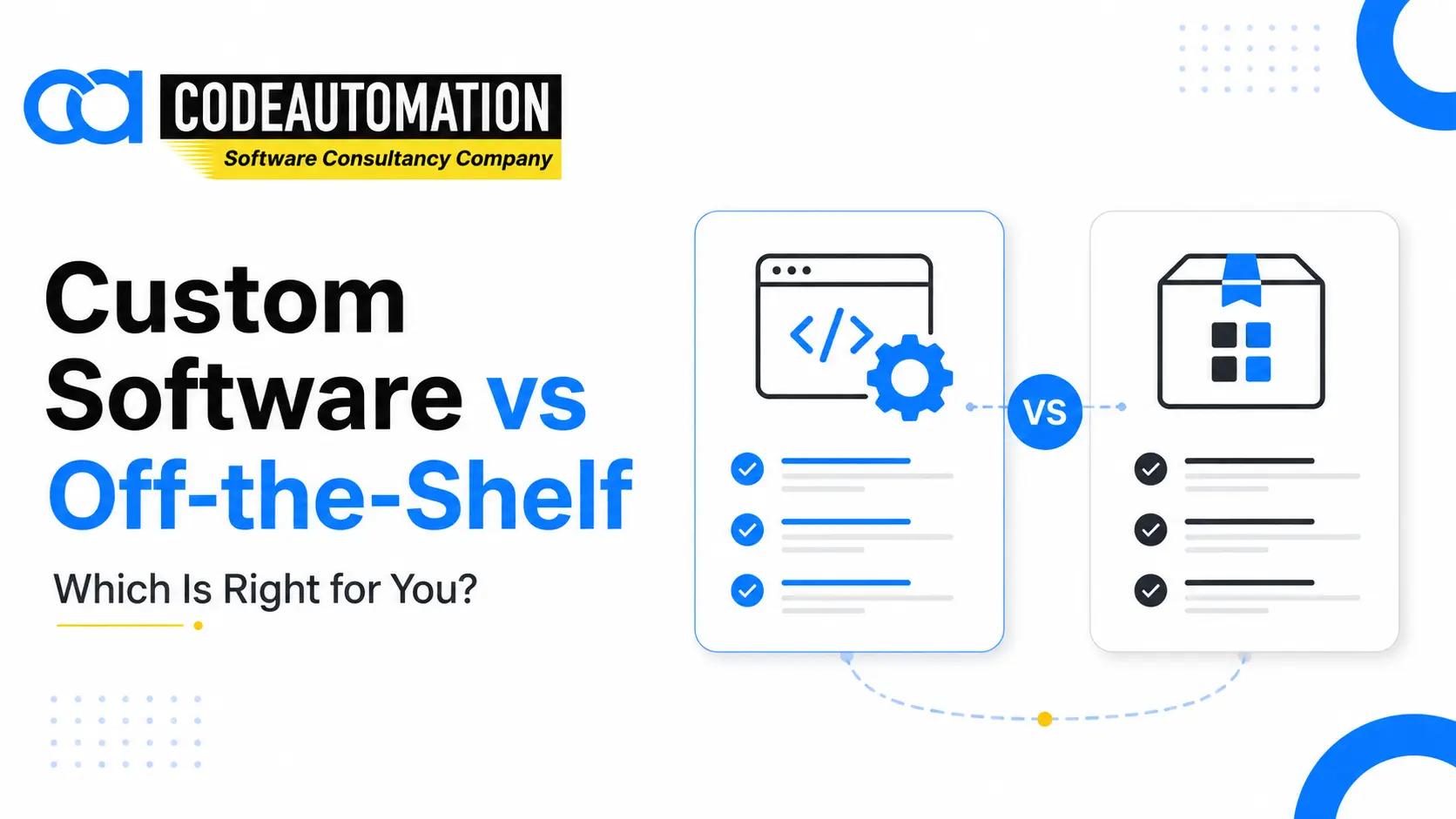
Custom Software vs. Off-the-Shelf Software: Which Is Right for Your Business?
Published 20/08/2026
Custom software is built around a business's specific workflows, integrations, and requirements, while off-the-shelf software is designed for a broader market and can usually be adopted faster at a lower upfront cost. The better choice depends on how unique your processes are, how quickly you need the software, and how much control you need over the system.

Ready to Automate Your Success?
From AI-powered applications to scalable software development, we help businesses automate workflows and accelerate growth.
Book a Free ConsultationChoosing the right software solution is an important decision for businesses looking to improve operations, automate processes, and support long-term growth. The wrong choice can result in unnecessary expenses, inefficient workflows, limited flexibility, or technology that cannot keep up with changing business needs.
When evaluating software options, businesses typically choose between custom software development and off-the-shelf software.
Custom software is designed specifically around a company’s workflows, requirements, and objectives. Off-the-shelf software is a ready-made solution created for a broader market and can usually be implemented faster with lower upfront costs.
Neither option is universally better. The right choice depends on factors such as your business processes, budget, timeline, integration requirements, scalability goals, and the level of control you need over your technology.
This guide explains the key differences between custom software and off-the-shelf software to help you make an informed decision.
What Is Custom Software?
Custom software is an application built specifically for the needs of a particular organization. Instead of adjusting business processes to fit an existing tool, businesses can create software that supports their workflows, goals, and operational requirements.
A custom solution may include specialized features such as:
- Automated business workflows
- Custom dashboards and reporting
- Internal management systems
- Customer portals
- Industry-specific applications
- Advanced integrations with existing tools
For example, a company with unique approval processes, complex data requirements, or multiple connected systems may find that standard software creates unnecessary limitations. Custom development allows those processes to be built directly into the software.
The biggest advantage of custom software is flexibility. Businesses can create a solution that matches their current operations while planning for future improvements.
However, custom software requires more upfront investment and development time because the solution must be researched, designed, built, tested, and maintained according to specific business requirements.
What Is Off-the-Shelf Software?
Off-the-shelf software is a pre-built application developed for a wide range of users or organizations. These solutions are designed to solve common business problems and are usually available through subscriptions, licensing, or usage-based pricing.
Examples include:
- Customer relationship management (CRM) platforms
- Accounting software
- Project management tools
- Marketing automation platforms
- Communication solutions
The main benefit of off-the-shelf software is speed. Businesses can often purchase, configure, and start using these tools quickly without going through a complete development process.
These solutions also usually include:
- Existing features
- Vendor support
- Documentation
- Regular updates
- Security improvements
The limitation is flexibility. Since these products are designed for many businesses, they may not fully match specialized workflows or unique operational requirements. Companies may need to adjust their processes or rely on additional plugins and integrations to achieve the desired functionality.
Custom Software vs. Off-the-Shelf Software: Key Differences
Cost
Cost is often the first factor businesses consider when choosing software.
Off-the-shelf software generally requires a lower initial investment because development costs are shared among many users. Businesses typically pay through monthly subscriptions, annual licenses, or usage-based pricing.
Custom software usually requires a higher upfront investment because the solution is designed and developed specifically for one organization.
However, initial price alone does not always determine the true cost of software. Businesses should also consider:
- Subscription fees over time
- Additional licenses
- Customization costs
- Integration expenses
- Migration requirements
- Maintenance needs
- Productivity losses caused by inefficient workflows
A cheaper software option may become more expensive if it requires constant workarounds or additional tools to support business operations.
Development Time
The time required to implement software is another major difference.
Off-the-shelf software already exists, meaning businesses can usually configure the system and begin using it quickly.
Custom software requires a structured development process that includes:
- Requirement analysis
- Software architecture planning
- UI/UX design
- Development
- Quality assurance testing
- Deployment
- Ongoing improvements
The timeline depends on project complexity, required features, integrations, and business goals.
For businesses that need an immediate solution for standard requirements, off-the-shelf software may be the better choice.
For organizations that require specific functionality or long-term flexibility, investing time in custom development can provide greater value.
Customization
Customization is one of the biggest advantages of custom software.
Off-the-shelf solutions usually provide settings, plugins, extensions, and configuration options. However, businesses are limited by what the vendor allows.
Custom software is created around specific requirements, allowing businesses to develop:
- Unique workflows
- Custom user experiences
- Automated processes
- Specialized reports
- Industry-specific features
This is especially valuable for businesses where technology plays an important role in improving efficiency or creating a competitive advantage.
Instead of changing internal processes to match software limitations, companies can build technology that supports the way their teams already work.
Scalability
Scalability determines whether software can continue supporting a business as it grows.
Off-the-shelf platforms can scale effectively when business needs match the capabilities provided by the vendor. However, companies may eventually encounter limitations related to:
- User limits
- Data volume
- Feature availability
- Integration restrictions
- Vendor pricing structures
Custom software can be designed with future growth in mind. Businesses can plan the architecture around expected users, workflows, data requirements, and expansion goals.
However, custom software is not automatically scalable. A successful solution depends on proper planning, architecture decisions, technology choices, and ongoing maintenance.
Integrations
Modern businesses rely on multiple systems working together, including:
- CRMs
- Accounting platforms
- ERP systems
- Payment solutions
- Marketing tools
- Internal databases
- Third-party APIs
Off-the-shelf software usually supports popular integrations, but specialized or older systems may not always be compatible.
Custom software provides greater flexibility when businesses require specific integrations or need multiple systems connected through custom workflows.
A well-designed custom solution can help businesses reduce manual processes, improve data flow, and create a more connected technology environment.
Security
Security is an important consideration when selecting software, especially for businesses handling sensitive customer information, financial data, healthcare records, or confidential company information.
Off-the-shelf software providers typically invest heavily in security measures because they support many customers. These solutions may include:
- Regular security updates
- Data encryption
- Access controls
- Compliance certifications
- Vulnerability monitoring
However, businesses have limited control over how security features are implemented or changed.
Custom software allows organizations to design security based on their specific requirements. Businesses can implement:
- Custom user permissions
- Role-based access controls
- Security policies aligned with internal processes
- Industry-specific compliance requirements
- Additional monitoring and protection layers
For industries with strict compliance requirements, custom software can provide greater control over how data is handled and protected.
Maintenance
Every software solution requires ongoing maintenance to remain reliable, secure, and compatible with changing business needs.
With off-the-shelf software, maintenance is usually handled by the vendor. Updates, bug fixes, security patches, and improvements are included as part of the subscription or licensing agreement.
However, businesses depend on the vendor’s priorities and release schedule. Changes that are important to your organization may not always be prioritized.
With custom software, maintenance is managed by your internal team or a dedicated development partner. This provides more control over:
- Feature improvements
- Performance optimization
- Security updates
- System upgrades
- New integrations
While custom software requires ongoing investment, businesses gain more control over the future direction of their technology.
Ownership and Control
Ownership is another important difference between custom and off-the-shelf software.
When using off-the-shelf software, businesses typically purchase a license to use the product. The vendor owns the platform, controls updates, and decides the future roadmap.
This means businesses may face challenges such as:
- Pricing changes
- Feature removals
- Vendor limitations
- Platform dependency
Custom software provides greater ownership and control. Depending on the agreement, businesses may own the source code and have more freedom to modify, expand, and manage the system.
For companies building technology that supports their competitive advantage, having greater control can be a significant benefit.
Advantages of Custom Software
Tailored Functionality
Custom software is designed around your business requirements rather than forcing your processes to fit a generic platform.
Every feature, workflow, and interface can be created based on how your team operates.
Better Business Process Alignment
A custom solution can automate existing workflows and remove unnecessary manual tasks.
Instead of adapting your business around software limitations, the software adapts to your business.
Greater Scalability
Custom applications can be planned around future growth, allowing businesses to add new features, users, integrations, and capabilities as requirements evolve.
Flexible Integrations
Custom development makes it possible to connect specialized systems, legacy platforms, databases, and third-party services that may not be supported by standard software.
Competitive Advantage
A software solution built specifically around your operations can improve efficiency, customer experience, and decision-making in ways that generic tools cannot always provide.
Advantages of Off-the-Shelf Software
Faster Implementation
Since the software is already developed, businesses can start using it much faster compared to building a solution from scratch.
Lower Initial Investment
Subscription-based pricing makes off-the-shelf software more accessible for businesses that need immediate functionality without a large upfront cost.
Proven Features
Established software products usually have tested features, user feedback, documentation, and a mature support system.
Vendor Support and Updates
Most vendors handle maintenance, security updates, infrastructure improvements, and product enhancements.
This reduces the technical workload for businesses that do not require extensive customization.
Custom Software vs SaaS: What Is the Difference?
Software as a Service (SaaS) is a type of off-the-shelf software delivered through the cloud using a subscription model.
Examples include CRM platforms, accounting tools, marketing platforms, and collaboration software.
SaaS solutions are attractive because they offer:
- Fast deployment
- Predictable subscription costs
- Vendor-managed maintenance
- Ready-to-use features
However, SaaS platforms also come with limitations:
- Limited customization
- Dependency on vendor roadmap
- Possible restrictions on integrations
- Less control over data and functionality
Custom software provides greater flexibility and ownership but requires more investment in development and maintenance.
The right choice depends on whether your business needs speed and convenience or deeper control and customization.
Can Businesses Combine Custom Software and Off-the-Shelf Solutions?
Yes. Many organizations use a hybrid approach by combining custom development with existing software platforms.
For example, a company may use:
- A CRM platform for customer management
- Accounting software for financial operations
- Custom software to automate internal workflows and connect different systems
This approach allows businesses to benefit from proven tools while creating custom solutions where they provide the most value.
A hybrid strategy is often useful for companies that want flexibility without replacing every existing system.
Understanding Total Cost of Ownership
When comparing software options, businesses should look beyond the initial price and evaluate the total cost of ownership.
The overall cost may include:
- Development or subscription fees
- Customization expenses
- Integration costs
- Training
- Maintenance
- Infrastructure
- Security requirements
- Future improvements
An inexpensive solution may become costly over time if it requires multiple add-ons, manual processes, or frequent workarounds.
Similarly, custom software may require a larger initial investment but provide better long-term value through improved efficiency and reduced operational limitations.
When Should You Choose Custom Software?
Custom software development is usually the better choice when:
- Your business has unique workflows
- Existing software requires too many compromises
- You need advanced integrations
- Your processes provide a competitive advantage
- You require complete control over features and functionality
- Your business expects significant growth
- You operate in a highly regulated industry
Custom software is especially valuable when technology is not just a supporting tool but a core part of how your business operates.
When Should You Choose Off-the-Shelf Software?
Off-the-shelf software may be the right choice when:
- Your requirements are standard
- You need a solution quickly
- Budget is limited
- Existing tools already solve your business problem
- Extensive customization is unnecessary
- Vendor-managed updates are preferred
For many small businesses and teams with common requirements, ready-made solutions provide excellent value.
How to Decide Between Custom Software and Off-the-Shelf Software
Before making a decision, evaluate the following questions:
1. Does existing software support your workflow?
If available solutions cover most of your requirements, off-the-shelf software may be sufficient.
2. Are your processes unique?
If your workflows are different from standard business operations, custom software may provide better results.
3. Will your requirements grow?
Consider whether your software needs will change as your business expands.
4. Do integrations matter?
If your business depends on multiple systems working together, custom development may provide more flexibility.
5. What is the long-term impact?
Look beyond initial costs and consider efficiency, scalability, maintenance, and future requirements.
Build the Right Software Strategy for Your Business
Choosing between custom software and off-the-shelf software depends on your business goals, operational requirements, and future plans.
Off-the-shelf software provides speed, affordability, and convenience for businesses with standard needs.
Custom software provides flexibility, scalability, and control for organizations that require solutions designed around their unique processes.
The best approach is not always the most expensive or the fastest option. It is the solution that creates the greatest long-term value for your business.
Need Custom Software Built Around Your Business?
At CodeAutomation.ai, we help businesses design and develop custom software solutions that improve efficiency, automate workflows, and support long-term growth.
Talk to our experts today to discuss your software requirements and get a tailored project estimate.
Frequently Asked Questions (FAQs)
Everything you need to know about our products and services
Neither option is better for every business. Custom software is ideal for companies with unique workflows, complex integrations, or specific scalability requirements. Off-the-shelf software works well for businesses with standard needs that require faster implementation.
Custom software usually requires a higher upfront investment because it is built specifically for your business. However, it may provide better long-term value by reducing workarounds, improving efficiency, and avoiding unnecessary software limitations.
Businesses should consider custom software when existing solutions cannot support their workflows, require extensive modifications, or limit future growth. It is also beneficial when technology provides a competitive advantage.
Yes. Custom software can be developed to connect with existing systems such as CRMs, ERPs, payment platforms, databases, and third-party applications.
Usually, yes. The vendor typically manages updates, security patches, and infrastructure. However, businesses have less control over changes and future product decisions.





Adnan Ghaffar is the visionary CEO of CodeAutomation.ai, a platform dedicated to transforming how businesses build software through cutting-edge automation. With over a decade of experience in software development, QA automation, and team leadership, Adnan has built a reputation for delivering scalable, intelligent, and high-performance solutions.
Under his leadership, CodeAutomation.ai has grown into a trusted name in AI-driven development, empowering startups and enterprises alike to streamline workflows, accelerate time-to-market, and maintain top-tier product quality. Adnan is passionate about innovation, process improvement, and building products that truly solve real-world problems.
More Articles
16/09/2026
Best AI Marketing Automation Tools for Businesses in 2026

7 Benefits of Using Agentic AI in Your Business in 2026

03/ 10/ 2026
Web Application Development Services for Growing Businesses
22/08/2026
What are the benefits of custom software?
17/09/2026
GeoAI for Real Estate: How Artificial Intelligence Is Transforming Property Decisions
31/08/2026