


How Does Agentic AI Differ from Traditional Automation?
How Does Agentic AI Differ from Traditional Automation?
Published 10 November 2026
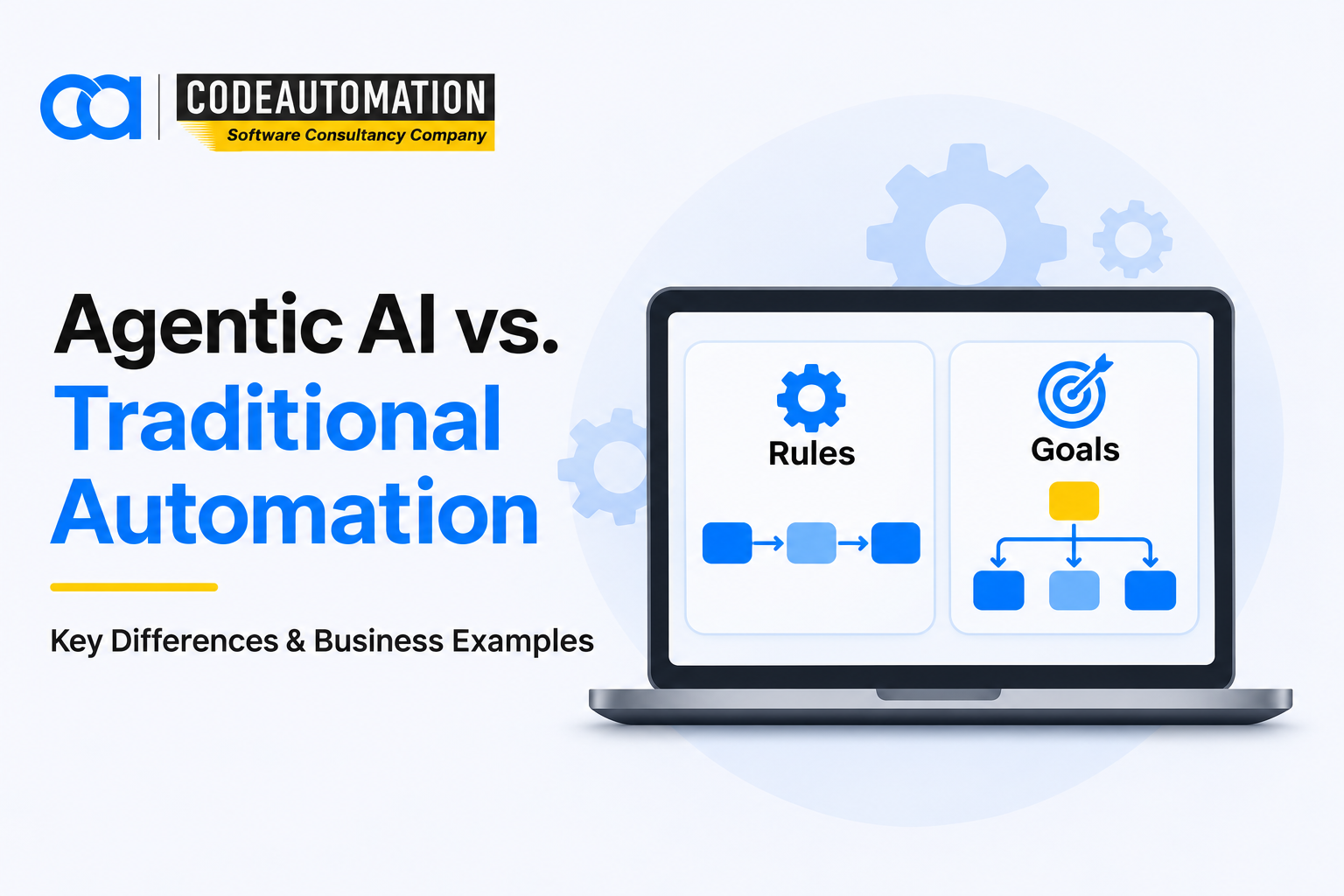
Agentic AI differs from traditional automation in how it makes decisions and executes tasks. Traditional automation follows predefined rules and workflows to complete specific operations, while agentic AI can understand objectives, plan actions, use tools, and adjust its approach based on changing information.
For example, traditional automation can automatically send a payment reminder when an invoice becomes overdue. An AI agent can go further by reviewing the customer's payment history, checking previous communications, and determining the appropriate next action.
Both technologies help businesses reduce manual work, but they serve different purposes. Traditional automation is particularly effective for predictable, repetitive processes, whereas agentic AI is better suited to tasks involving contextual decisions and multiple steps.
Understanding these differences helps small and medium-sized enterprises (SMEs) determine which approach best fits their operational requirements.
What Is Traditional Automation?
Traditional automation uses predefined rules, instructions, and workflows to perform tasks with minimal human intervention. It executes specific operations when configured conditions or triggers are met.
For example, an automated system can generate invoices after a purchase, send confirmation emails, update customer records, or notify employees when an approval is required.
How Traditional Automation Works
Traditional automation generally follows a structured process:
- Trigger: An event initiates the workflow, such as a new order or form submission.
- Condition: The system checks predefined rules.
- Action: It performs the configured operation.
- Completion: The workflow finishes after executing its assigned steps.
The system follows the instructions established during development. If an unexpected situation occurs outside its configured conditions, it may require manual intervention or an updated workflow.
Common Examples of Traditional Automation
- Automatically sending invoice and payment reminders.
- Updating CRM records after form submissions.
- Sending order confirmations and notifications.
- Scheduling recurring reports.
- Processing structured data and transferring information between applications.
Traditional automation works particularly well when business processes are repetitive, predictable, and follow consistent rules.
What Is Agentic AI?
Agentic AI refers to AI systems that can pursue defined objectives by understanding tasks, planning actions, using available tools, and evaluating results.
Unlike conventional automation, which generally follows a predetermined execution sequence, agentic AI can select its next actions based on context and the information available.
For example, an AI agent handling a customer inquiry can interpret the request, retrieve relevant account information, examine applicable policies, and determine the appropriate next step.
Depending on its permissions, it may resolve the request or escalate it to a human employee.
How Agentic AI Works
An AI agent typically follows an iterative process:
- Understand: Interpret the objective or user request.
- Gather information: Retrieve relevant data from connected sources.
- Plan: Determine the actions required to achieve the objective.
- Execute: Use available tools and applications to perform those actions.
- Evaluate: Review the results and determine whether additional steps are needed.
This process allows agents to handle tasks involving multiple decisions rather than relying exclusively on fixed instructions.
Core Capabilities of AI Agents
- Autonomous decision-making: Evaluate available information and select appropriate actions.
- Planning and reasoning: Break complex objectives into smaller tasks.
- Dynamic execution: Adjust actions based on changing circumstances.
- Tool integration: Interact with authorized APIs, databases, and business applications.
- Contextual understanding: Interpret information and respond according to the task requirements.
The level of autonomy depends on the AI model, instructions, integrations, permissions, and safeguards.

Ready to Automate Your Success?
From AI-powered applications to scalable software development, we help businesses automate workflows and accelerate growth.
Book a Free ConsultationAgentic AI vs. Traditional Automation: Key Differences
The fundamental difference is that traditional automation executes predefined instructions, while agentic AI can determine which actions are appropriate for achieving a specific objective.
At a Glance
- Operating approach: Traditional automation — Predefined workflows; Agentic AI — Goal-oriented execution.
- Decision-making: Traditional automation — Programmed rules; Agentic AI — Contextual reasoning.
- Execution: Traditional automation — Configured steps; Agentic AI — Dynamically selected actions.
- Adaptability: Traditional automation — Limited to configured scenarios; Agentic AI — Can adjust based on context.
- Problem solving: Traditional automation — Predefined error handling; Agentic AI — Can investigate alternative actions.
- Tool usage: Traditional automation — Configured integrations; Agentic AI — Can select authorized tools.
- Human involvement: Traditional automation — Needed for exceptions and changes; Agentic AI — Can operate within defined permissions.
Decision-Making and Autonomy
Traditional automation relies on predefined conditions to determine which action to execute. For example, an automated payment system may approve a transaction when it meets specific criteria.
Agentic AI can evaluate multiple pieces of information before selecting an action.
An AI agent handling a refund request could review purchase history, check refund policies, and determine whether the request meets the required conditions.
Rule-Based vs. Goal-Oriented Execution
Traditional automation follows instructions designed around specific tasks and expected outcomes.
Agentic AI works toward a broader objective and determines the steps needed to achieve it.
For example, a traditional onboarding workflow might send documents and create employee accounts automatically. An AI agent could additionally check missing information, coordinate outstanding requirements, and determine which actions are needed to complete the onboarding process.
Adaptability and Problem Solving
Traditional automation generally handles unexpected situations through predefined conditions. When an exception falls outside those conditions, the workflow may stop or require manual review.
Agentic AI can evaluate new information, investigate available options, and adjust its next actions.
For example, if an AI agent receives incomplete customer information, it may request clarification before continuing instead of simply stopping the process.
Workflow Execution and Task Management
Traditional automation executes configured sequences of actions. Agentic AI can coordinate multiple tasks and determine what needs to happen next based on previous results.
This makes AI agents useful for workflows where each step depends on information gathered during earlier stages.
Human Oversight and Control
Both technologies can operate with limited human intervention. However, agentic AI requires particular attention to permissions and decision boundaries.
Businesses can configure agents to perform routine tasks independently while requiring human approval for sensitive operations, such as financial transactions or important account changes.
Real World Examples of Agentic AI vs. Traditional Automation
The differences become clearer when both technologies are applied to the same business processes.
Customer Support
Traditional automation: Sends predefined responses, answers common questions, and routes customer requests based on configured conditions.
Agentic AI: Interprets customer requests, retrieves account information, checks relevant policies, and coordinates actions to resolve issues.
Sales and Lead Management
Traditional automation: Captures incoming leads, assigns them to sales representatives, and sends scheduled follow-up emails.
Agentic AI: Reviews lead information, gathers relevant business context, evaluates qualification criteria, and recommends or performs appropriate follow-up actions.
Data Processing
Traditional automation: Extracts structured information, validates predefined fields, and transfers records into databases.
Agentic AI: Interprets less structured information, identifies missing details, compares records, and determines which information requires additional review.
How SMEs Can Use AI Agent Development Services
SMEs dealing with complex business processes may need more than predefined workflows. Tasks involving contextual decisions, multiple applications, and changing information can benefit from custom AI agents.
AI agent development services help businesses build agents around their specific operational requirements.
For example, a company may need a custom AI agent to qualify sales leads, handle customer inquiries, retrieve information from internal systems, or coordinate tasks across multiple applications.
Custom AI agent development can help SMEs:
- Build agents for specific business objectives.
- Automate tasks involving contextual decision-making.
- Connect AI agents with existing business applications.
- Coordinate multi-step operations across different systems.
CodeAutomation provides AI agent development services to help businesses develop custom AI agents tailored to their workflows and operational requirements.
How SMEs Can Use AI Automation Services
Not every business process requires an autonomous AI agent. Many SMEs simply need to automate repetitive tasks, connect disconnected applications, and reduce manual work.
AI automation services help businesses streamline these processes through workflow automation, AI-powered processing, and application integrations.
For example, a business can automate invoice processing, CRM updates, customer notifications, data transfers, and internal approval workflows.
AI automation services can help SMEs:
- Automate repetitive administrative processes.
- Connect existing business applications.
- Reduce manual data entry and information transfers.
- Streamline workflows across departments.
- Improve consistency in recurring operations.
CodeAutomation offers AI business automation services to help SMEs identify automation opportunities and implement solutions that improve operational efficiency.
Can Agentic AI and Traditional Automation Work Together?
Yes. Agentic AI and traditional automation can complement each other within the same business environment.
Traditional automation can manage predictable operations, while AI agents handle tasks requiring contextual understanding and decision-making.
For example, an automated sales workflow can capture incoming leads, update CRM records, and notify sales representatives. An AI agent can then review lead information, evaluate qualification criteria, and determine the appropriate follow-up action.
This hybrid approach allows businesses to maintain control over structured processes while introducing greater flexibility where necessary.
Frequently Asked Questions
Everything you need to know about our products and services
Neither is universally better. Traditional automation is effective for repetitive and predictable tasks, while agentic AI is more suitable for complex processes involving contextual decisions and dynamic execution.
Agentic AI can replace or improve certain automation workflows, but traditional automation remains valuable for structured operations that require consistent execution. Many businesses benefit from using both technologies.
Robotic Process Automation (RPA) uses software bots to execute predefined actions, often through application interfaces. Agentic AI can interpret objectives, evaluate information, and select actions based on context. Both technologies can also work together.
Yes. SMEs can use agentic AI for customer support, lead qualification, information retrieval, and multi-step business operations. The best starting point is a clearly defined business process where autonomous decision-making provides practical value.





Adnan Ghaffar is the visionary CEO of CodeAutomation.ai, a platform dedicated to transforming how businesses build software through cutting-edge automation. With over a decade of experience in software development, QA automation, and team leadership, Adnan has built a reputation for delivering scalable, intelligent, and high-performance solutions.
Under his leadership, CodeAutomation.ai has grown into a trusted name in AI-driven development, empowering startups and enterprises alike to streamline workflows, accelerate time-to-market, and maintain top-tier product quality. Adnan is passionate about innovation, process improvement, and building products that truly solve real-world problems.
More Articles
How to Leverage AI in Marketing: A Practical Guide 2026

03/ 27/ 2026
How a robotic process automation company can transform your business
19/08/2026
How Much Does Custom Software Development Cost in 2026?

24/ 04/ 2026
How AI is transforming customer support in 2026
01/10/2026
Multi-Agent AI Systems: Architecture, Orchestration, and Enterprise Use Cases
25/ 11/ 2025


