























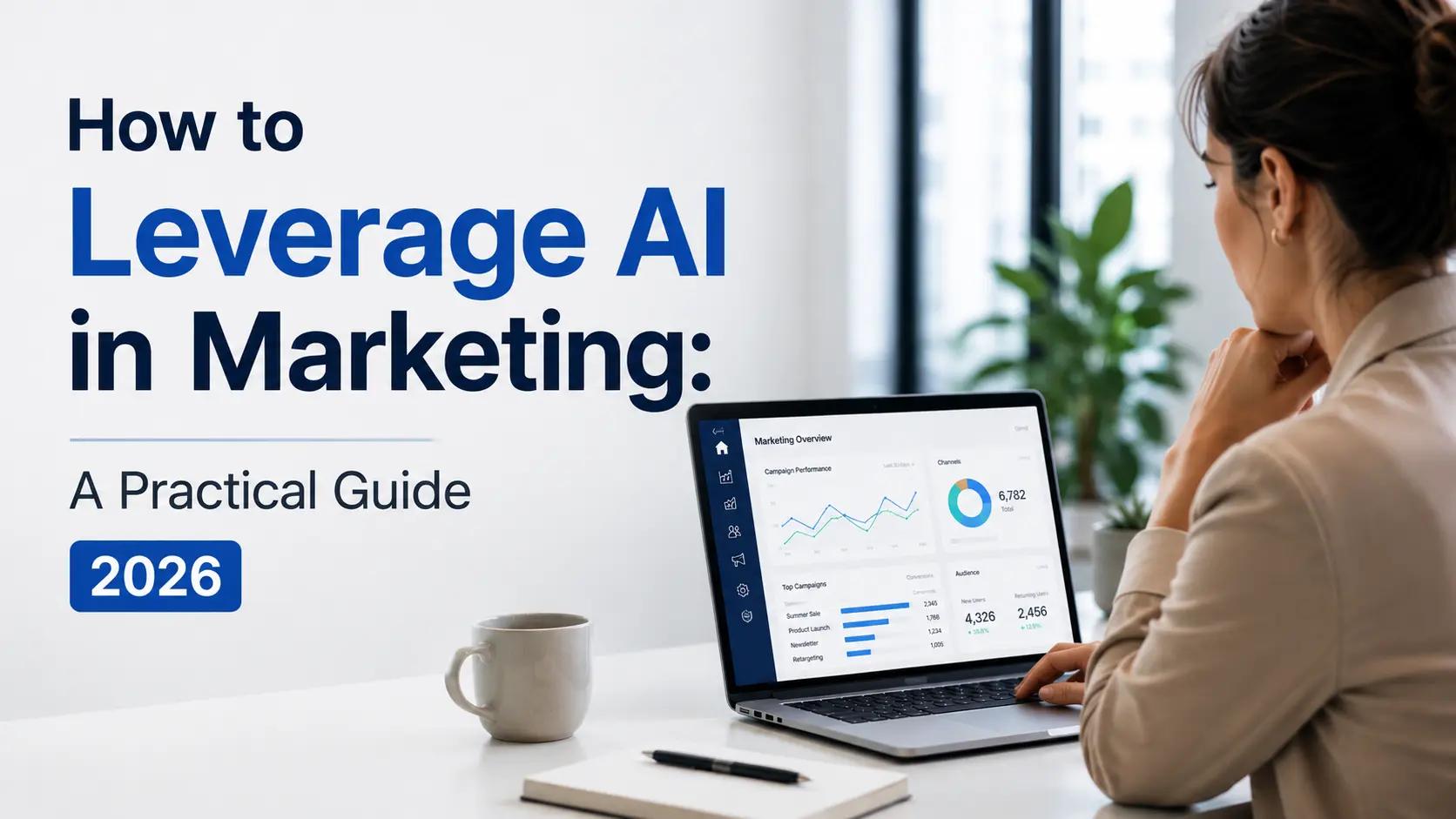
How to Leverage AI in Marketing: A Practical Guide 2026
How to Leverage AI in Marketing: A Practical Guide 2026
Leveraging AI in marketing means strategically applying artificial intelligence where it multiplies your effort instead of treating it as a novelty.

Ready to Automate Your Success?
From AI-powered applications to scalable software development, we help businesses automate workflows and accelerate growth.
Book a Free ConsultationLeveraging AI in marketing means strategically applying artificial intelligence where it multiplies your effort instead of treating it as a novelty. In practice, that involves automating repetitive work, analyzing large volumes of customer data, predicting buying behavior, and delivering personalized experiences at scale. According to a recent industry report, 87 percent of marketers now use generative AI in at least one workflow, up from 51 percent two years earlier.
The most effective AI approach starts with high impact, low effort agentic applications like content creation and campaign optimization, then scales the wins that produce measurable results. Handled well, the technology becomes an always on assistant that spots patterns in your data and helps decide when, where, and how to reach the right audience. This guide breaks down exactly how to put that into practice.
What Is the Role of AI in Marketing?
AI works as the layer between your data and your decisions. It processes large volumes of customer information, handles repetitive tasks automatically, and turns raw signals into sharper targeting, stronger personalization, and better campaign performance. Powered by generative models and machine learning, it surfaces patterns that a human team could never catch by hand.
This shows up across the full buyer journey. When someone opens an email, browses a product page, or comments on a social post, the technology records those moments, learns from them, and refines what comes next. It also makes sense of unstructured input like reviews and comment threads, groups audiences with precision, and closes the gap that appears when a team faces more data across more channels than it can review in real time. The point is not replacement. These tools carry the scale and speed so people can concentrate on strategy and creativity.
Why Should Marketers Adopt AI Now?
For teams that want to stay competitive, waiting is the bigger risk. Surveys consistently show that most marketing leaders plan to increase their investment, and companies that scale the technology across operations report far stronger returns than those applying it in scattered, one off ways.
The core benefits fall into a few clear buckets. Efficiency rises as routine tasks run on their own, freeing your team to focus on strategy and creativity. Accuracy improves as behavior gets predicted and high quality leads get flagged early. Personalization deepens as content adapts to individuals at a scale manual work cannot match. Together these lift conversion rates, cut wasted ad spend, and build stronger customer relationships.
There is also a speed advantage that compounds over time. Because these systems learn from every interaction, each campaign teaches the next one what works, so results improve month over month without a proportional increase in effort. A team that once needed a week to analyze a campaign and adjust can now read performance signals and shift budget within hours. That faster feedback loop is often the difference between reacting to a trend and leading it, and it is a large part of why early adopters tend to pull ahead of slower moving competitors.
How Do You Put AI to Work Step by Step?
The teams that succeed follow a repeatable process rather than adopting tools at random. Here is the framework that appears across nearly every successful rollout.
Start by identifying a specific problem:
Look at your current efforts and find one area where a quick, measurable win is possible. That might be sharpening how you target key accounts, speeding up a slow reporting process, or scaling content production. A narrow focus prevents wasted budget and gives you a clear result to build on.
Define what success looks like:
Set one or two concrete goals before integrating anything. Common objectives include better lead quality, higher return on ad spend, stronger email conversions, or deeper engagement. Clear targets keep your investment tied to business outcomes.
Audit your data:
Output is only as good as the information behind it. Confirm that your data is accurate, current, and relevant, and that your chosen platform can connect to existing systems. Unified, accessible data produces reliable insights and predictions.
Choose tools that fit your stack:
Select platforms that already integrate with your marketing technology. Look for strong API capabilities so a new addition works alongside what you already run. Introduce each tool gradually, beginning with your most important area, to minimize disruption.
Run a small pilot:
Test a single application, such as an automated email campaign or a chatbot, before rolling anything out across every channel. Measure the results against the goals you set.
Scale what works:
Once a pilot proves its value, expand it. This is where the biggest returns appear, because a scaled implementation outperforms scattered, isolated tools by a wide margin.
Keep humans in the loop:
Let the AI workflow technology generate content and insights, then have people refine messaging, protect brand voice, and make final calls. Automation should enhance human creativity, not stand in for it.
What Are the Main Applications to Prioritize?
Artificial intelligence touches almost every part of the marketing function. These are the highest value areas to focus on first.
Content creation at scale:
Generate blog outlines, social posts, ad copy variations, and email drafts, then refine the strongest outputs with your brand voice and expertise. Small teams can produce far more this way without sacrificing quality.
Personalization:
Customer data becomes the fuel for individually relevant experiences. Brands like Netflix and Spotify shape recommendations and feeds this way, and the same capability lets any company tailor product suggestions, offers, and messages to each person.
Predictive analytics:
By analyzing historical performance, demographics, and contextual signals, forecasting tools can flag which creative, platform, and placement combination is most likely to convert, so campaigns get planned with far greater accuracy.
Audience segmentation and targeting:
Traditional targeting relied on known traits like location and past purchases. A predictive layer adds something new by grouping customers based on what they are likely to do next, filling gaps that manual methods miss.
Marketing automation:
Campaign flows can be designed, audiences and key metrics identified, performance data processed, and the next best action recommended based on previous results. That means smarter campaigns, outcomes predicted before launch, and real time adjustments.
Conversational assistants and chatbots:
Modern chatbots provide personalized support, capture leads, and boost engagement around the clock, lifting customer satisfaction while gathering useful data.
Dynamic pricing:
Prices can be optimized by reading demand, seasonality, and competitive signals in near real time, helping you charge the right amount at the right moment while keeping customers satisfied.
How Does AI Automation Fit in Marketing?
Automation is where marketing efforts move from occasional wins to a system that runs on its own. Most teams begin by applying intelligent tools to single tasks, such as drafting emails or scoring leads, but the larger payoff comes from connecting those tasks into workflows that operate without constant manual input. When repetitive steps like data syncing, audience updates, report generation, and follow up sequences run automatically, your team recovers hours every week and campaigns respond to customer behavior in real time rather than on a delay.
The shift matters because isolated tools rarely reach their full potential on their own. A chatbot that captures a lead is useful, but it becomes far more powerful when that lead is automatically scored, routed to the right sequence, and logged for future targeting without anyone touching it. Building that connected foundation is exactly where purpose built AI automation solutions prove their value, tying campaign automation, data processing, and decision workflows together so they run consistently across departments instead of living as separate experiments.
For marketing leaders, the practical move is to treat automation as core infrastructure rather than a collection of one off tricks. Map the repetitive processes that slow your team down, identify where handoffs break or data gets re entered by hand, and automate those first. Once pilots prove their value and you are ready to move from testing to production scale, a proper automation layer underneath your marketing engine is what turns early experiments into a reliable, repeatable growth system.
What Does a Real Example Look Like?
One clear illustration comes from the food delivery brand Zomato, which used voice cloning and generative models to produce millions of hyper personalized video adverts featuring a celebrity. The system tailored each version to specific regions, languages, and even individual dishes, then distributed them based on user location. Starting from a small amount of source material, the company built a vast library of ads that felt personal to every viewer. It shows how limited input can become personalization at a scale that would be impossible to reach by hand.
What Are the Best Practices to Follow?
A handful of principles separate teams that get lasting value from those that stall.
Put data quality above everything, since inaccurate inputs produce unreliable output. Define clear objectives so every effort ties back to a business goal. Begin small and focused rather than overhauling your entire operation at once. Monitor and evaluate campaigns continuously to find fresh room for optimization. Pair automation with human creativity to keep your marketing well rounded and authentic. Finally, stay transparent with customers about how the technology is applied, which builds trust and signals ethical practice.
What Challenges Should You Prepare For?
Adoption comes with real hurdles worth planning around. Machine learning needs large volumes of accurate data and time to become genuinely useful, so confirm you have that information or the experts to source it. Privacy and compliance matter deeply, and any rollout must respect regulations such as GDPR and CCPA to protect customer trust. There is also a people dimension. Bring your team along by framing the change as a way to make their work better rather than to remove their roles, celebrate early wins openly, and offer ongoing training. A governance framework for ethical practice, along with attention to shifting regulations, rounds out a responsible approach.
Cost and measurement deserve equal attention. Some tools carry meaningful subscription and integration expenses, so tie every purchase to a clear return before committing. Set baseline metrics such as current conversion rate, cost per lead, or hours spent on manual tasks so you can prove impact once a system goes live. Without that baseline, it becomes hard to tell whether a tool is earning its place or simply adding another line item, and clear numbers make it far easier to secure a budget for the next phase of adoption.
Key Takeaways
Bringing artificial intelligence into marketing is a strategic process, not a spontaneous purchase. Start with a specific problem, set measurable goals, secure clean data, pilot a single application, and scale the successes. Concentrate your energy on the highest value areas, which include content creation, personalization, predictive analytics, segmentation, automation, chatbots, and pricing.
Throughout, keep people in charge of judgment and brand voice, protect customer privacy, and treat the technology as an amplifier for your team rather than a shortcut that replaces it. Marketers who follow this path gain speed, precision, and deeper customer relationships, and they move ahead of competitors still experimenting at the edges.
Frequently Asked Questions (FAQs)
Everything you need to know about our products and services
AI can be used in marketing for content creation, customer segmentation, personalization, predictive analytics, campaign optimization, lead scoring, chatbots, and marketing automation. These applications help businesses improve efficiency and deliver more relevant customer experiences.
AI in marketing can improve campaign efficiency, personalization, targeting, lead quality, and decision-making. It can also automate repetitive tasks, analyze customer data, and help marketers optimize campaigns based on real-time performance.
AI marketing automation uses customer data and machine learning to automate tasks such as audience segmentation, email campaigns, lead scoring, follow-ups, reporting, and campaign optimization. Connected workflows can respond to customer behavior with less manual intervention.
AI analyzes customer behavior, preferences, interactions, and other data to create more relevant marketing experiences. Businesses can use these insights to personalize product recommendations, offers, emails, advertisements, and content for different customer segments.
Businesses can start with high-impact applications such as AI content creation, predictive analytics, audience segmentation, personalized marketing, chatbots, and marketing automation. Starting with a focused use case and scaling after measuring results can help maximize ROI.





Adnan Ghaffar is the visionary CEO of CodeAutomation.ai, a platform dedicated to transforming how businesses build software through cutting-edge automation. With over a decade of experience in software development, QA automation, and team leadership, Adnan has built a reputation for delivering scalable, intelligent, and high-performance solutions.
Under his leadership, CodeAutomation.ai has grown into a trusted name in AI-driven development, empowering startups and enterprises alike to streamline workflows, accelerate time-to-market, and maintain top-tier product quality. Adnan is passionate about innovation, process improvement, and building products that truly solve real-world problems.
More Articles
26/08/2026
What Is Business Intelligence? A Complete Guide for Modern Businesses
16/09/2026
Mapbox Development Services: Building Custom Mapping and Location Solutions

05/ 05/ 2026
How Enterprise AI Powers Intelligent Automation
17/09/2026
GeoAI for Real Estate: How Artificial Intelligence Is Transforming Property Decisions

10 April 2025
Why QA Testers Are Essential in Software Development – Especially in the Age of AI ?

18 july 2026