























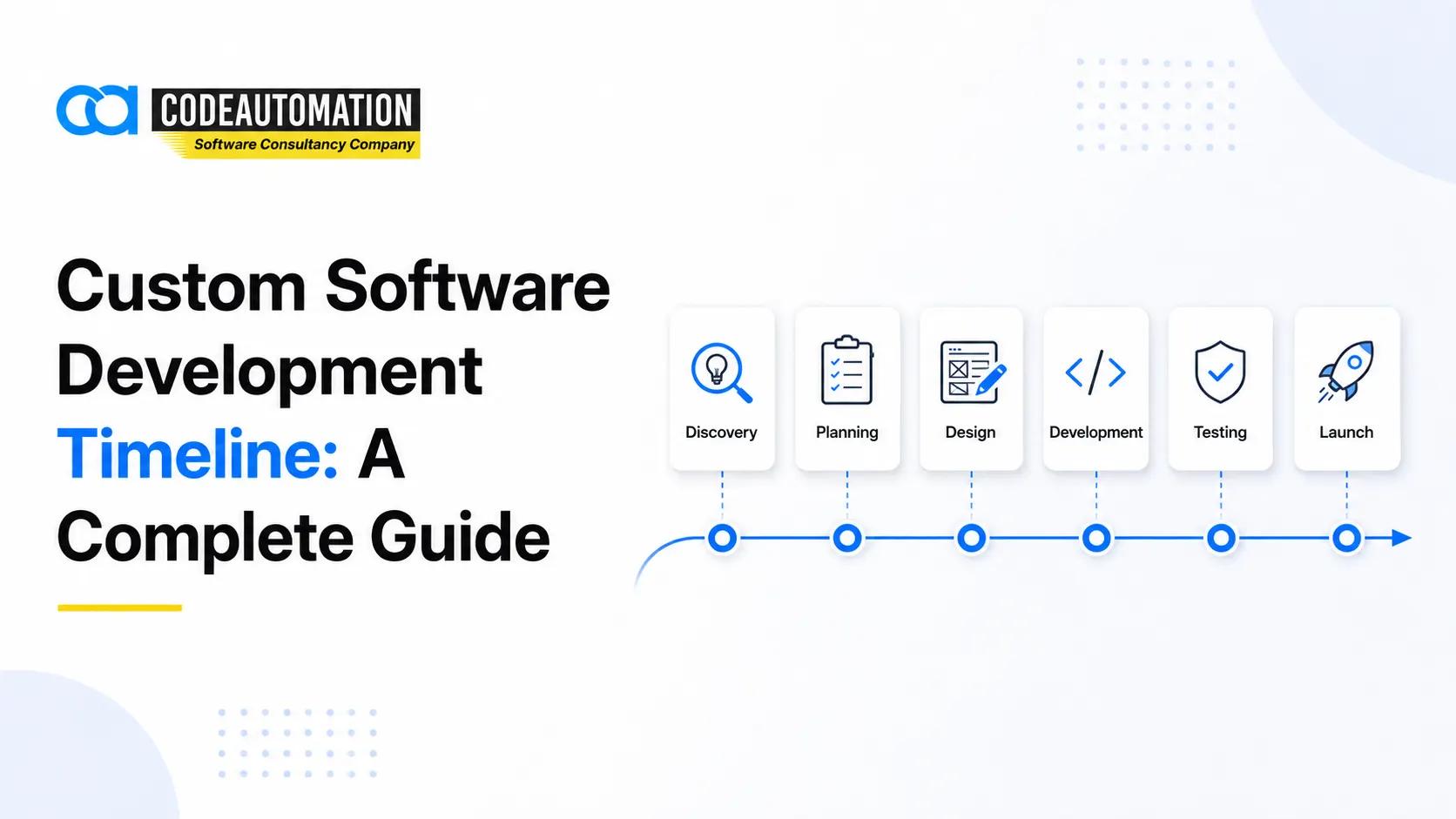
Custom Software Development Timeline: A Complete Guide
Published 21/08/2026
There is a question that prefaces any custom software project: how long is this going to take? “It depends” is the truthful reply, yet it is seldom enough for a stakeholder who has a budget or a launch date in mind. In truth, timelines depend on scope, team dynamics, integrations, and features; assuming one project is like another leads to missed deadlines and empty promises.

Ready to Automate Your Success?
From AI-powered applications to scalable software development, we help businesses automate workflows and accelerate growth.
Book a Free ConsultationThere is a question that prefaces any custom software project: how long is this going to take? “It depends” is the truthful reply, yet it is seldom enough for a stakeholder who has a budget or a launch date in mind. In truth, timelines depend on scope, team dynamics, integrations, and features; assuming one project is like another leads to missed deadlines and empty promises.
What follows is an examination of the process in its actual components. We put forward the elements that truly dictate development time and offer a phase-by-phase view with durations you can count on. There is also some clarity on what separates an MVP from a full product in terms of the schedule, along with the practical measures needed to stay on course. The aim is to leave you with a sound framework for your timeline, not one based on conjecture.
How Long Does Custom Software Development Take?
When it comes to custom software, one can expect a project to run anywhere from three to twelve months from the initial kickoff to the day of launch. Of course, the scope of work dictates the schedule; a straightforward MVP or internal tool might be ready in as little as six to ten weeks, whereas building an enterprise platform with its various integrations typically requires nine months at a minimum. Choosing the right custom software development approach and partner early in the process can help define realistic timelines, reduce unnecessary delays, and ensure the final solution aligns with your business goals.
But vague numbers do not make for effective planning when it is time to set a budget or pin down a date. To that end, this guide puts the timeline in perspective by looking at the actual components: the phases involved, the elements that put pressure on the clock, and the steps necessary to see the project through on time.
What Determines the Development Timeline?
Seven factors consistently decide how long a project takes. Understanding each one helps you set realistic expectations before development starts.
Project scope: Sets the boundary for everything else. A narrow, well-defined scope moves quickly. A broad scope with shifting requirements stretches almost every project past its original estimate.
Features: Add time in direct proportion to their number and depth. A basic login screen takes days. Role-based permissions, multi-factor authentication, and audit logging can take weeks on their own.
Complexity: Matters independently of feature count. A payment system with ten features is harder to build than a content page with fifty. Business logic, data relationships, and edge cases drive complexity more than the feature list does.
Integrations: With third-party systems, introduce dependencies outside your team's control. Connecting to a CRM, a payment gateway, or a legacy database means working around someone else's API limits, documentation gaps, and release schedules.
UI/UX requirements: Shape both the design phase and the development phase. A functional internal dashboard needs far less design time than a consumer app competing on user experience.
Technology stack: Affects speed in both directions. Mature frameworks with strong community support speed up development. Cutting-edge or niche technology often slows it down, since fewer resources and pre-built solutions exist.
Team size: Has diminishing returns. Adding developers speeds up parallel work, but coordination overhead grows too. A team that doubles in size rarely finishes twice as fast.
Custom Software Development Phases
Every custom software project moves through eight distinct phases. Skipping or rushing any of them tends to cost more time later than it saves upfront.
Discovery and requirements: Comes first. The team gathers business goals, user needs, and technical constraints. This phase produces the foundation every later decision rests on.
Planning: Turns discovery into a roadmap. The team defines milestones, assigns resources, and sets a realistic sequence for the work ahead.
UI/UX design: Translates requirements into wireframes and visual designs. Good design work here prevents expensive rebuilds during development.
Prototyping: Validates the design before full development begins. A clickable prototype lets stakeholders test the flow and catch problems while changes are still cheap.
Development: Is where the actual coding happens. This phase usually consumes the largest share of the timeline, since it includes backend logic, frontend interfaces, and database architecture.
Testing: Verifies that the software works as intended. Functional testing, performance testing, and security testing all belong here, ideally running alongside development rather than only at the end.
Deployment: Moves the finished software into a live environment. This phase includes server setup, data migration, and final configuration checks.
Maintenance: Continues after launch. Bug fixes, performance monitoring, and feature updates keep the software reliable as usage grows and requirements evolve.
How Long Does Each Development Phase Take?
Timelines vary by project size, but the following ranges hold true for most mid-sized custom builds.
- Discovery and requirements: one to three weeks
- Planning: one to two weeks
- UI/UX design: two to four weeks
- Prototyping: one to two weeks
- Development: eight to twenty weeks
- Testing: two to six weeks, often overlapping with development
- Deployment: one to two weeks
- Maintenance: ongoing, with no fixed end date
MVP vs. Full-Product Development Timeline
The minimum viable product, or MVP, is by definition a narrow scope. It is built to test a core concept with actual users and contains nothing but the features necessary for that purpose. Because of this, an MVP can be put together in six to twelve weeks.
A full product makes a significant difference. That entails the complete feature set, a polished design, and all the integrations one’s long-term vision calls for. Such projects typically take six to twelve months, and enterprise platforms will take even longer.
The MVP is particularly useful for validating demand before making any major investment. A good number of teams will put an MVP out there to see what real users have to say, and let the data from that feedback drive the priorities for the full product roadmap. In the end, following that process tends to yield a superior product to what one would get by building everything at once on the strength of assumptions.
How Integrations Affect Development Time
Timeline risks are often underestimated, and integrations are prime examples. While a well-documented API will only set one back by a matter of days, a legacy system with scant documentation or onerous rate limits can put in weeks of unanticipated work.
Then there are the particular idiosyncrasies of payment gateways, authentication providers, and CRM and ERP platforms. To test an integration properly, accounting for every edge case and failure mode is time-consuming, something that is easily overlooked if the planning has been done without sufficient experience. The prudent course of action is to view the integration as a project unto itself. It should be given its own space on the overall schedule, with the research, testing, and buffer time to spare.
How to Speed Up Software Development Without Sacrificing Quality
Define scope precisely before development starts: Clear requirements prevent the mid-project changes that cause the most delays.
Use agile sprints: Breaking development into short, focused cycles surfaces problems early instead of at the end.
Test continuously: Running tests throughout development, rather than only before launch, catches bugs when they are cheapest to fix.
Choose proven technology: A mature, well-supported stack moves faster than an experimental one, especially for teams without deep niche expertise.
Reuse existing components: Pre-built libraries, frameworks, and design systems save development time while maintaining quality.
Communicate constantly with stakeholders: Fast, clear decision-making from the client side prevents the waiting periods that quietly extend timelines.
Common Causes of Software Development Delays
Project delays usually stem from a few common issues. Scope creep is the primary culprit, as adding features mid-project pushes back milestones. Unclear requirements lead to ambiguous specs, causing wasted effort and costly rework. Poor communication between stakeholders and developers stalls decisions, while unappreciated complexity, especially around integrations and edge cases, creates unexpected roadblocks. Finally, rushing testing to hit deadlines backfires when production bugs require urgent fixes. Teams that recognize these risks early can adjust their strategy, streamline communication, and prevent minor setbacks from becoming major crises.
How to Create a Realistic Software Development Timeline
Accurate project timelines require a clearly defined scope from the start, as vague goals lead to imprecise estimates. Break the project down by phase and assign specific time estimates to each, rather than relying on a single overall figure. Be sure to account for testing and integrations, which frequently take longer than anticipated. Involve the development team directly in estimating effort; those building the product understand its complexity far better than sales teams.
Finally, treat the timeline as a dynamic document rather than a fixed contract. Continuously review and adjust it as new information emerges. Updating your schedule based on actual progress ensures a much more reliable launch date than clinging to outdated initial predictions.
Frequently Asked Questions (FAQs)
Everything you need to know about our products and services
Estimating a custom software project timeline requires understanding the business goals, required functionality, technical requirements, integration needs, and expected user experience. A discovery phase helps identify project complexity and create a realistic delivery roadmap before development begins.
Yes, timelines can change when project requirements evolve, new features are introduced, technical challenges appear, or external dependencies affect progress. Maintaining clear communication and managing scope changes properly helps keep the project on track.
Yes, the type of software has a major impact on delivery time. Internal business tools, customer-facing applications, enterprise platforms, and systems requiring advanced security or integrations each have different development requirements and complexity levels.
Business involvement is important throughout development. Regular feedback, requirement clarification, testing participation, and timely decision-making help ensure the software meets expectations and avoid unnecessary revisions later.
Before development begins, businesses should define their objectives, identify users and workflows, list essential features, prepare existing system details, and establish success criteria. Clear preparation helps development teams create better estimates and deliver more effectively.





Adnan Ghaffar is the visionary CEO of CodeAutomation.ai, a platform dedicated to transforming how businesses build software through cutting-edge automation. With over a decade of experience in software development, QA automation, and team leadership, Adnan has built a reputation for delivering scalable, intelligent, and high-performance solutions.
Under his leadership, CodeAutomation.ai has grown into a trusted name in AI-driven development, empowering startups and enterprises alike to streamline workflows, accelerate time-to-market, and maintain top-tier product quality. Adnan is passionate about innovation, process improvement, and building products that truly solve real-world problems.
More Articles

17/09/2026
GeoAI for Real Estate: How Artificial Intelligence Is Transforming Property Decisions

26 March 2025
Software Developer vs. Software Engineer: Key Differences, Skills, and Career Paths
Why Do 85% of AI Projects Fail? (And How to Be in Winning 15%)

03/ 09/ 2025
How to Hire QA and Automation Engineers: A Complete Guide

18 july 2026
Complete Guide to Software Development: Roles, Salaries, Career Paths, and How to Become a Developer in 2026

03/ 23/ 2026